


The longitudinal course of comorbid oppositional defiant disorder in girls with attention-deficit/hyperactivity disorder: findings from a controlled 5-year prospective longitudinal follow-up study
- PMID: 19077845
- PMCID: PMC2849719
- DOI: 10.1097/DBP.0b013e318190b290
The longitudinal course of comorbid oppositional defiant disorder in girls with attention-deficit/hyperactivity disorder: findings from a controlled 5-year prospective longitudinal follow-up study
Abstract
Objective: A better understanding of the long-term scope and impact of the comorbidity with oppositional defiant disorder (ODD) in girls with attention-deficit/hyperactivity disorder (ADHD) has important clinical and public health implications. However, most of the available information on the subject derives from predominantly male samples. This study evaluated the longitudinal course and impact of comorbid ODD in a large sample of girls with ADHD.
Methods: Subjects were pediatrically and psychiatrically referred girls with and without ADHD assessed blindly at baseline (mean age = 11.6 years), and 5 years later (mean age = 16.6 years) by mid to late adolescence. The subjects' diagnostic status of ADHD with and without comorbid ODD at baseline was used to define three groups (controls [N = 107], ADHD [N = 77], ADHD + ODD [N = 37]). Outcomes were examined using logistic regression (for binary outcomes) and linear regression (for continuous outcomes).
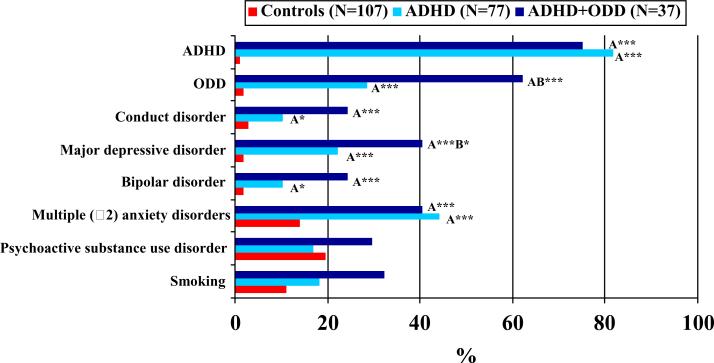
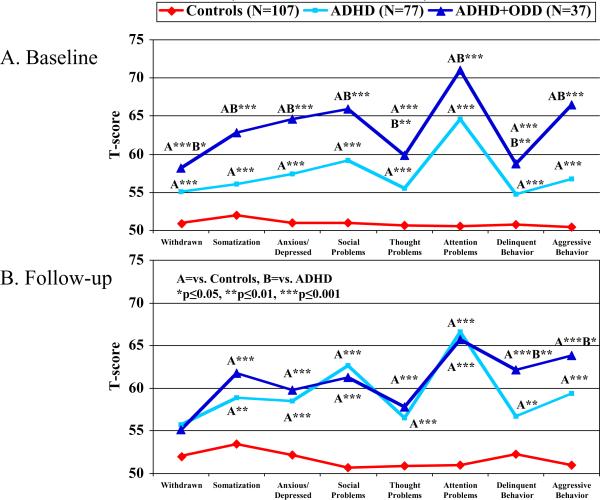
Results: Compared with girls who had ADHD only, those with ADHD + ODD at baseline had a significantly increased risk for ODD and major depression at follow-up. Both groups of girls with ADHD had an increased risk for conduct disorder and bipolar disorder at follow-up.
Conclusions: These longitudinal findings in girls with ADHD support and extend previously reported findings in boys indicating that ODD heralds a compromised outcome for girls with ADHD in adolescence.
Figures
References
-
- Anderson JC, Williams S, McGee R, et al. DSM-III disorders in preadolescent children: Prevalence in a large sample from the general population. Archives of General Psychiatry. 1987;44:69–76. - PubMed
-
- Bird HR, Canino G, Rubio-Stipec M, et al. Estimates of the prevalence of childhood maladjustment in a community survey in Puerto Rico: The use of combined measures. Archives of General Psychiatry. 1988;45:1120–1126. - PubMed
-
- Biederman J, Monuteaux M, Mick E, et al. Young Adult Outcome of Attention Deficit Hyperactivity Disorder: A Controlled 10 year Prospective Follow-Up Study. Psychological Medicine. 2006;36(2):167–179. - PubMed
-
- Kadesjo C, Hagglof B, Kadesjo B, et al. Attention-deficit-hyperactivity disorder with and without oppositional defiant disorder in 3- to 7-year-old children. Dev Med Child Neurol. 2003 Oct;45(10):693–699. - PubMed
-
- Biederman J, Faraone SV, Mick E, et al. Clinical correlates of ADHD in females: findings from a large group of girls ascertained from pediatric and psychiatric referral sources. Journal of the American Academy of Child and Adolescent Psychiatry. 1999;38(8):966–975. - PubMed
Publication types
MeSH terms
Grants and funding
LinkOut - more resources
Full Text Sources
Medical
