. 2009 May;34(6):1578-89.
doi: 10.1038/npp.2008.215. Epub 2008 Dec 10.

Assessment of glutamate transporter GLAST (EAAT1)-deficient mice for phenotypes relevant to the negative and executive/cognitive symptoms of schizophrenia

Affiliations

Assessment of glutamate transporter GLAST (EAAT1)-deficient mice for phenotypes relevant to the negative and executive/cognitive symptoms of schizophrenia

Rose-Marie Karlsson et al. Neuropsychopharmacology. 2009 May.

Abstract

Glutamatergic dysfunction is increasingly implicated in the pathophysiology of schizophrenia. Current models postulate that dysfunction of glutamate and its receptors underlie many of the symptoms in this disease. However, the mechanisms involved are not well understood. Although elucidating the role for glutamate transporters in the disease has been limited by the absence of pharmacological tools that selectively target the transporter, we recently showed that glial glutamate and aspartate transporter (GLAST; excitatory amino-acid transporter 1) mutant mice exhibit abnormalities on behavioral measures thought to model the positive symptoms of schizophrenia, some of which were rescued by treatment with either haloperidol or the mGlu2/3 agonist, LY379268 the mGlu2/3 agonist, LY379268. To further determine the role of GLAST in schizophrenia-related behaviors we tested GLAST mutant mice on a series of behavioral paradigms associated with the negative (social withdrawal, anhedonia), sensorimotor gating (prepulse inhibition of startle), and executive/cognitive (discrimination learning, extinction) symptoms of schizophrenia. GLAST knockout (KO) mice showed poor nesting behavior and abnormal sociability, whereas KO and heterozygous (HET) both demonstrated lesser preference for a novel social stimulus compared to wild-type littermate controls. GLAST KO, but not HET, had a significantly reduced acoustic startle response, but no significant deficit in prepulse inhibition of startle. GLAST KO and HET showed normal sucrose preference. In an instrumental visual discrimination task, KO showed impaired learning. By contrast, acquisition and extinction of a simple instrumental response was normal. The mGlu2/3 agonist, LY379268, failed to rescue the discrimination impairment in KO mice. These findings demonstrate that gene deletion of GLAST produces select phenotypic abnormalities related to the negative and cognitive symptoms of schizophrenia.


Conflict of interest statement

DISCLOSURE/CONFLICT OF INTEREST

The authors declare no conflicts of interest.

Figures
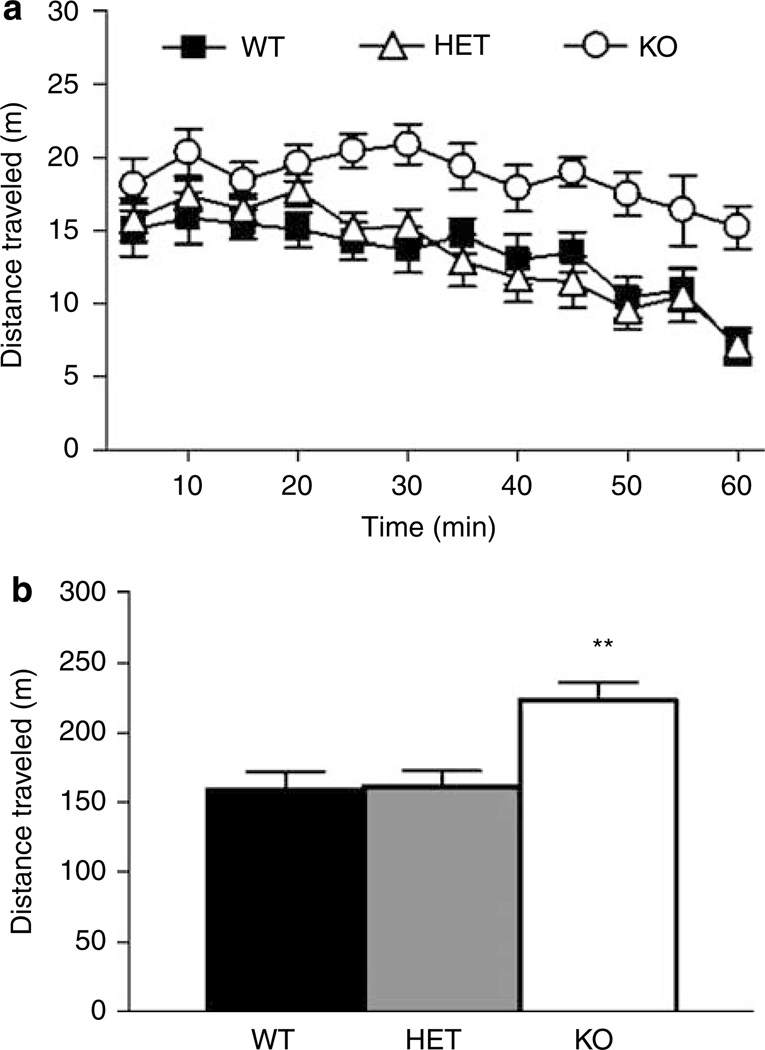
Figure 1
Figure 1
GLAST KO showed locomotor hyperactivity in a novel open field. GLAST KO mice show increased locomotor activity compared to WT controls (a). Over the session as a whole, GLAST KO were more active than WT (b). n = 10–19 per genotype. Data are mean ± SEM.
Figure 2
Figure 2
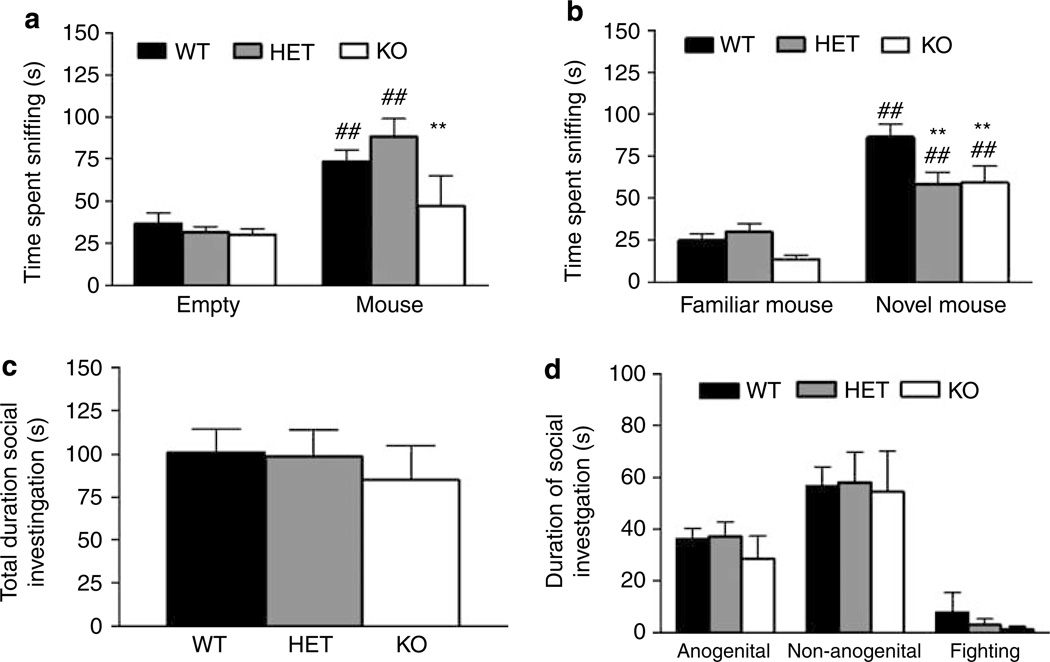
Decreased sociability and social novelty preference, but normal free social interaction in GLAST KO mice. WT and HET, but not KO, spent more time sniffing a cage containing a mouse than an empty cage, and KO spent less time sniffing the mouse-containing cage than WT controls (a). All genotypes spent more time sniffing a cage containing a novel mouse than a familiar mouse, but KO spent less time sniffing either stimulus than WT, whereas HET spent less time sniffing the novel stimulus than WT (b). Total time spent investigating an unfamiliar stimulus mouse in a free dyadic encounter did not differ between genotypes (c). Time spent engaged in anogenital and nonanogenital investigation, or aggression, did not differ between genotypes (d). n = 17–22 per genotype. **P <0.01 vs WT; ##P <0.01 vs empty cage or familiar mouse-containing cage for same genotype. Data are mean ± SEM.
Figure 3
Figure 3
GLAST KO showed a reduced acoustic startle response but normal sensorimotor gating. Prepulse inhibition of the startle response was no different between genotypes regardless of prepulse intensity (a). GLAST KO showed a lesser acoustic startle response than WT (b). n = 13–22 per genotype. **P <0.01 vs WT. Data are mean ± SEM.
Figure 4
Figure 4
GLAST KO showed normal instrumental learning and extinction. Genotypes did not differ in trials to instrumental learning criterion (a). Genotypes did not differ in trials to instrumental extinction criterion (b). n = 7–9 per genotype. Data are mean ± SEM.
Figure 5
Figure 5
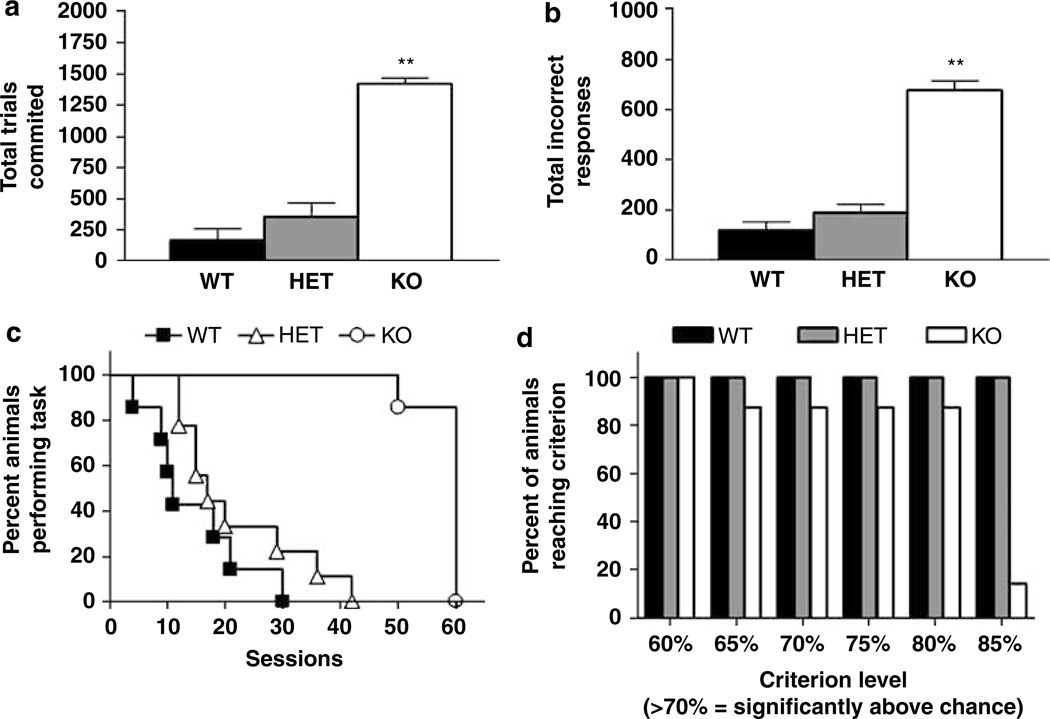
GLAST KO showed impaired pairwise discrimination learning. GLAST KO committed (a) more trials and (b) incorrect responses than WT over a maximum of 60 discrimination sessions. (c) Survival analysis showed that all WT and HET had attained the 85% correct criterion by 30–40 sessions whereas only one KO had attained criterion after 60 sessions. (d) Analysis of the percentage of each genotype attaining increasing performance thresholds revealed that nearly KO were able to attain a 80% correct criterion level that was well above statistical chance (ie, >70% correct). n = 7–9 per genotype. **P <0.01 vs WT. Data are mean ± SEM.
Figure 6
Figure 6
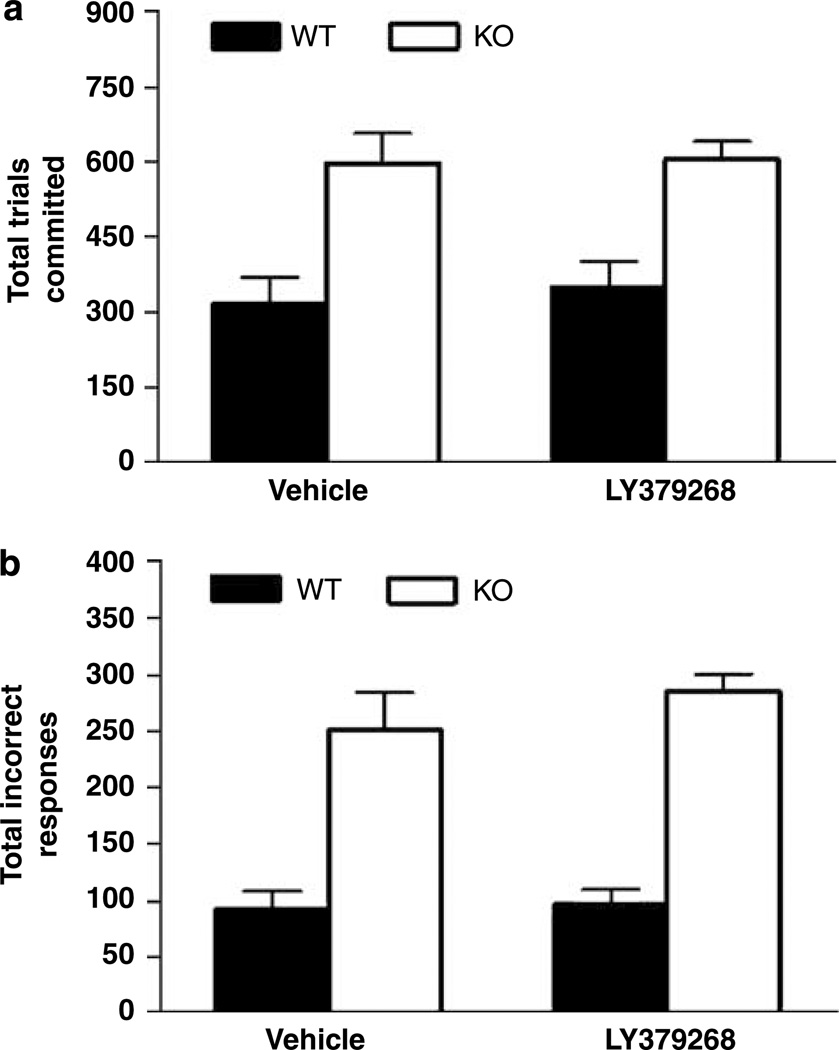
Treatment with the mGlu2/3 receptor agonist LY379268 did not rescue impaired pairwise discrimination learning in GLAST KO. Regardless of drug treatment, GLAST KO committed (a) more trials and (b) incorrect responses than WT over the 22 discrimination sessions taken for all WT mice to attain criterion. n = 6–8 per genotype per treatment. Data are mean ± SEM.

References

    1. Adler CM, Malhotra AK, Elman I, Goldberg T, Egan M, Pickar D, et al. Comparison of ketamine-induced thought disorder in healthy volunteers and thought disorder in schizophrenia. Am J Psychiatry. 1999;156:1646–1649. - PubMed
    1. American Psychiatric Association (APA) Diagnostic and Statistical Manual of Mental Disorders. 4th edn. (text rev.) Washington, DC: American Psychiatric Press; 2000.
    1. Arguello PA, Gogos JA. Modeling madness in mice: one piece at a time. Neuron. 2006;52:179–196. - PubMed
    1. Bauer D, Gupta D, Harotunian V, Meador-Woodruff JH, McCullumsmith RE. Abnormal expression of glutamate transporter and transporter interacting molecules in prefrontal cortex in elderly patients with schizophrenia. Schizophr Res. 2008;104:108–120. - PMC - PubMed
    1. Bechtholt AJ, Smith K, Gaughan S, Lucki I. Sucrose intake and fasting glucose levels in 5-HT(1A) and 5-HT(1B) receptor mutant mice. Physiol Behav. 2008;93:659–665. - PMC - PubMed

Publication types

MeSH terms