


Diurnal variations in human pulmonary function
- PMID: 19079662
- PMCID: PMC2592592
Diurnal variations in human pulmonary function
Abstract
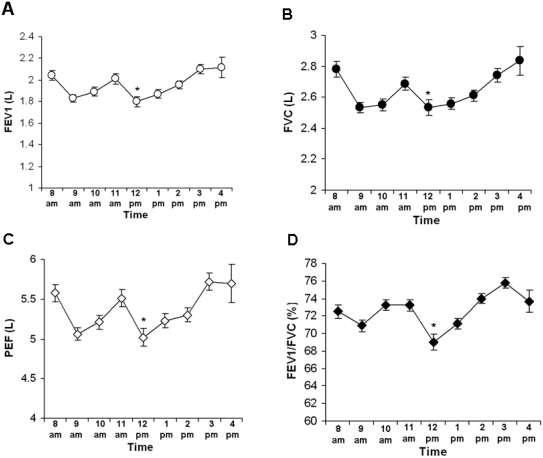
Pulmonary function has circadian modulations. Variations in human pulmonary function during the daytime hours (diurnal variations) remain to be well characterized. Discerning these variations will contribute to better understanding the relationship between biorhythms and lung physiology and to improving clinical management of pulmonary diseases. The aim of this study was to determine the magnitude of pulmonary function variability during the usual daytime hours in a population of patients referred for pulmonary function testing. Diurnal fluctuations of human pulmonary function were examined by studying retrospectively a study population of 4,756 individuals with performed pulmonary function tests. We found the lowest and highest spirometric values in the 12:00-12:59 pm and 3:00-4:59 pm time intervals respectively. The difference in the forced expiratory volume in 1 second (FEV1) between the noon (12:00-12:59 pm) and afternoon (4:00-4:59 pm) intervals was 17.6% (P<0.01). Furthermore, the highest values of diffusing capacity of the lung for carbon monoxide [DLCO] and alveolar volume [Va] were identified in the 8:00-8:59 am time interval. These findings, identifying a model of diurnal variations of pulmonary function in individuals referred for pulmonary function testing, are of interest for better understanding lung physiology and human circadian rhythms and may have clinical value in managing lung disorders.
Keywords: Pulmonary function; diffusing capacity; diurnal variations; pulmonary diseases; pulmonary function tests.
Figures


References
-
- Klein DC, Moore RY, Reppert SM. Suprachiasmatic Nucleus: The Mind's Clock. New York: Oxford University Press; 1991.
-
- Ralph MR, Foster RG, Davis FC, Menaker M. Transplanted suprachiasmatic nucleus determines circadian period. Science. 1990;247:975–978. - PubMed
-
- Sangoram AM, Saez L, Antoch MP, Gekakis N, Staknis D, Whiteley A, Fruechte EM, Vitaterna NH, Shimomura K, King DP, Young MW, Weitz CJ, Takahashi JS. Mammalian circadian autoregulatory loop: a timeless ortholog and mPer1 interact and negatively regulate CLOCK-BMAL1-induced transcription. Neuron. 1998;21:1101–1113. - PubMed
-
- Cardone L, Hirayama J, Giordano F, Tamaru T, Palvimo JJ, Sassone-Corsi P. Circadian clock control by SUMOylation of BMAL1. Science. 2005;309:1390–1394. - PubMed
-
- Bovbjerg DH. Circadian disruption and cancer: sleep and immune regulation. Brain Behav Immun. 2003;17:S48–S50. - PubMed
LinkOut - more resources
Full Text Sources