


Neurocognitive impairment in unaffected siblings of youth with bipolar disorder
- PMID: 19079809
- PMCID: PMC2853769
- DOI: 10.1017/S0033291708004832
Neurocognitive impairment in unaffected siblings of youth with bipolar disorder
Abstract
Background: There is growing evidence for the familiality of pediatric bipolar disorder (BPD) and its association with impairments on measures of processing speed, verbal learning and 'executive' functions. The current study investigated whether these neurocognitive impairments index the familial risk underlying the diagnosis.
Method: Subjects were 170 youth with BPD (mean age 12.3 years), their 118 non-mood-disordered siblings and 79 non-mood-disordered controls. Groups were compared on a battery of neuropsychological tests from the Wechsler Intelligence Scales, the Stroop Color Word Test, the Wisconsin Card Sorting Test (WCST), the Rey-Osterrieth Complex Figure (ROCF), an auditory working memory Continuous Performance Test (CPT) and the California Verbal Learning Test-Children's Version (CVLT-C). Measures were factor analyzed for data reduction purposes. All analyses controlled for age, sex and attention-deficit/hyperactivity disorder (ADHD).
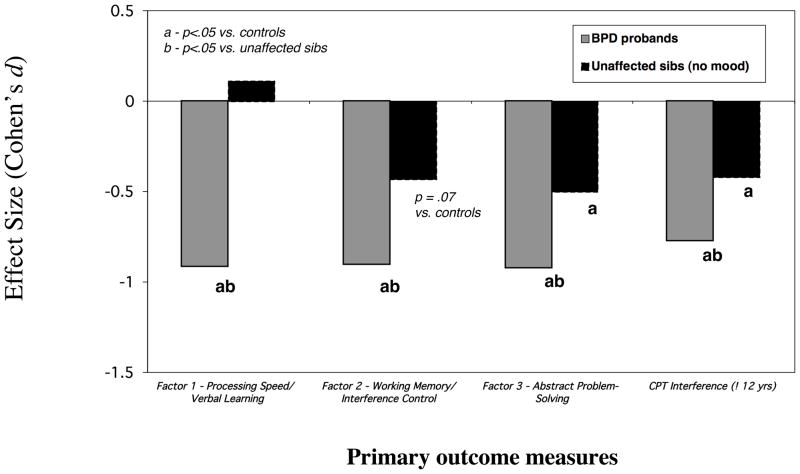
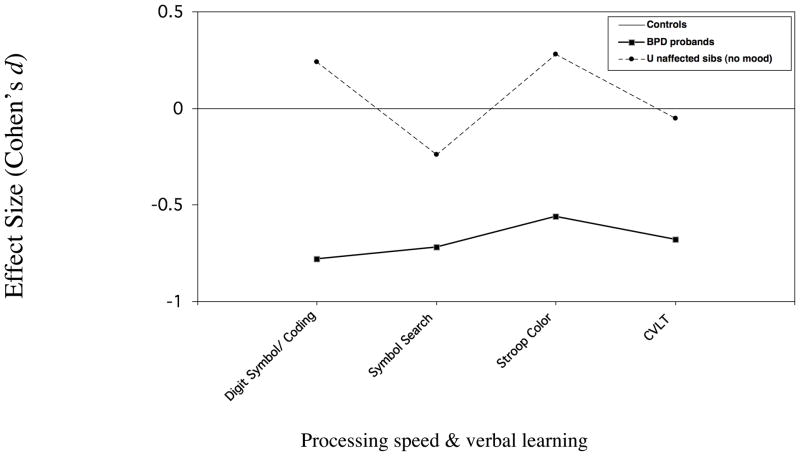
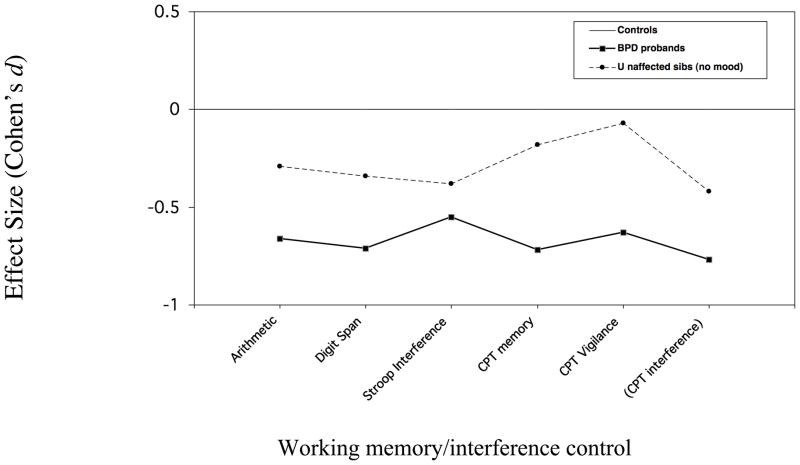
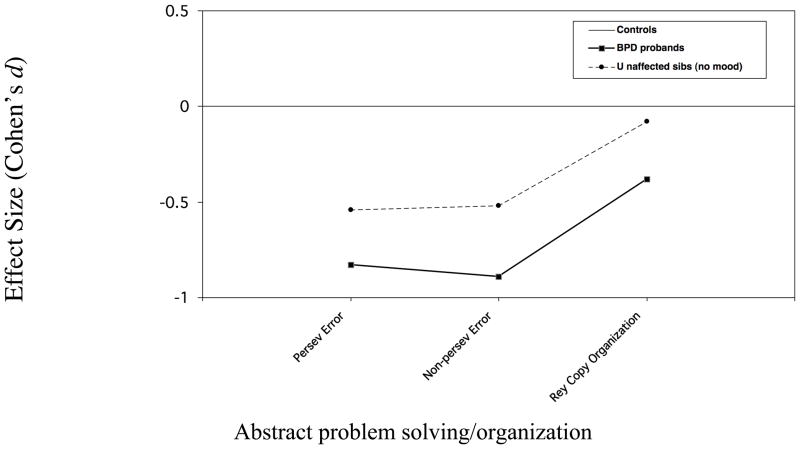
Results: Principal components analyses with a promax rotation yielded three factors reflecting: (1) processing speed/verbal learning, (2) working memory/interference control and (3) abstract problem solving. The CPT working memory measure with interference filtering demands (WM INT) was only administered to subjects aged > or =12 years and was therefore analyzed separately. BPD youth showed impairments versus controls and unaffected relatives on all three factors and on the WM INT. Unaffected relatives exhibited impairments versus controls on the abstract problem-solving factor and the WM INT. They also showed a statistical trend (p=0.07) towards worse performance on the working memory/interference control factor.
Conclusions: Neurocognitive impairments in executive functions may reflect the familial neurobiological risk mechanisms underlying pediatric BPD and may have utility as endophenotypes in molecular genetic studies of the condition.
Figures
References
-
- Barkley RA. Behavioral inhibition, sustained attention, and executive functions: constructing a unifying theory of ADHD. Psychol Bull. 1997b;121:65–94. - PubMed
-
- Barnett JH, Salmond CH, Jones PB, Sahakian BJ. Cognitive reserve in neuropsychiatry. Psychol Med. 2006;36(8):1053–64. - PubMed
-
- Bearden CE, Glahn DC, Caetano S, Olvera RL, Fonseca M, Najt P, Hunter K, Pliszka SR, Soares JC. Evidence for disruption in prefrontal cortical functions in juvenile bipolar disorder. Bipolar Disord. 2007;9(s1):145–159. - PubMed
-
- Bernstein JH, Waber DP. Developmental scoring system for the Rey-Osterreith Complex Figure [manual] Odessa, Florida: Psychological Assessment Resources, Inc; 1996.
-
- Biederman J. Pediatric bipolar disorder coming of age. Biological Psychiatry. 2003;53(11):931–934. - PubMed
Publication types
MeSH terms
Grants and funding
LinkOut - more resources
Full Text Sources
Other Literature Sources
Medical
