


Myoclonus and tremor response to thalamic deep brain stimulation parameters in a patient with inherited myoclonus-dystonia syndrome
- PMID: 19081669
- PMCID: PMC3101371
- DOI: 10.1016/j.clineuro.2008.10.015
Myoclonus and tremor response to thalamic deep brain stimulation parameters in a patient with inherited myoclonus-dystonia syndrome
Abstract
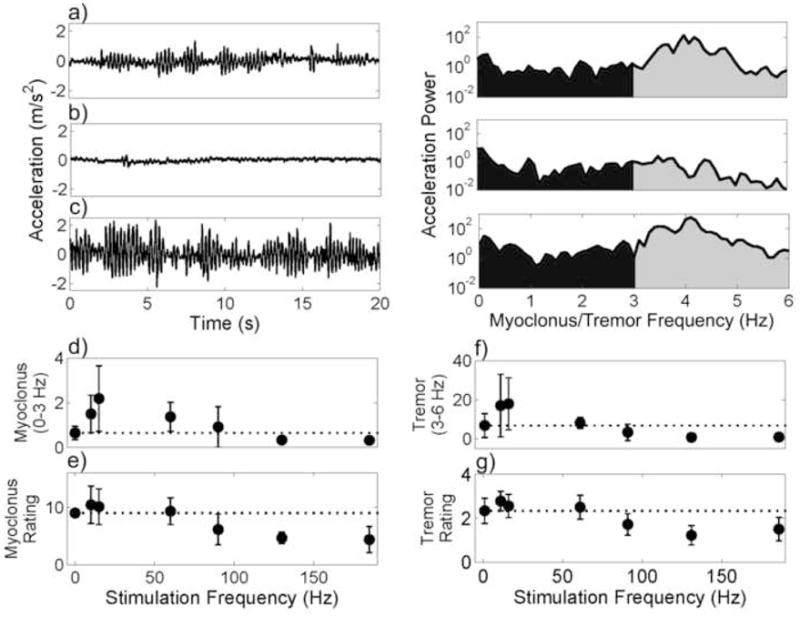
We present a 74-year-old woman with inherited myoclonus-dystonia, with predominant myoclonus and a novel mutation in the epsilon-sarcoglycan gene. The patient reports a life-long history of rapid, jerking movements, most severe in the upper extremities as well as a postural and action tremor. Bilateral deep brain stimulation (DBS) of the ventral intermediate nucleus of the thalamus was performed, and the patient demonstrated moderate clinical improvement in myoclonus. We studied the effects on myoclonus and tremor of varying DBS frequency and amplitude. The frequency tuning curve for myoclonus was similar to that of tremor, suggesting similar mechanisms by which DBS alleviates both disorders.
Conflict of interest statement
Disclosure: The authors have reported no conflicts of interest.
Figures
References
-
- Furukawa Y, Rajput AH. Inherited myoclonus-dystonia: How many causative genes and clinical phenotypes. Neurology. 2002;59:1130–1131. - PubMed
-
- Montcel STd, Clot F, Vidailhet M, Roze E, Damier P, Jedynak CP, Camuzat A, Lagueny A, Vercueil L, Doummar D, Guyant-Marechal L, Houeto JL, Ponsot G, Thobois S, Cournelle MA, Durr A, Durif F, Echenne B, Hannequin D, Tranchant C, Brice A the French Dystonia N. Epsilon sarcoglycan mutations and phenotype in French patients with myoclonic syndromes. J Med Genet. 2006;43:394–400. - PMC - PubMed
-
- Zimprich A, Grabowski M, Asmus F, Naumann M, Berg D, Bertram M, Scheidtmann K, Kern P, Winkelmann J, Muller-Myhsok B, Riedel L, Bauer M, Muller T, Castro M, Meitinger T, Strom TM, Gasser T. Mutations in the gene encoding epsilon-sarcoglycan cause myoclonus-dystonia syndrome. Nature Genetics. 2001;29:66–69. - PubMed
-
- Quinn NP. Essential myoclonus and myoclonic dystonia. Mov Disord. 1996;11:119–124. - PubMed
-
- Brown P. Myoclonus. In: Sawle G, editor. Movement Disorders in Clinical Practice. Oxford: Isis Medical Media Ltd; 1999. pp. 147–157.
Publication types
MeSH terms
Substances
Grants and funding
LinkOut - more resources
Full Text Sources
Other Literature Sources
Medical
