


High serum Abeta and vascular risk factors in first-degree relatives of Alzheimer's disease patients
- PMID: 19081767
- PMCID: PMC2600489
- DOI: 10.2119/molmed.2008.00118
High serum Abeta and vascular risk factors in first-degree relatives of Alzheimer's disease patients
Abstract
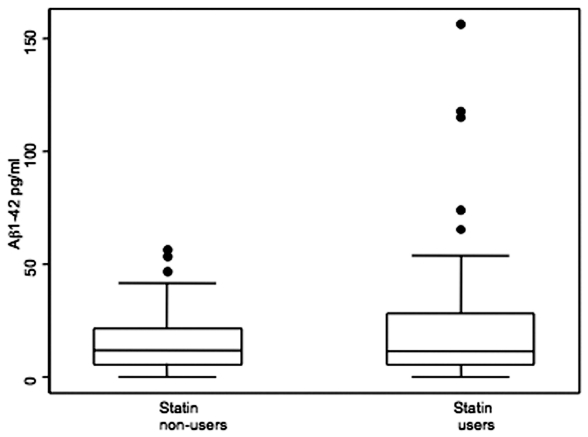
The main objective of this study was to determine whether elevated blood beta-amyloid (Abeta) levels among the first-degree relatives of patients with Alzheimer's Disease (AD) are associated with vascular risk factors of AD. Serum Abeta was measured in samples from 197 cognitively normal first-degree relatives of patients with AD-like dementia. Study participants were recruited as part of an ancillary study of the Alzheimer's Disease Anti-inflammatory Prevention Trial (ADAPT subpopulation). The ADAPT subpopulation was found to be similar in age, sex, and ethnicity to another cognitively normal cohort (n = 98). Using cross-sectional analyses, we examined the association of Abeta with blood pressure, lipid levels, apolipoprotein E genotypes, and the use of prescribed medication to treat vascular risk factors in the ADAPT subpopulation. Abeta(1-40) was positively associated with age, use of antihypertensives, and serum creatinine, and we observed a marginal negative interaction on Abeta(1-40) associated with systolic blood pressure and use of antihypertensives. Serum Abeta(1-42) was associated with statin use and a positive correlation of Abeta (1-42) with HDL was observed among statin nonusers. These findings suggest that high Abeta in the periphery among the family history-enriched cohorts may be due to enrichment of vascular risk factors and may reflect presymptomatic AD pathology. It remains to be determined whether the association of Abeta with medications used for treating vascular risk factors indicates prevention of AD. Longitudinal evaluation of blood Abeta in this cohort will provide a better understanding of the significance of this association in AD etiology.
Figures
References
-
- Tandon A, Rogaeva E, Mullan M, St George-Hyslop PH. Molecular genetics of Alzheimer’s disease: the role of beta-amyloid and the presenilins. Curr Opin Neurol. 2000;13:377–84. - PubMed
-
- Mayeux R, et al. Plasma Aβ40 and Aβ42 and Alzheimer’s disease: relation to age, mortality, and risk. Neurology. 2003;61:1185–9. - PubMed
-
- Casoli T, et al. Release of beta-amyloid from high-density platelets: implications for Alzheimer’s disease pathology. Ann. N. Y. Acad. Sci. 2007;1096:170–8. - PubMed
-
- van Oijen M, Hofman A, Soares HD, Koudstaal PJ, Breteler MM. Plasma Aβ1–40 and Aβ1–42 and the risk of dementia: a prospective case-cohort study. Lancet Neurol. 2006;5:655–60. - PubMed
-
- Blasko I, et al. Conversion from cognitive health to mild cognitive impairment and Alzheimer’s disease: prediction by plasma amyloid beta 42, medial temporal lobe atrophy and homocysteine. Neurobiol Aging. 2008;29:1–11. - PubMed
Publication types
MeSH terms
Substances
Grants and funding
LinkOut - more resources
Full Text Sources
Other Literature Sources
Medical
