


The relative contributions of race/ethnicity, socioeconomic status, health, and social relationships to life satisfaction in the United States
- PMID: 19082871
- PMCID: PMC6036920
- DOI: 10.1007/s11136-008-9426-2
The relative contributions of race/ethnicity, socioeconomic status, health, and social relationships to life satisfaction in the United States
Abstract
Purpose: To evaluate racial/ethnic disparities in life satisfaction and the relative contributions of socioeconomic status (SES; education, income, employment status, wealth), health, and social relationships (social ties, emotional support) to well-being within and across racial/ethnic groups.
Methods: In two cross-sectional, representative samples of U.S. adults (the 2001 National Health Interview Survey and the 2007 Behavioral Risk Factor Surveillance System; combined n > 350,000), we compared life satisfaction across Whites, Hispanics, and Blacks. We also evaluated the extent to which SES, health, and social relationships 'explained' racial/ethnic group differences and compared the magnitude of variation explained by life satisfaction determinants across and within these groups.
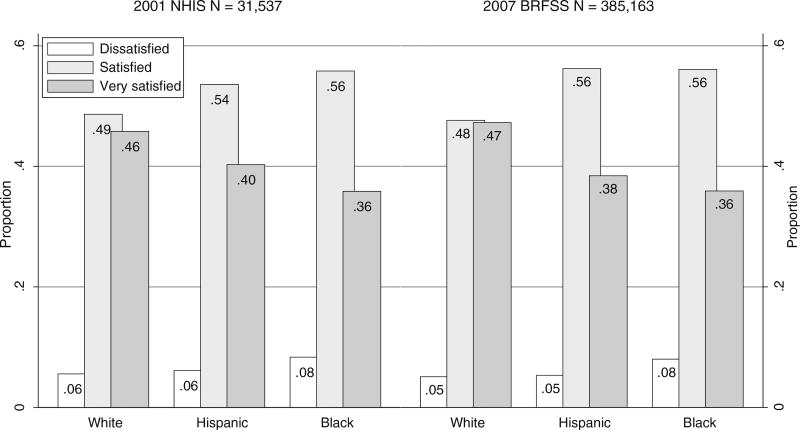
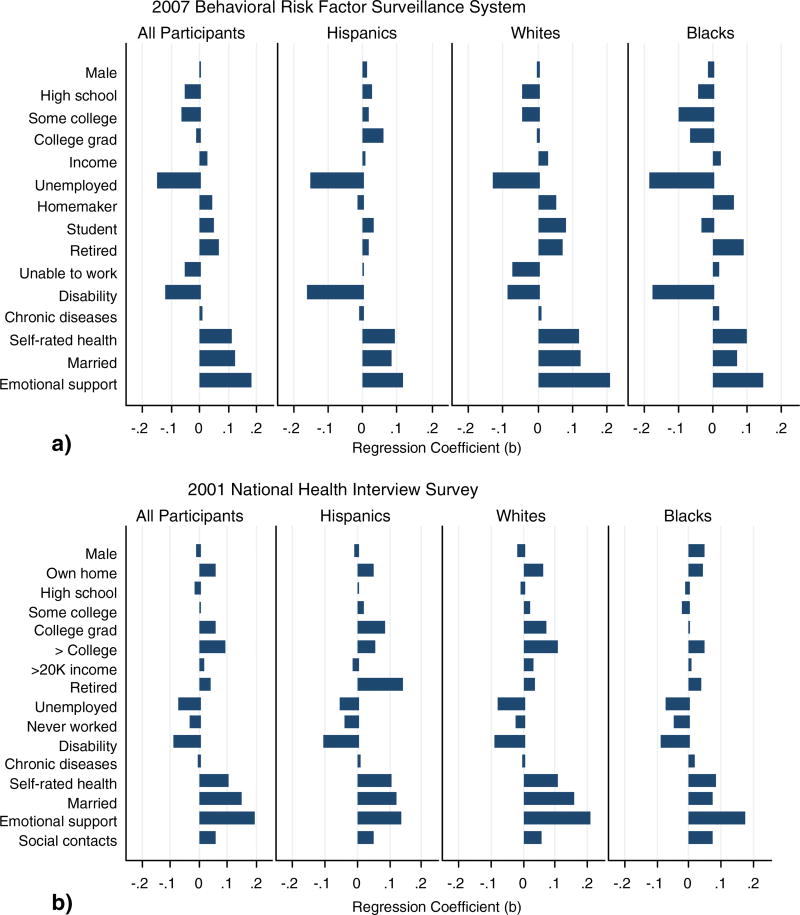
Results: Relative to Whites, both Blacks and Hispanics were less likely to be very satisfied. Blacks were somewhat more likely to report being dissatisfied. These differences were reduced or eliminated with adjustment for SES, health, and social relationships. Together, SES and health explained 12-15% of the variation in life satisfaction, whereas social relationships explained an additional 10-12% of the variance.
Conclusions: Racial/ethnic life satisfaction disparities exist for Blacks and Hispanics, and these differences are largest when comparing those reporting being 'satisfied' to 'very satisfied' versus 'dissatisfied' to 'satisfied.' SES, health, and social relationships were consistently associated with life satisfaction, with emotional support having the strongest association with life satisfaction.
Figures
References
-
- World Health Organization. Promoting mental health: Concepts, emerging evidence, practice. World Health Organization, Department of Mental Health and Substance Abuse in collaboration with the Victorian Health Promotion Foundation and the University of Melbourne; 2005.
-
- U.S. Department of Health and Human Services. Healthy People 2010: Understanding and improving health. 2. Washington, DC: US Government Printing Office; 2000.
-
- Diener E, Seligman MEP. Beyond money: Toward an economy of well-being. Psychological Science in the Public Interest. 2004;5:1–31. - PubMed
MeSH terms
Grants and funding
LinkOut - more resources
Full Text Sources
