Review
. 2009 Jun;10(3):235-52.
doi: 10.1007/s10522-008-9205-z. Epub 2008 Dec 15.

Roles of RECQ helicases in recombination based DNA repair, genomic stability and aging

Affiliations
Review

Roles of RECQ helicases in recombination based DNA repair, genomic stability and aging

Dharmendra Kumar Singh et al. Biogerontology. 2009 Jun.

Abstract

The maintenance of the stability of genetic material is an essential feature of every living organism. Organisms across all kingdoms have evolved diverse and highly efficient repair mechanisms to protect the genome from deleterious consequences of various genotoxic factors that might tend to destabilize the integrity of the genome in each generation. One such group of proteins that is actively involved in genome surveillance is the RecQ helicase family. These proteins are highly conserved DNA helicases, which have diverse roles in multiple DNA metabolic processes such as DNA replication, recombination and DNA repair. In humans, five RecQ helicases have been identified and three of them namely, WRN, BLM and RecQL4 have been linked to genetic diseases characterized by genome instability, premature aging and cancer predisposition. This helicase family plays important roles in various DNA repair pathways including protecting the genome from illegitimate recombination during chromosome segregation in mitosis and assuring genome stability. This review mainly focuses on various roles of human RecQ helicases in the process of recombination-based DNA repair to maintain genome stability and physiological consequences of their defects in the development of cancer and premature aging.


Figures
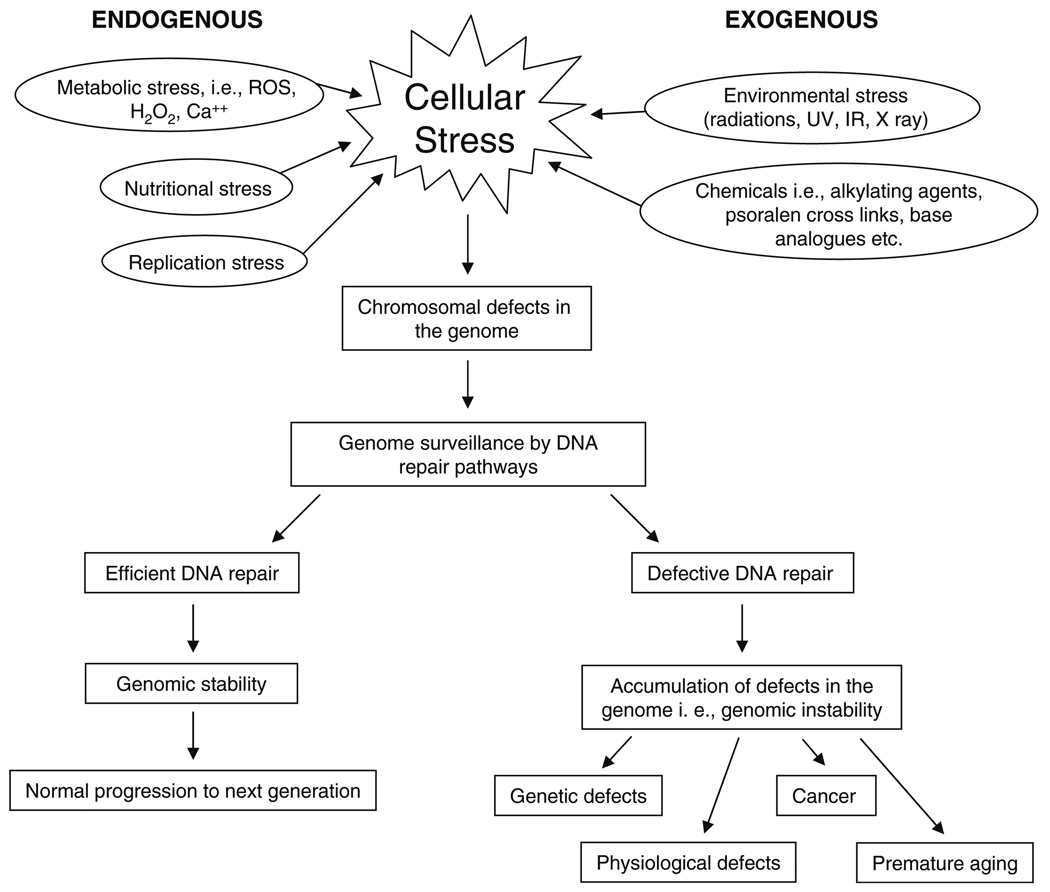
Fig. 1
Fig. 1
Overview of relationship between cellular stress responses, DNA repair and genome stability. During the course of their life span, organisms tolerate multiple stresses which might have deleterious effects on their genome. These deleterious effects are encountered by continuous genome surveillance by various DNA repair pathways such as BER, NER, DSB, MMR and mitochondrial DNA repair. Efficient DNA repair machinery in an organism leads to genomic stability, and protects the genome from harmful effects of stress. On the other hand, defective DNA repair machinery would ultimately lead to chromosomal abnormalities which might cause genetic and physiological defects, cellular death, cancer and/or premature aging
Fig. 2
Fig. 2
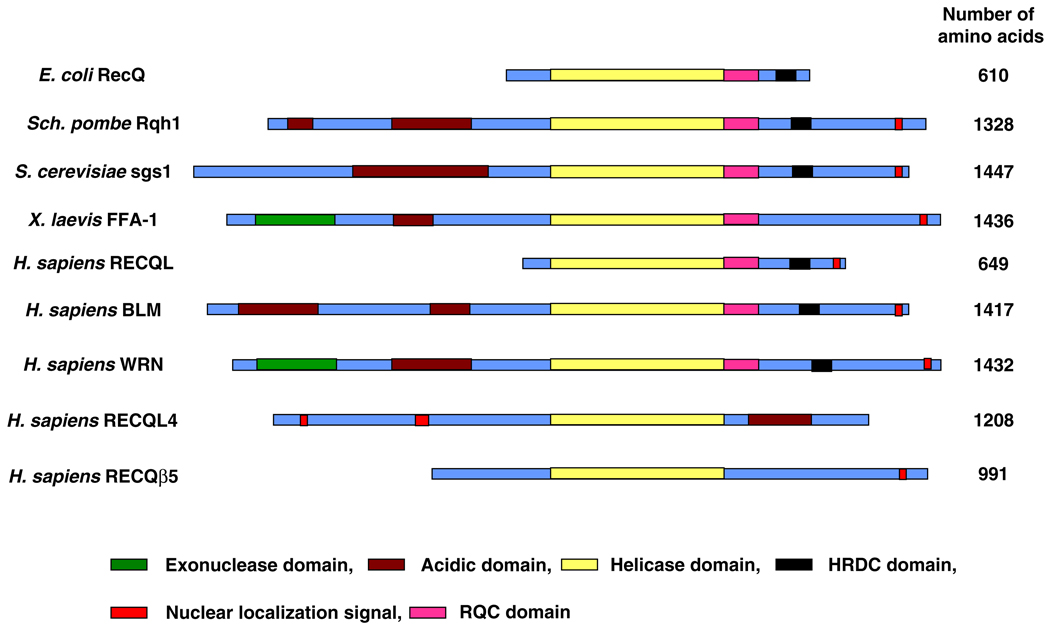
Domain architecture of RecQ helicase family. RecQ helicases from different organisms are shown. All the members have a conserved helicase domain in the central region of the protein (yellow). The nuclear localization signal (depicted in red) is present at the C-terminus in most of the family members, except in RECQL4 where it resides at the N-terminus. The WRN protein is unique among human RecQ helicase members in having an exonuclease domain (green) at the N-terminus
Fig. 3
Fig. 3
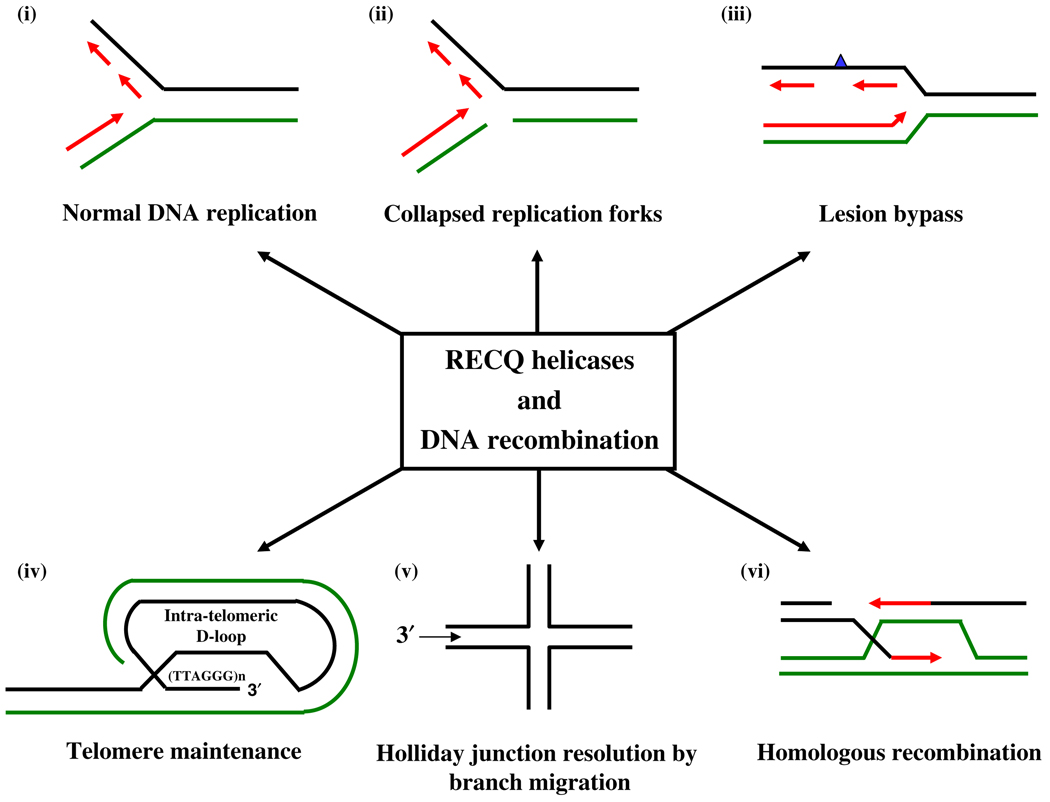
RecQ helicases play important roles in various DNA metabolic and repair pathways involving homologous recombination. The RecQ helicases are involved in (i) Resolving aberrant structures encountered at the replication fork during normal DNA replication, (ii) Replication restart at collapsed replication fork sites which arise due to the presence of a nick within the leading strand ahead of replication fork. When the progressing replication fork encounter these nicks (which mimic double strand breaks), it leads to replication arrest. RecQ helicases helps in the replication recovery at the arrested replication fork by promoting fork regression and homologous recombination, (iii) Lesion bypass when the base error is present in the lagging strand. The nick is created due to removal of an incorrectly incorporated nucleotide in the lagging strand which is filled by recombination-mediated gap repair. This is followed by RecQ helicase-mediated resolution of recombinogenic structures (iv) Telomeric maintenance by promoting intra- or inter-strand invasion of 3′ tail of the telomere followed by homologous recombination, (v) Resolution of Holliday junctions by branch migration activity, (vi) Homologous recombination and dissolution of Holliday junctions during the process of meiotic segregation and preventing illegitimate recombination during mitosis
Fig. 4
Fig. 4
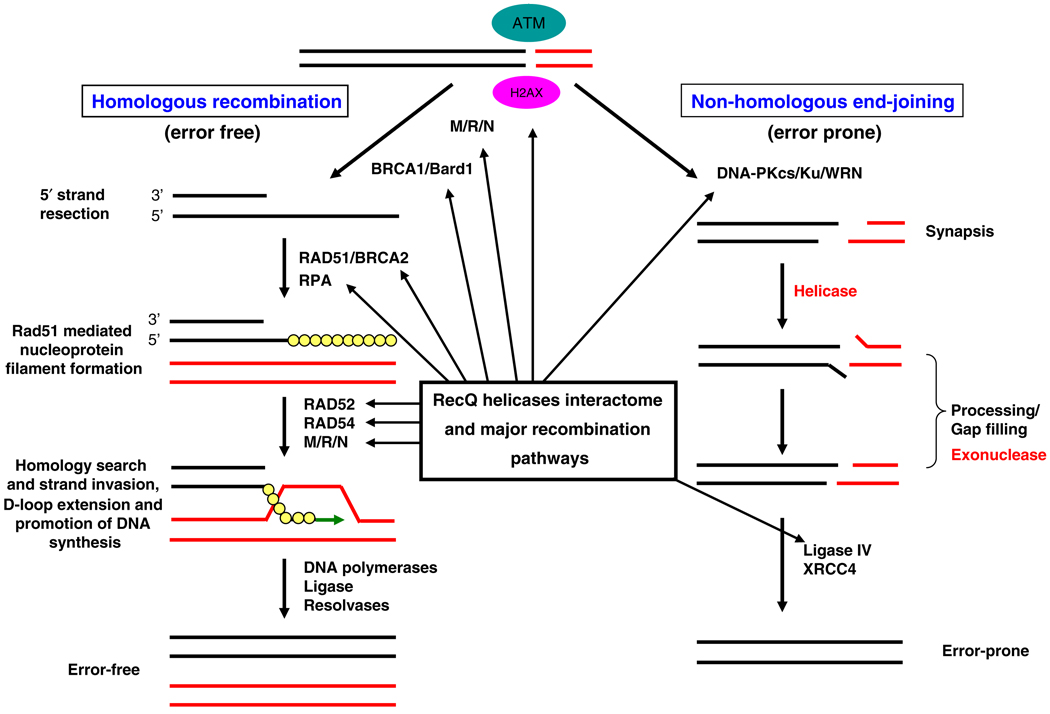
RecQ helicases are involved in multiple steps of major recombination pathways. The members of the RecQ helicase family interacts with various proteins involved in different steps of the major recombination pathways i.e., error free homologous recombination (HR) pathway and error prone non-homologous end-joining (NHEJ) pathway. (See text for details)

References

    1. Adams MD, McVey M, Sekelsky JJ. Drosophila BLM in double-strand break repair by synthesis-dependent strand annealing. Science. 2003;299:265–267. - PubMed
    1. Akkari YM, Bateman RL, Reifsteck CA, Olson SB, Grompe M. DNA replication is required to elicit cellular responses to psoralen-induced DNA interstrand cross-links. Mol Cell Biol. 2000;20:8283–8289. doi: 10.1128/MCB. 20.21.8283-8289.2000. - DOI - PMC - PubMed
    1. Anbari KK, Ierardi-Curto LA, Silber JS, Asada N, Spinner N, Zackai EH, Belasco J, Morrissette JD, Dormans JP. Two primary osteosarcomas in a patient with Rothmund–Thomson syndrome. Clin Orthop Relat Res. 2000;378:213–223. doi: 10.1097/00003086-200009000-00032. - DOI - PubMed
    1. Bachrati CZ, Hickson ID. RecQ helicases: suppressors of tumorigenesis and premature aging. Biochem J. 2003;374:577–606. doi: 10.1042/BJ20030491. - DOI - PMC - PubMed
    1. Bachrati CZ, Hickson ID. RecQ helicases: guardian angels of the DNA replication fork. Chromosoma. 2008;117:219–233. doi: 10.1007/s00412-007-0142-4. - DOI - PubMed

Publication types