


The role of Akt/protein kinase B subtypes in retinal ischemic preconditioning
- PMID: 19084003
- PMCID: PMC2709455
- DOI: 10.1016/j.exer.2008.11.013
The role of Akt/protein kinase B subtypes in retinal ischemic preconditioning
Abstract
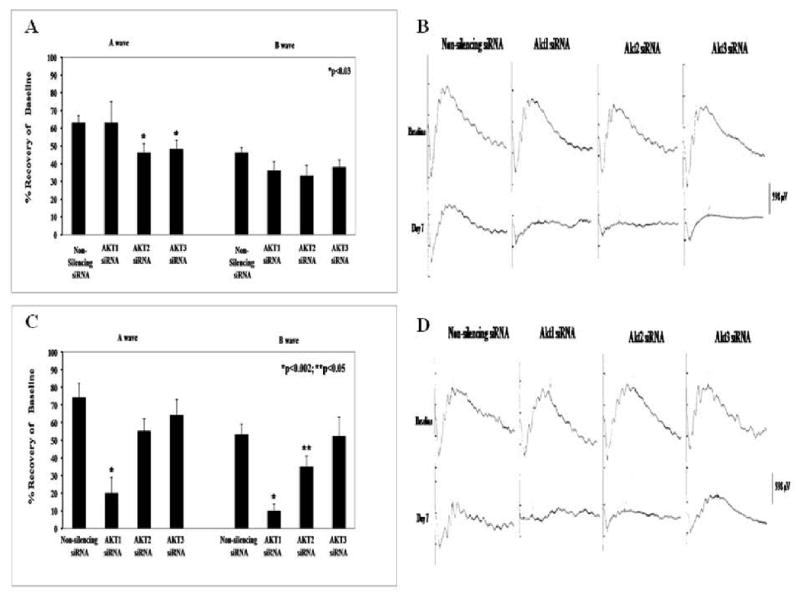
Potent endogenous protection from ischemia can be induced in the retina by ischemic preconditioning (IPC). Protein kinase B/Akt is a cellular survival factor. We hypothesized that Akt was integral to IPC based upon differential effects of Akt subtypes. Rats were subjected to retinal ischemia after IPC or IPC-mimicking by the opening of mitochondrial KATP (mKATP) channels. The effects of blocking Akt using wortmannin, API-2, or small interfering RNA (siRNA) were examined. Electroretinography assessed functional recovery after ischemia, and TUNEL examined retinal ganglion cell apoptosis. We studied the relationship between Akt activation and known initiators of IPC, including adenosine receptor stimulation and the opening of mKATP channels. The PI-3 kinase inhibitor wortmannin 1 or 4 mg/kg (i.p.), the specific Akt inhibitor API-2, 5-500 microM in the vitreous, or intravitreal siRNA directed against Akt2 or -3, but not Akt1, significantly attenuated the neuroprotective effect of IPC. Interfering RNA against any of the three Akt subtypes significantly but time-dependently attenuated mKATP channel opening to mimic IPC. Adenosine A1 receptor blockade (DPCPX), A2a blockade (CSC), or the mKATP channel blocker 5-hydroxydecanoic acid significantly attenuated Akt activation after IPC. Interfering RNA directed against Akt subtypes prevented the ameliorative effect of IPC on post-ischemic apoptosis. All three Akt subtypes are involved in functional retinal neuroprotection by IPC or IPC-mimicking. Akt is downstream of adenosine A1 and A2a receptors and mKATP channel opening. The results indicate the presence in the retina of robust and redundant endogenous neuroprotection based upon subtypes of Akt.
Conflict of interest statement
Proprietary Interest: None
Figures




References
-
- Cardone MH, Roy N, Stennicke HR, Salvasen GS, Franke TF, Stanbridge E, Frisch S, Reed JC. Regulation of cell death protease caspase-9 by phosphorylation. Science. 1998;282:1318–1321. - PubMed
-
- Chavarria T, Valenciano AI, Mayordomo R, Egea J, Comella JX, Hallbook F, de Pablo F, de la Rosa EJ. Differential, age-dependent MEK-ERK and PI3K-Akt activation by insulin acting as a survival factor during embryonic retinal development. Dev Neurobiol. 2007;67:1777–1788. - PubMed
-
- Chong ZZ, Li F, Maiese K. Oxidative stress in the brain: novel cellular targets that govern survival during neurodegenerative disease. Prog Neurobiol. 2005;75:207–246. - PubMed
-
- Datta SR, Dudek H, Tao X, Masters S, Fu H, Gotah Y, Greenberg ME. Akt phosphorylation of BAD couples survival signals to the cell-intrinsic death machinery. Cell. 1997;911:231–241. - PubMed
Publication types
MeSH terms
Substances
Grants and funding
LinkOut - more resources
Full Text Sources
Molecular Biology Databases
Research Materials
Miscellaneous
