


The critical period for surgical treatment of dense congenital bilateral cataracts
- PMID: 19084444
- PMCID: PMC3310432
- DOI: 10.1016/j.jaapos.2008.07.010
The critical period for surgical treatment of dense congenital bilateral cataracts
Abstract
Introduction: We examined the critical period for deprivation amblyopia in a cohort of patients with dense bilateral congenital cataracts to investigate the optimum timing for surgical treatment.
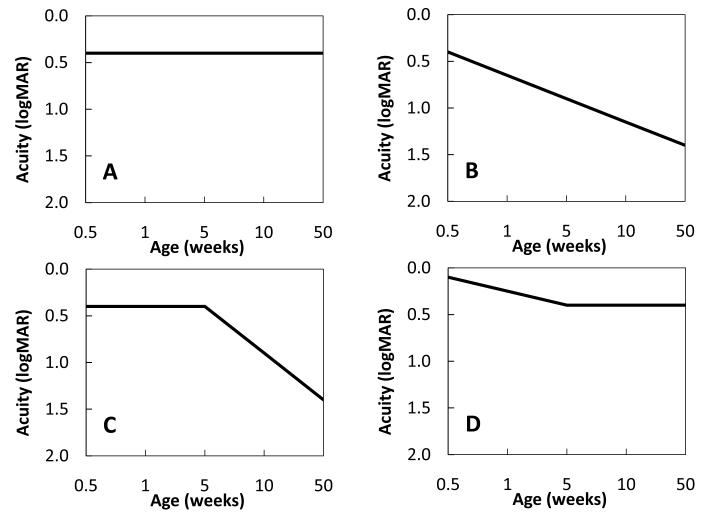
Methods: Thirty-seven infants with dense bilateral congenital cataracts that were extracted by 31 weeks of age were enrolled prospectively. Visual acuity outcome was assessed at >/=5 years of age. We statistically evaluated which of 4 models provided the best fit to the data: (1) no change in visual acuity outcome with delay in surgery, (2) linear decline of outcome with delay, (3) a bilinear model in which a critical age exists after which outcome depends on delay, and (4) a bilinear model in which a critical age exists before which outcome depends on delay. In addition, we reviewed medical records for associated adverse outcomes, including strabismus, nystagmus, secondary membrane formation, and glaucoma.
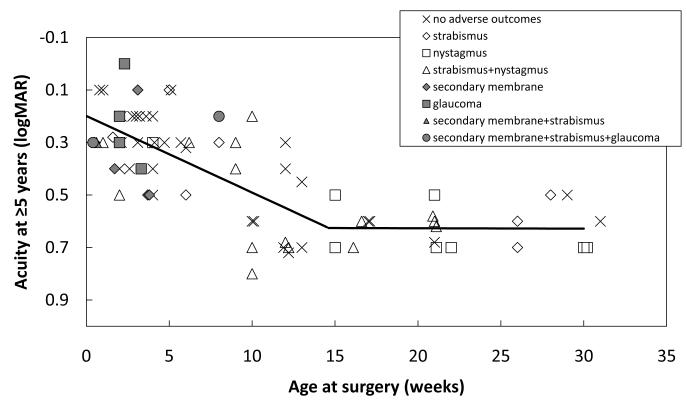
Results: A bilinear model with a critical age of 14 weeks fit the data better than a linear model (chi(2) = 14.7; p < 0.0006). During weeks 0-14, mean visual acuity decreased by 1 line with each 3 weeks' delay in surgery. From 14 to 31 weeks, visual acuity was independent the subject's age at surgery, averaging 20/80. Surgery after 4 weeks was associated with a greater prevalence of strabismus and nystagmus than surgery before 4 weeks, whereas surgery during the first 4 weeks was associated with a greater prevalence of secondary membrane formation and glaucoma.
Conclusions: We did not find a latent period for the treatment of children with dense bilateral congenital cataracts. Deprivation amblyopia may be minimized with early surgery for bilateral cataracts.
Figures
Comment in
-
The critical period for surgical treatment of dense congenital bilateral cataracts.J AAPOS. 2009 Oct;13(5):527-8; author reply 528. doi: 10.1016/j.jaapos.2009.07.003. J AAPOS. 2009. PMID: 19840740 No abstract available.
References
-
- Birch EE, Stager D, Leffler J, Weakley D. Early treatment of congenital unilateral cataract minimizes unequal competition. Invest Ophthalmol Vis Sci. 1998;39(9):1560–6. - PubMed
-
- Birch EE, Stager DR. The critical period for surgical treatment of dense congenital unilateral cataract. Invest Ophthalmol Vis Sci. 1996;37(8):1532–8. - PubMed
-
- Jeffrey BG, Birch EE, Stager DR, Jr., et al. Early binocular visual experience may improve binocular sensory outcomes in children after surgery for congenital unilateral cataract. Journal of AAPOS. 2001;5(4):209–16. - PubMed
-
- Maurer D, Lewis TL. Visual outcomes after infantile cataract. In: Simons K, editor. Early Visual Development: Normal and Abnormal. Oxford University Press; New York: 1993.
-
- Lambert S, Lynn M, Reeves R, et al. Is there a latent period for the surgical treatment of children with dense bilateral congenital cataracts? Journal of AAPOS. 2006;10:30–1. - PubMed
Publication types
MeSH terms
Grants and funding
LinkOut - more resources
Full Text Sources
Medical
