


Functional linkage of cirrhosis-predictive single nucleotide polymorphisms of Toll-like receptor 4 to hepatic stellate cell responses
- PMID: 19085953
- PMCID: PMC2891538
- DOI: 10.1002/hep.22697
Functional linkage of cirrhosis-predictive single nucleotide polymorphisms of Toll-like receptor 4 to hepatic stellate cell responses
Abstract
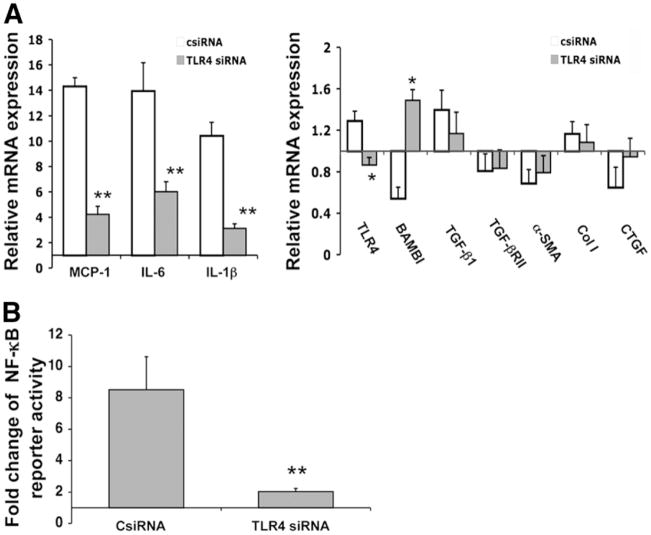
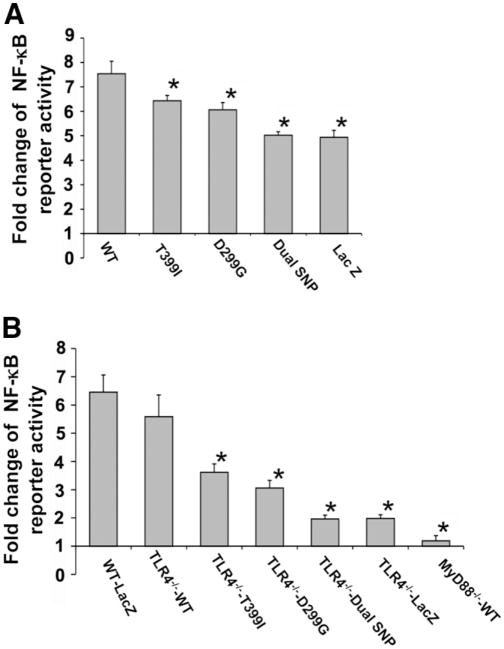
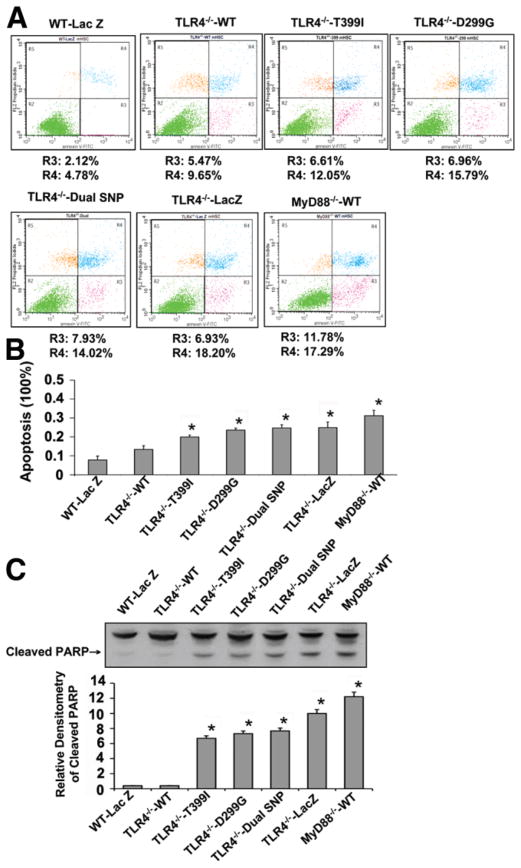
In a recent study, a single nucleotide polymorphism (SNP) of the Toll-like receptor 4 (TLR4) gene (c.1196C>T [rs4986791, p.T399I]) emerged as conferring protection from fibrosis progression compared to a major, wild-type (WT) CC allele (p.T399). The present study examined the functional linkage of this SNP, along with another common, highly cosegregated TLR4 SNP (c.896A>G [rs4986790, p.D299G]), to hepatic stellate cell (HSC) responses. Both HSCs from TLR4(-/-) mice and a human HSC line (LX-2) reconstituted with either TLR4 D299G and/or T399I complementary DNAs were hyporesponsive to lipopolysaccharide (LPS) stimulation compared to those expressing WT TLR4, as assessed by the expression and secretion of LPS-induced inflammatory and chemotactic cytokines (i.e., monocyte chemoattractant protein-1, interleukin-6), down-regulation of bone morphogenic protein and the activin membrane-bound inhibitor expression (an inhibitory transforming growth factor beta pseudoreceptor), and activation of a nuclear factor kappaB (NF-kappaB)-responsive luciferase reporter. In addition, spontaneous apoptosis, as well as apoptosis induced by pathway inhibitors of NF-kappaB, extracellular signal-regulated kinase (ERK), and phosphatidylinositol 3-kinase were greatly increased in HSCs from either TLR4(-/-) or myeloid differentiation factor 88(-/-) (a TLR adaptor protein) mice, as well as in murine HSCs expressing D299G and/or T399I SNPs; increased apoptosis in these lines was accompanied by decreased phospho-ERK and Bcl-2.
Conclusion: TLR4 D299G and T399I SNPs that are associated with protection from hepatic fibrosis reduce TLR4-mediated inflammatory and fibrogenic signaling and lower the apoptotic threshold of activated HSCs. These findings provide a mechanistic link that explains how specific TLR4 SNPs may regulate the risk of fibrosis progression.
Conflict of interest statement
Potential conflict of interest: Nothing to report.
Figures




References
-
- Poynard T, Bedossa P, Opolon P. Natural history of liver fibrosis progression in patients with chronic hepatitis C. The OBSVIRC, METAVIR, CLINIVIR, and DOSVIRC groups. Lancet. 1997;349:825–832. - PubMed
-
- Asselah T, Bieche I, Paradis V, Bedossa P, Vidaud M, Marcellin P. Genetics, genomics, and proteomics: implications for the diagnosis and the treatment of chronic hepatitis C. Semin Liver Dis. 2007;27:13–27. - PubMed
-
- Huang H, Shiffman ML, Friedman S, Venkatesh R, Bzowej N, Abar OT, et al. A 7 gene signature identifies the risk of developing cirrhosis in patients with chronic hepatitis C. Hepatology. 2007;46:297–306. - PubMed
-
- Arbour NC, Lorenz E, Schutte BC, Zabner J, Kline JN, Jones M, et al. TLR4 mutations are associated with endotoxin hyporesponsiveness in humans. Nat Genet. 2000;25:187–191. - PubMed
-
- Lorenz E, Mira JP, Frees KL, Schwartz DA. Relevance of mutations in the TLR4 receptor in patients with gram-negative septic shock. Arch Intern Med. 2002;162:1028–1032. - PubMed
Publication types
MeSH terms
Substances
Grants and funding
LinkOut - more resources
Full Text Sources
Other Literature Sources
Medical
Research Materials
Miscellaneous