


Inversion of configuration at the metal in diastereomeric imido alkylidene monoaryloxide monopyrrolide complexes of molybdenum
- PMID: 19086901
- PMCID: PMC2652865
- DOI: 10.1021/ja808308e
Inversion of configuration at the metal in diastereomeric imido alkylidene monoaryloxide monopyrrolide complexes of molybdenum
Abstract
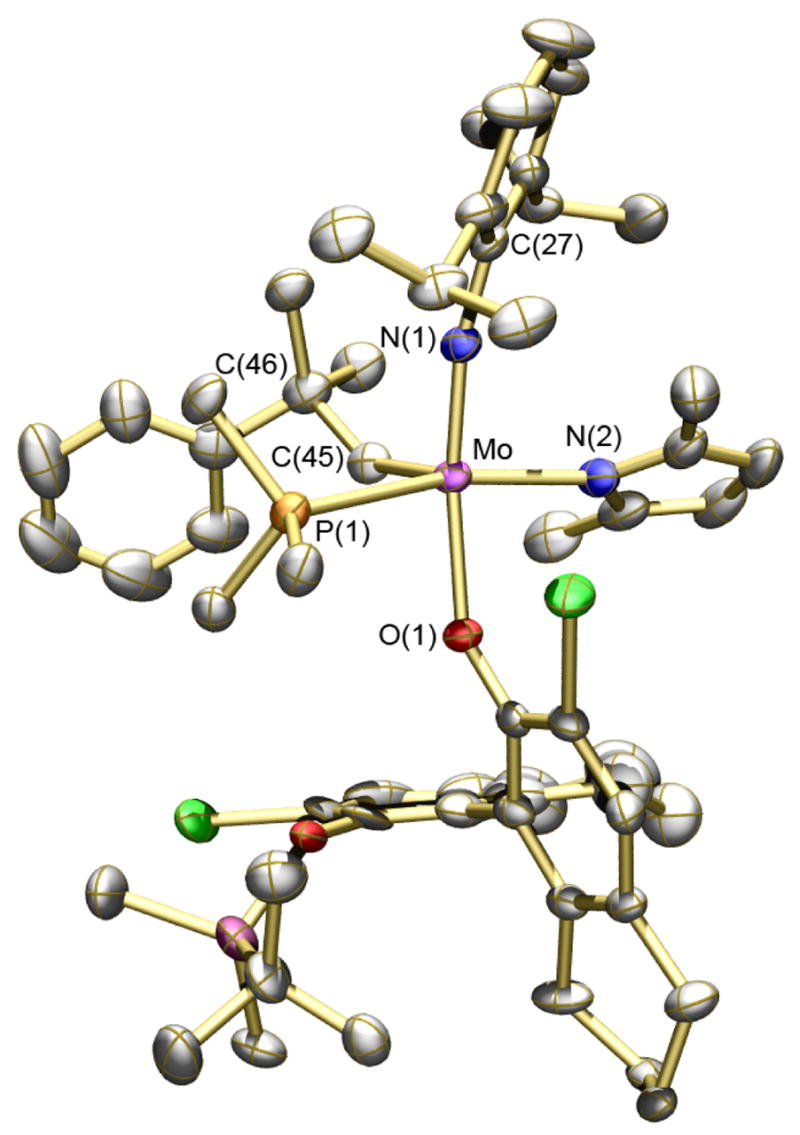
The two diastereomers of Mo(NAr)(CHCMe(2)Ph)(2,5-dimethylpyrrolide)(1), (S(M)R(1))-2 and (R(M)R(1))-2, respectively, where 1 is an enantiomerically pure (R) phenoxide and Ar = 2,6-diisopropylphenyl, form adducts with PMe(3). One of these ((R(M)R(1))-2(PMe(3))) has been isolated. An X-ray structure reveals that PMe(3) has added trans to the pyrrolide; it is a model for where an olefin would attack the metal. Trimethylphosphine will catalyze slow interconversion of (S(M)R(1))-2 and (R(M)R(1))-2 via formation of weak PMe(3) adducts. Reactions between (S(M)R(1))-2 or (R(M)R(1))-2 and ethylene yield Mo(NAr)(CH(2))(Me(2)Pyr)(1) species in which the configuration at Mo is inverted by ethylene at a rate of the order of the NMR time scale at 22 degrees C via formation of metallacyclobutane intermediates with imido and aryloxide ligands in axial positions. A reactant olefin is proposed to approach Mo and the product olefin to leave Mo trans to the pyrrolide.
Figures
References
-
- Singh R, Schrock RR, Müller P, Hoveyda AH. J Am Chem Soc. 2007;129:12654. - PubMed
-
- Schrock RR, Hoveyda AH. Angew Chem Int Ed. 2003;42:4592. - PubMed
- Schrock RR, Czekelius CC. Adv Syn Catal. 2007;349:55.
-
- Schrock RR, Crowe WE, Bazan GC, DiMare M, O’Regan MB, Schofield MH. Organometallics. 1991;10:1832.
- Schrock RR, Gabert AJ, Singh R, Hock AS. Organometallics. 2005;24:5058.
- Gabert AJ, Schrock RR, Müller P. Chem Asian J. 2008;3:1535. - PubMed
- Adamchuk J, Schrock RR, Tonzetich ZJ, Müller P. Organometallics. 2006;25:2364.
- Feldman J, Schrock RR. Prog Inorg Chem. 1991;39:1.
Publication types
MeSH terms
Substances
Grants and funding
LinkOut - more resources
Full Text Sources
Other Literature Sources
Research Materials
