


Bacterial overgrowth and irritable bowel syndrome: unifying hypothesis or a spurious consequence of proton pump inhibitors?
- PMID: 19086951
- PMCID: PMC2949084
- DOI: 10.1111/j.1572-0241.2008.01992.x
Bacterial overgrowth and irritable bowel syndrome: unifying hypothesis or a spurious consequence of proton pump inhibitors?
Abstract
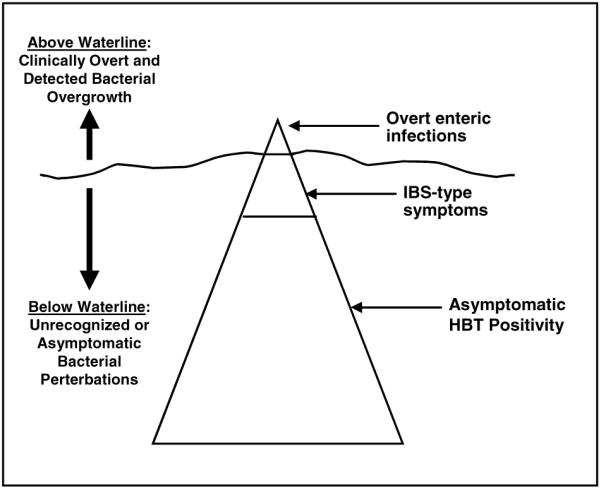
Some studies indicate that small intestinal bacterial overgrowth (SIBO), as measured by hydrogen breath tests (HBT), is more prevalent in patients with irritable bowel syndrome (IBS) vs. matched controls without IBS. Although the data are conflicting, this observation has led to the hypothesis that SIBO may be a primary cause of IBS. Yet, it remains unclear whether SIBO is truly fundamental to the pathophysiology of IBS, or is instead a mere epiphenomenon or bystander of something else altogether. We hypothesize that SIBO might be a byproduct of the disproportionate use of proton pump inhibitors (PPIs) in IBS, as follows: (1) IBS patients are more likely than controls to receive PPI therapy; (2) PPI therapy may promote varying forms of SIBO by eliminating gastric acid; and (3) existing studies linking SIBO to IBS have not adjusted for or excluded the use of PPI therapy. When linked together, these premises form the basis for a simple and testable hypothesis: the relationship between SIBO and IBS may be confounded by PPIs. Our article explores these premises, lays out the argument supporting this "PPI hypothesis," discusses potential implications, and outlines next steps to further investigate this possibility.
Figures

References
-
- Longstreth GF, Thompson WG, Chey WD, et al. Functional bowel disorders. Gastroenterology. 2006;130:1480–91. - PubMed
-
- Lin HC. Small intestinal bacterial overgrowth: A frame-work for understanding irritable bowel syndrome. JAMA. 2004;292:852–8. - PubMed
-
- Pimentel M, Chow EJ, Lin HC. Eradication of small intestinal bacterial overgrowth reduces symptoms of irritable bowel syndrome. Am J Gastroenterol. 2000;95:3503–6. - PubMed
-
- Lupascu A, Gabrielli M, Lauritano EC, et al. Hydrogen glucose breath test to detect small intestinal bacterial overgrowth: A prevalence case-control study in irritable bowel syndrome. Aliment Pharmacol Ther. 2005;22:1157–60. - PubMed
-
- Nucera G, Gabrielli M, Lupascu A, et al. Abnormal breath tests to lactose, fructose and sorbitol in irritable bowel syndrome may be explained by small intestinal bacterial overgrowth. Aliment Pharmacol Ther. 2005:1391–5. - PubMed
