


Survival and haematological recovery of children with severe malaria transfused in accordance to WHO guidelines in Kilifi, Kenya
- PMID: 19087286
- PMCID: PMC2615447
- DOI: 10.1186/1475-2875-7-256
Survival and haematological recovery of children with severe malaria transfused in accordance to WHO guidelines in Kilifi, Kenya
Abstract
Background: Severe anaemia requiring emergency blood transfusion is a common complication of malaria in children. To ensure access for urgent blood transfusion, the World Health Organization has developed clear guidelines with haemoglobin thresholds prevent unwarranted transfusion,. Few studies have reported outcome and haematological recovery of children with severe malaria where transfusion practice complies with WHO recommendations.
Methods: A prospective observational study of survivors of severe and complicated malaria transfused in accordance with WHO guidelines. Children were invited for review at one month post-discharge. Non-attendees were traced in the community to ascertain survival.
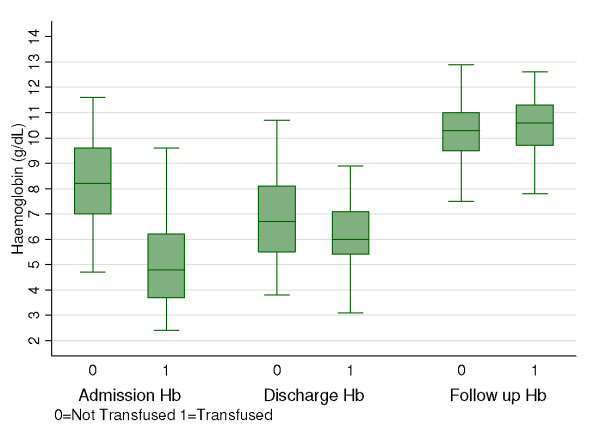
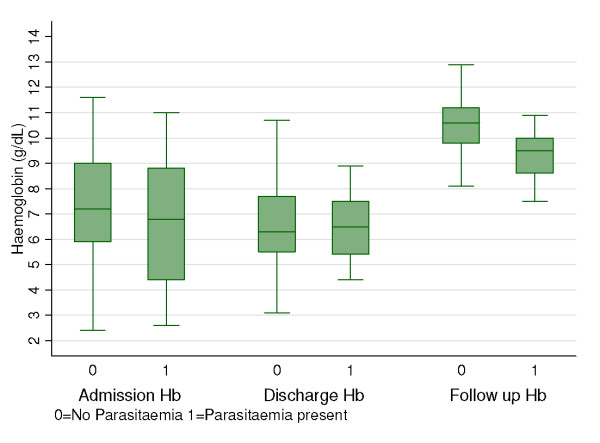
Results: Outcome was assessed in 213 survivors. Those transfused were younger, had a higher base deficit, mean lactate levels and a higher prevalence of respiratory distress. As expected mean admission haemoglobin (Hb) was significantly lower amongst transfused [5.0 g/dL SD: 1.9] compared to non-transfused children [8.3 g/dL SD: 1.7] (p < 0.001). At discharge mean Hb was similar 6.4 g/dL [SD: 1.5] and 6.8 g/dL [SD: 1.6] respectively (p = 0.08), most children remained moderately to severely anaemic. At one month follow up 166 children (78%) returned, in whom we found no differences in mean Hb between the transfused (10.2 g/dL [SD: 1.7]) and non-transfused (10.0 g/dL [SD: 1.3]) survivors (p = 0.25). The major factors affecting haematological recovery were young age (<24 months) and concomitant malaria parasitaemia; Hb being 8.8 g/dL [SD: 1.5] in parasitaemic individuals compared with 10.5 g/dL [SD: 1.3] in those without (p < 0.001).
Conclusion: This data supports the policy of rational use of blood transfusion, as proposed in the WHO guidelines, for children with anaemia in areas where access to emergency transfusion is not guaranteed. We have provided empirical data indicating that transfusion does not influence superior recovery in haemoglobin concentrations and therefore cannot be justified on this basis alone. This may help resolve the disparity between international policy and current clinical practice. Effective anti-malarial treatment at discharge may prevent reoccurrence of anaemia.
Figures
References
-
- Lackritz EM, Hightower AW, Zucker JR, Ruebush TK, 2nd, Onudi CO, Steketee RW, Were JB, Patrick E, Campbell CC. Longitudinal evaluation of severely anemic children in Kenya: the effect of transfusion on mortality and hematologic recovery. Aids. 1997;11:1487–1494. doi: 10.1097/00002030-199712000-00013. - DOI - PubMed
-
- Jager H, N'Galy B, Perriens J, Nseka K, Davachi F, Kabeya CM, Rauhaus G, Peyerl G, Ryder RW, Rehle T. Prevention of transfusion-associated HIV transmission in Kinshasa, Zaire: HIV screening is not enough. Aids. 1990;4:571–574. - PubMed
Publication types
MeSH terms
Substances
Grants and funding
LinkOut - more resources
Full Text Sources
Medical
Research Materials
