. 2008 Dec 30;105(52):20876-81.
doi: 10.1073/pnas.0811203106. Epub 2008 Dec 16.

E3 ligase activity of BRCA1 is not essential for mammalian cell viability or homology-directed repair of double-strand DNA breaks

Affiliations

E3 ligase activity of BRCA1 is not essential for mammalian cell viability or homology-directed repair of double-strand DNA breaks

Latarsha J Reid et al. Proc Natl Acad Sci U S A. .

Abstract

Hereditary cases of breast and ovarian cancer are often attributed to germ-line mutations of the BRCA1 tumor suppressor gene. Although BRCA1 is involved in diverse cellular processes, its role in the maintenance of genomic integrity may be a key component of its tumor suppression activity. The protein encoded by BRCA1 interacts in vivo with the related BARD1 protein to form a heterodimeric complex that acts as a ubiquitin E3 ligase. Because the enzymatic activity of the BRCA1/BARD1 heterodimer is conserved over a broad phylogenetic range, it is thought to be critical for the central functions of BRCA1. To test this hypothesis, we have generated isogenic clones of embryonic stem cells that do or do not express an enzymatically proficient Brca1 polypeptide. Surprisingly, cells lacking the ubiquitin ligase activity of BRCA1 are viable and do not accumulate spontaneous cytogenetic rearrangements. Gene targeting efficiencies are modestly reduced in these cells, and chromosomal rearrangements arise at elevated rates in response to genotoxic stress. Nonetheless, cells lacking Brca1 enzymatic activity are not hypersensitive to the DNA cross-linking agent mitomycin C. They also form Rad51 focus in response to ionizing radiation and repair chromosome breaks by homologous recombination at wild-type levels. These results indicate that key aspects of BRCA1 function in genome maintenance, including its role in homology-directed repair of double-strand DNA breaks, do not depend on the E3 ligase activity of BRCA1.


Conflict of interest statement

The authors declare no conflict of interest.

Figures
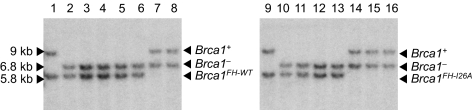
Fig. 1.
Fig. 1.
Isogenic ES cells that express either a wild-type (Brca1FH-WT/−) or enzymatically-deficient (Brca1FH-I26A/−) Brca1 protein. Heterozygous Brca1FH-I26A/+ and Brca1FH-WT/+ ES cells were electroporated with the null targeting construct pBrca1ex2-hyg, and hygromycin-resistant subclones were screened by Southern blot analysis of NcoI-digested genomic DNA with probe B. The introduction of additional NcoI sites in the targeting vectors reduces the 9 kb NcoI germ-line fragment to a 5.8-kb fragment in the Brca1FH-I26A and Brca1FH-WT knock-in alleles and to a 6.8 kb in the null Brca1 allele. Electroporation of Brca1FH-WT/+ cells (lane 1) with pBrca1ex2-hyg generated hygromycin-resistant subclones with either the Brca1FH-WT/+ (lanes 7 and 8) or Brca1FH-WT/− (lanes 2–6) genotypes, whereas electroporation of Brca1FH-I26A/+ cells (lane 9) yielded subclones of the Brca1FH-I26A/+ (lanes 14–16) or Brca1FH-I26A/− (lanes 10–13) genotypes.
Fig. 2.
Fig. 2.
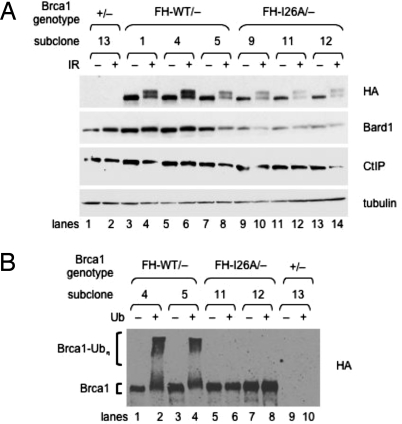
Expression and enzymatic activity of the knock-in FH-Brca1 polypeptides. (A) ES cells were subjected to 10 Gy of IR or left untreated; 2 h later, lysates were prepared from Brca1+/− cells (lanes 1 and 2) and from several independent subclones of Brca1FH-WT/− (lanes 3–8) and Brca1FH-I26A/− (lanes 9–14) cells. The ES cell lysates were then fractionated by PAGE and immunoblotted with antibodies specific for the HA epitope (to detect FH-Brca1 polypeptides), mouse Bard1, mouse Ctip, or α-tubulin. (B) I26A-mutant FH-Brca1 polypeptides from Brca1FH-I26A/− cells lack autoubiquitination activity. Ubiquitination reactions were conducted, in the presence (even lanes) or absence (odd lanes) of ubiquitin, by using FH-Brca1 complexes immunoprecipitated on M2 beads from independent subclones of either Brca1FH-WT/− (lanes 1–4) or Brca1FH-I26A/− (lanes 5–8) knock-in ES cells or from control Brca1+/− ES cells (lanes 9 and 10). The PAGE-fractionated reaction products were then immunoblotted with HA-specific antibodies to reveal autoubiquitinated conjugates of the wild-type (lanes 2 and 4), but not the I26A-mutant (lanes 6 and 8), FH-Brca1 polypeptides.
Fig. 3.
Fig. 3.
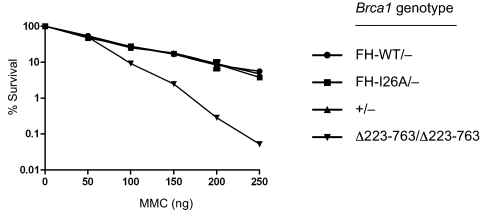
Cells lacking Brca1 enzymatic activity are resistant to MMC-induced genotoxic stress. Isogenic ES cells that are proficient (Brca1FH-WT/−) or deficient (Brca1FH-I26A/−) for Brca1 E3 ligase activity were examined for MMC sensitivity in clonogenic survival assays, together with ES cells homozygous for a hypomorphic Brca1 mutation (Brca1Δ223–763/Δ223–763) and control ES cells (Brca1+/−). Cells were plated and treated with various concentration of MMC for 4 h. After 8–10 days, the surviving colonies were stained with Giemsa and counted. Survival is calculated as a percentage of colonies in the mock-treated plates. Each subclone was tested in triplicate, and the error bars represent SE of the mean of survival for each subclone. Similar results were also observed in separate experiments by using additional independently derived Brca1FH-WT/− and Brca1FH-I26A/− ES subclones.
Fig. 4.
Fig. 4.
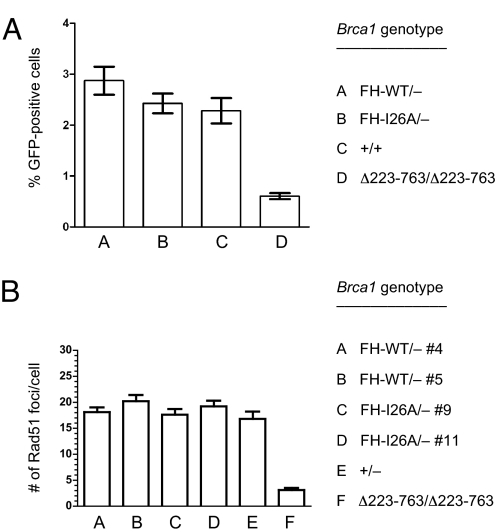
Cells lacking Brca1 enzymatic activity are proficient for HDR of DSBs and assembly of Rad51 nuclear foci in response to DNA damage. (A) Brca1+/+, Brca1FH-WT/−, Brca1FH-I26A/−, and Brca1Δ223–763/Δ223–763 ES subclones containing the DR-GFP substrate integrated into the Pim1 locus were transiently transfected with either the I-SceI expression vector or the empty vector. GFP-positive cells were rarely generated (<0.01%; data not shown) on transfection with the empty vector. I-SceI expression strongly induced the number of GFP-positive cells in the Brca1+/+, Brca1FH-WT/−, and Brca1FH-I26A/− ES subclones, indicating efficient DSB repair by gene conversion, but not in the Brca1Δ223–763/Δ223–763 ES cells, which are known to be deficient in HDR of DSBs (5). Each ES subclone was assayed in triplicate, and the error bars represent SE of the mean. Similar results were also observed in separate experiments by using additional independently derived Brca1FH-WT/− and Brca1FH-I26A/− ES subclones. (B) Brca1FH-WT/−, Brca1FH-I26A/−, Brca1+/−, and Brca1Δ223–763/Δ223–763 ES cells were exposed to IR (10 Gy) and IRIF formation was assessed 3 h later by immunostaining with Rad51-specific antibodies. Rad51-containing IRIFs were counted in 50 nuclei of each genotype, and the error bars represent SE of the mean. IR treatment strongly induced the number of IRIFs in the Brca1FH-WT/−, Brca1FH-I26A/−, and Brca1+/− ES subclones, but not in Brca1Δ223–763/Δ223–763 ES cells, which are known to be deficient for IRIF assembly of Rad51 (24).

References

    1. Wooster R, Weber BL. Breast and ovarian cancer. N Engl J Med. 2003;348:2339–2347. - PubMed
    1. Deng CX. BRCA1: Cell cycle checkpoint, genetic instability, DNA damage response and cancer evolution. Nucleic Acids Res. 2006;34:1416–1426. - PMC - PubMed
    1. Nagaraju G, Scully R. Minding the gap: The underground functions of BRCA1 and BRCA2 at stalled replication forks. DNA Repair (Amsterdam) 2007;6:1018–1031. - PMC - PubMed
    1. Evers B, Jonkers J. Mouse models of BRCA1 and BRCA2 deficiency: Past lessons, current understanding and future prospects. Oncogene. 2006;25:5885–5897. - PubMed
    1. Moynahan ME, Cui TY, Jasin M. Homology-directed DNA repair, mitomycin-c resistance, and chromosome stability is restored with correction of a Brca1 mutation. Cancer Res. 2001;61:4842–4850. - PubMed

Publication types

MeSH terms