


Comment
doi: 10.1038/ni0109-16.
A new function for the RNA-editing enzyme ADAR1
Affiliations
- PMID: 19088736
- PMCID: PMC2945685
- DOI: 10.1038/ni0109-16
Item in Clipboard
Comment
A new function for the RNA-editing enzyme ADAR1
Nat Immunol.
2009 Jan.
Abstract
ADAR1 catalyzes the deamination of adenosine to inosine in double-stranded RNA. This RNA-editing enzyme is now shown to be involved in hematopoiesis, where it acts to suppress interferon signaling and to block premature apoptosis.
Figures
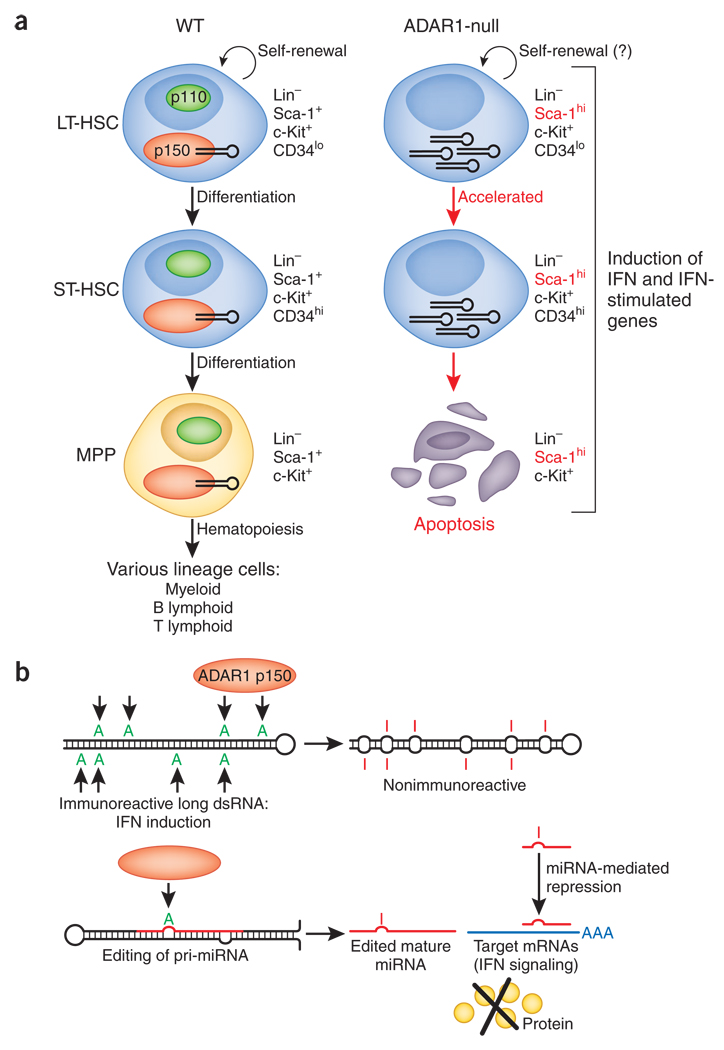
A-to-I RNA editing of an as-yet-unknown dsRNA by ADAR1 is required for the maintenance of HSCs. (a) In the presence of ADAR1, especially the p150 isoform LT-HSCs are able to self-renew (semicircular arrows) differentiate into ST-HSCs and then into MPPs defined by surface expression of lineage markers (Lin), c-Kit, Sca-1 and CD34. In Adar−/− HSCs and MPPs, more interferon and global upregulation of interferon-stimulated genes, including the gene encoding Sca-1, are detected. Unregulated activation of an interferon signaling pathway in Adar−/− HSCs leads to rapid apoptosis after they differentiate into MPPs. The possibility that ADAR1 is required also for the self-renewal of HSCs is not completely eliminated (right question mark). (b) The ADAR1 target dsRNA critical for suppression of the interferon signaling pathway and consequent protection of HSCs is unknown. Among several possible scenarios, two are presented here: A-to-I editing of noncoding long hairpin dsRNA molecules, such as those made from Alu and long interspersed repetitive elements, may decrease their immunoreactive properties (top); alternatively, A-to-I editing of a specific primary transcript of microRNA (pri-miRNA) and consequent expression of a sequence-altered mature microRNA (edited mature miRNA) may lead to silencing of target genes, perhaps those involved in regulating the interferon signaling pathway (bottom).
Comment on
-
ADAR1 is essential for the maintenance of hematopoiesis and suppression of interferon signaling.Nat Immunol. 2009 Jan;10(1):109-15. doi: 10.1038/ni.1680. Epub 2008 Dec 7. Nat Immunol. 2009. PMID: 19060901 Free PMC article.
References
Publication types
MeSH terms
Substances
Grants and funding
LinkOut - more resources
Full Text Sources
