TENS and low-level laser therapy in the management of temporomandibular disorders
- PMID: 19089044
- PMCID: PMC4327455
- DOI: 10.1590/s1678-77572006000200012
TENS and low-level laser therapy in the management of temporomandibular disorders
Abstract
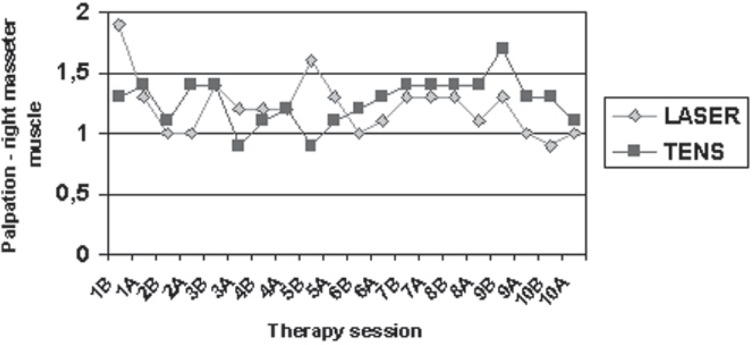
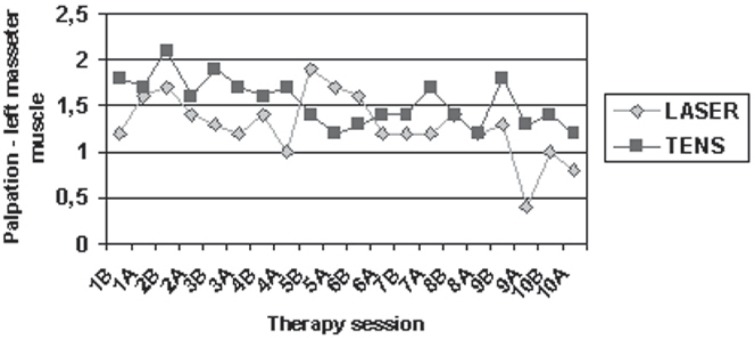
Pain relief and reestablishment of normal jaw function are the main goals of conservative management of Temporomandibular Disorders (TMD). Transcutaneous electrical nerve stimulation (TENS) and laser therapy are part of these modalities, although little is known about their real efficacy in controlled studies. This research compared these two treatments in a sample of 18 patients with chronic TMD of muscular origin, divided into two groups (LASER and TENS). Treatment consisted of ten sessions, in a period of 30 days. Active range of motion (AROM), visual analogue scale (VAS) of pain and muscle (masseter and anterior temporalis) palpation were used for follow-up analysis. Data were analyzed by Friedman test and ANOVA for repeated measurements. Results showed decrease in pain and increase in AROM for both groups (p<0.05), and improvement in muscle tenderness for the LASER group. Authors concluded that both therapies are effective as part of TMD management and a cumulative effect may be responsible for the improvement. Caution is suggested when analyzing these results because of the self-limiting feature of musculoskeletal conditions like TMD.
Otratamento das Disfunções Temporomandibulares (DTM) objetiva ser conservador e reversível para alívio da dor e restauração da função normal. Sendo assim, tratamentos como a estimulação neural elétrica transcutânea (TENS) e o laser de baixa freqüência têm sido utilizados. Portanto, foi premissa deste trabalho a comparação do TENS com o a terapia com laser de baixa freqüência no tratamento de pacientes com DTM. Foram selecionados dezoito pacientes com sinais e sintomas de DTM crônica de origem muscular. O grupo LASER recebeu aplicação de laser e o grupo TENS, estimulação elétrica, totalizando 10 sessões, três vezes por semana, durante um mês. A avaliação foi feita imediatamente antes e 5 minutos após cada sessão terapèutica, por meio da escala de análise visual (EAV) para o registro da sensação de dor mensuração de abertura máxima e palpação muscular (masseter e temporal anterior). Para análise estatística foram utilizados o teste de Friedman e ANOVA para mensurações repetidas. Os resultados demonstraram decréscimo na EAV e aumento da abertura bucal máxima de ambos os grupos (p<0,05). A palpação muscular apresentou diferença significante para o grupo LASER (p<0,05). Baseado na análise da EAV e movimentação ativa, concluiu-se que ambas as terapias propostas foram efetivas no tratamento das DTM, sendo que o efeito acumulativo pode ser o responsável pela melhora obtida. Porém, é sugerida cautela quando se analisa o presente resultado, devido ao aspecto auto-limitante das condições músculo-esqueletais como as DTMs.
Figures


References
-
- Basford JR. Low energy laser therapy: controversies and research findings. Lasers Surg Med. 1989;9:1–5. - PubMed
-
- Bassanta AD, Sprosser JG, Paiva G. Estimulação elétrica neural transcutânea (TENS): sua aplicação nas disfunções temporomandibulares. Rev Odontol Univ São Paulo. 1997;11(2):1–15.
-
- Beckerman H, de Bie RA, Bouter LM, De Cuyper HJ, Oostendorp RA. The efficacy of laser therapy for musculoskeletal and skin disorders: a criteria-based meta-analysis of randomized clinical trials. Phys Ther. 1992;72:483–491. - PubMed
-
- Bezuur NJ, Habets LLMH, Hansson TL. The effect of therapeutic laser treatment on patients with craniomandibular disorders. J Craniomandib Disord. 1988;2:83–86. - PubMed
-
- Boschiero R, Fraccari F, Panacco O. Analysis of the results of the use of the Myomonitor in patients with reduced mouth opening. Minerva Stomat. 1986;35:857–64. - PubMed
LinkOut - more resources
Full Text Sources
Other Literature Sources
Medical