Efficacy of biofilm disclosing agent and of three brushes in the control of complete denture cleansing
- PMID: 19089247
- PMCID: PMC4327299
- DOI: 10.1590/s1678-77572006000600012
Efficacy of biofilm disclosing agent and of three brushes in the control of complete denture cleansing
Abstract
Objective: This report evaluated the efficacy of three brushes and one biofilm disclosing agent in complete denture cleansing.
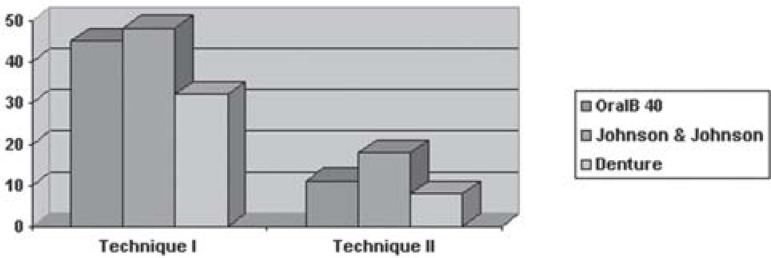
Methods: Twenty-seven wearers of maxillary dentures were distributed into three groups and received different brushes: Oral B40, conventional toothbrush (Oral B); Denture, denture-specific brush (Condor); Johnson & Johnson, denture-specific brush (Johnson & Johnson). The 60-day experimental period was divided into two techniques: I - brushing (brush associated with a paste - Dentu Creme, Dentco) three times a day; II - brushing and daily application of 1% neutral red on the denture internal surface. Biofilm quantification was carried out weekly and the areas with dye biofilm were obtained by means of Image Tool 2.02 software.
Results: Biofilm removal was more effective during Technique II (Wilcoxon test: p=0.01) for the three groups of brushes. When the brushes were compared in Technique I, the Kruskal Wallis test indicated statistical difference between Denture X Johnson & Johnson and Denture X Oral B40, in which the Denture was more efficient. For Technique II, there was no statistical difference between brushes (p>0.05).
Conclusion: The disclosed application promoted more efficacy on biofilm removal, regardless of the brush used. Denture (Condor) was more efficient than the other brushes during Technique I.
Este trabalho avaliou três escovas e um evidenciador de biofilme na higiene de próteses totais. Vinte e sete usuários de próteses totais superiores foram distribuídos em três grupos que receberam diferentes escovas: Oral B40 para dentes naturais (Oral B); Denture para dentadura (Condor) e Johnson & Johnson para dentadura (Johnson & Johnson). O período experimental de 60 dias foi dividido em 2 Técnicas: I - utilização das escovas associadas a um dentifrício (Dentu-Creme, Dentco) três vezes ao dia; II – escovação e aplicação diária do evidenciador Vermelho neutro a 1% na superfície interna da prótese total. A quantificação do biofilme foi realizada semanalmente e as áreas com biofilme corado foram medidas com o auxílio do software Image Tool 2.02. A remoção do biofilme foi mais efetiva durante a Técnica II (teste de Wilcoxon: p=0.01) nos três grupos. Comparando as escovas, na Técnica I o teste de Kruskal Wallis indicou diferença significante (p=0.05) entre Denture X Johnson & Johnson e Denture X OralB 40, sendo a Denture a mais eficaz. Na Técnica II, as escovas não apresentaram diferença estatisticamente significante (p>0,05). A aplicação do evidenciador promoveu maior eficácia na remoção do biofilme, independentemente da escova utilizada. Na comparação das escovas na Técnica I, a escova Denture foi a mais eficiente.
Figures
References
-
- Abelson DC. Denture plaque and denture cleansers: review of the literature. Gerodontics. 1985;1:202–206. - PubMed
-
- Ambjornsen E, Valderhaug J, Norheim PW, Floystrand F. Assessment of an additive index for plaque accumulation on complete maxillary dentures. Acta Odontol Scand. 1982;40:203–208. - PubMed
-
- Andruciolli MCD, Macedo LD, Lara EHG, Panzeri H, Paranhos HFO. Avaliação de pasta higienizadora de próteses totais sobre o biofilme dentadura em pacientes com estomatite de dentadura. Pesqui Odontol Bras. 2002;16:84–84.
-
- Budtz–Jørgensen E. The significance of Candida albicans in denture stomatitis. Scand J Dent Res. 1974;82:151–190. - PubMed
-
- Budtz-JÆRgensen E, Kelstrup J. Enzyme as a denture cleansers. Scand J Dent Res. 1977;58:209–215. - PubMed
LinkOut - more resources
Full Text Sources
Medical