


Prevalence and trends of receipt of cancer screenings among US women with diagnosed diabetes
- PMID: 19089511
- PMCID: PMC2628996
- DOI: 10.1007/s11606-008-0858-8
Prevalence and trends of receipt of cancer screenings among US women with diagnosed diabetes
Abstract
Background: Diabetes increases the risk of breast and colorectal cancers and has an undetermined relationship to cervical cancer. Improved screenings for these cancers are effective in reducing cancer mortality.
Objectives: To examine the prevalence of receiving recommended screenings for these cancers and to assess the trends in the screening rates over time among US women with diagnosed diabetes in comparison with women without diabetes.
Design: Cross-sectional.
Participants: A total of 63,650 to 182,168 adult women participated in the 1996-2006 (biennially) Behavioral Risk Factor Surveillance System.
Methods: The prevalence of receiving cancer screenings was age-standardized to the 2000 US population. The adjusted prevalence and adjusted odds ratios (AORs) with 95% confidence intervals (CIs) were estimated using logistic regression analyses. The linear trends in the screening rates were tested using orthogonal polynomial contrasts.
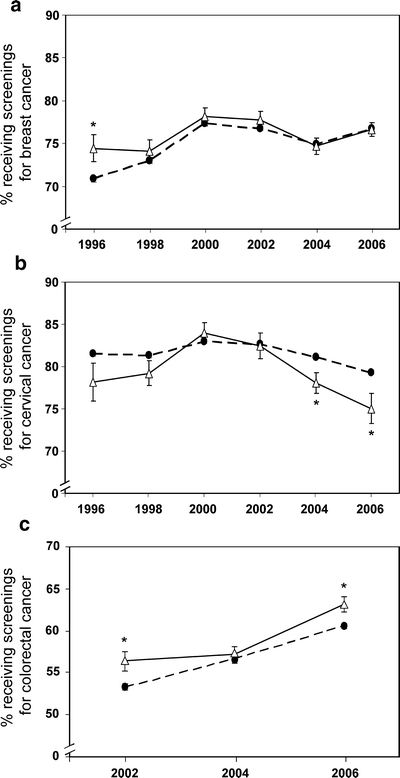
Results: In 2006, women with diabetes had a lower adjusted prevalence (74% versus 79%, P < 0.05) and the AOR (0.73, 95% CI: 0.66-0.81) for receiving cervical cancer screenings, but had a higher adjusted prevalence (63% versus 60%, P < 0.05) and the AOR (1.14, 95% CI: 1.04-1.24) for receiving colorectal cancer screenings compared to those without. In both women with diabetes and those without, the screening rate for colorectal cancer increased linearly during 2002-2006, whereas the screening rates for breast and cervical cancers changed little during 1996-2006.
Conclusion: Women with diabetes were equally likely to be screened for breast cancer, less likely to be screened for cervical cancer, but more likely to be screened for colorectal cancer compared to those without. Overall, the screening rates in both groups remain below the recommended levels.
Figures
References
-
- American Cancer Society. Cancer Statistics 2007. Available at URL:http://www.cancer.org/downloads/STT/Cancer_Statistics_Combined_2007.ppt#... Accessed Nov. 12, 2008.
Publication types
MeSH terms
LinkOut - more resources
Full Text Sources
Medical
