


Temporomandibular joint and muscle disorder-type pain in U.S. adults: the National Health Interview Survey
- PMID: 19090404
- PMCID: PMC4357589
Temporomandibular joint and muscle disorder-type pain in U.S. adults: the National Health Interview Survey
Abstract
Aims: To compare prevalences of self-reported temporomandibular joint and muscle disorders (TMJMD)-type pain in the 2002 U.S. National Health Interview Survey (NHIS) by age and gender for non-Hispanic whites (Caucasians) and non-Hispanic blacks (African Americans).
Methods: Data from the 2002 NHIS included information on gender, age, race, ethnicity, education, and TMJMD-type pain. Rao-Scott survey chi-square and survey logistic regression analyses using sampling weights and accounting for the complex design were used to analyze variables relating to prevalences.
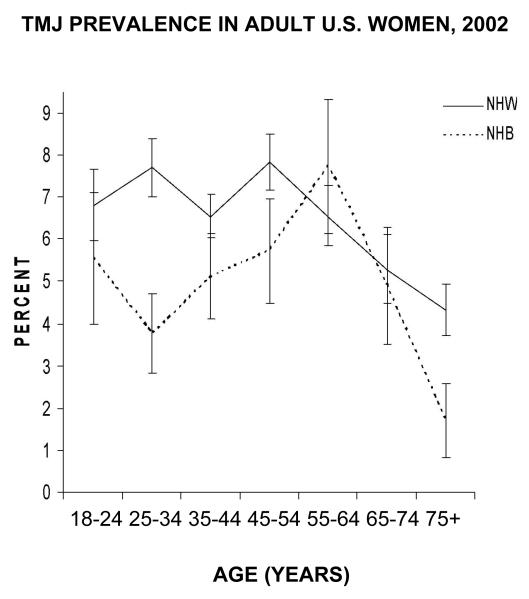
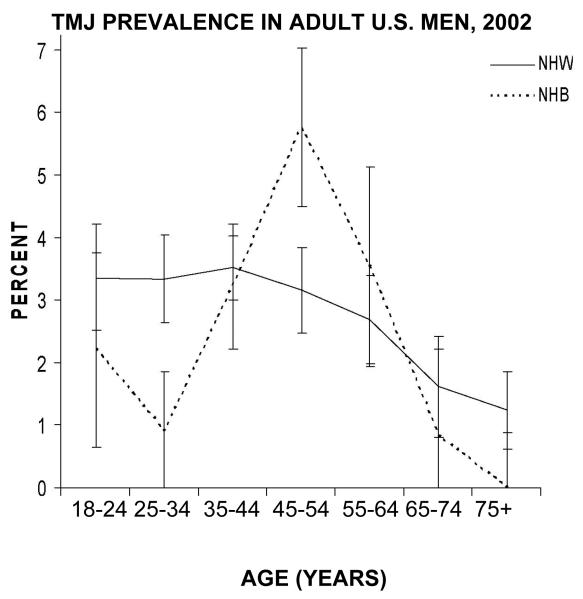
Results: A total of 30,978 people, 17,498 females and 13,480 males, 20,389 non-Hispanic whites and 4179 non-Hispanic blacks, were included. The overall prevalence of TMJMD-type pain was 4.6%, with 6.3% for women and 2.8% for men. However, based on age, a significant but modest racial/ethnic difference emerged after adjusting for socioeconomic status. For non-Hispanic white women up to age 50, the prevalence was approximately 7% to 8%, but it decreased after age 55. Non-Hispanic black women had much lower prevalence at younger ages (approximately 4% at 25 to 34 years), which increased thereafter up to 55 to 64 years of age. A similar racial pattern seemed to emerge for non-Hispanic black men, with the lowest prevalence at ages 25 to 34 years, while non-Hispanic white men had higher prevalences. Overall, however, age seemed to play more of a role in women than men.
Conclusion: This is the first report of findings from a nationally representative US sample for TMJMD-type pain by age and race/ethnicity. TMJMD-type pain differed significantly by race, age, and gender after adjusting for socioeconomic status.
Figures
References
-
- Dworkin SF, Huggins KH, LeResche L. Epidemiology of signs and symptoms in temporomandibular disorders: Clinical signs in cases and controls. J Am Dent Assoc. 1990;120:273–281. - PubMed
-
- Dworkin SF, LeResche L, editors. Research Diagnostic Criteria for Temporomandibular Disorders: Review, criteria, examinations and specifications, critique. J Craniomandib Disord. 1992;6:301–355. - PubMed
-
- LeResche L. Epidemiology of temporomandibular disorders: Implications for the investigation of etiological factors. Crit Rev Oral Bioi Med. 1997;8:291–305. - PubMed
-
- Goulet J-P, Levigne GJ, Lund JP. Jaw pain prevalence among French-speaking Canadians in Quebec and related symptoms of temporomandibular disorders. J Dent Res. 1995;74:1738–1744. - PubMed
-
- List T, Dworkin SF. Comparing TMD diagnoses and clinical findings at Swedish and US TMD Centers using research diagnostic criteria for temporomandibular disorders. J Orofac Pain. 1996;10:240–253. - PubMed
Publication types
MeSH terms
Grants and funding
LinkOut - more resources
Full Text Sources
Medical