


doi: 10.1021/nl8032476.
Synergistic effects of mutations and nanoparticle templating in the self-assembly of cowpea chlorotic mottle virus capsids
Affiliations
- PMID: 19090695
- PMCID: PMC2753382
- DOI: 10.1021/nl8032476
Item in Clipboard
Synergistic effects of mutations and nanoparticle templating in the self-assembly of cowpea chlorotic mottle virus capsids
Nano Lett.
2009 Jan.
Abstract
A study of the in vitro nanoparticle-templated assembly of a mutant of cowpea chlorotic mottle virus lacking most of the N-terminal domain (residues 4-37), NDelta34, is presented. Mutant empty proteins assemble into empty capsids with a much broader distribution of sizes than the wild-type virus. This increased flexibility in the assembly outcomes is known to be detrimental for the assembly process in the presence of molecular polyanions. However, when rigid polyanionic cores are used, such as nanoparticles, the assembly process is restored and virus-like particles form. Moreover, the breadth of the nanoparticle-templated capsid size distribution becomes comparable with the wild-type virus size distribution.
Figures
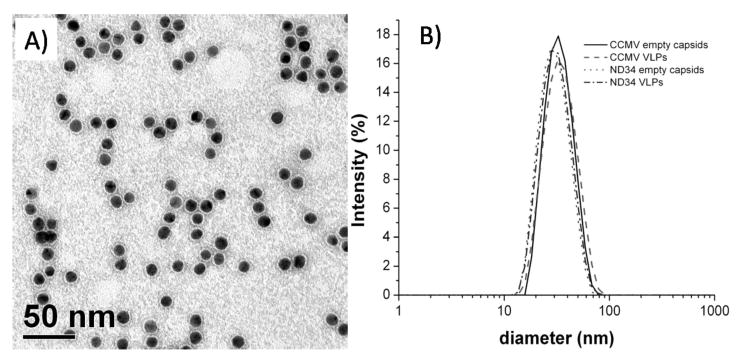
Formation of NΔ34 and CCMV VLPs using TEG-coated gold nanoparticles cores. (A) TEM image of 11.7 nm TEG-coated gold nanoparticles. The particles are stained with 2% uranyl acetate making the PEG layer visible. Scale bar: 50 nm. (B) Dynamic light scattering (DLS) intensity plots of empty and gold-encapsulating wt and mutant capsids taken at 10 °C.
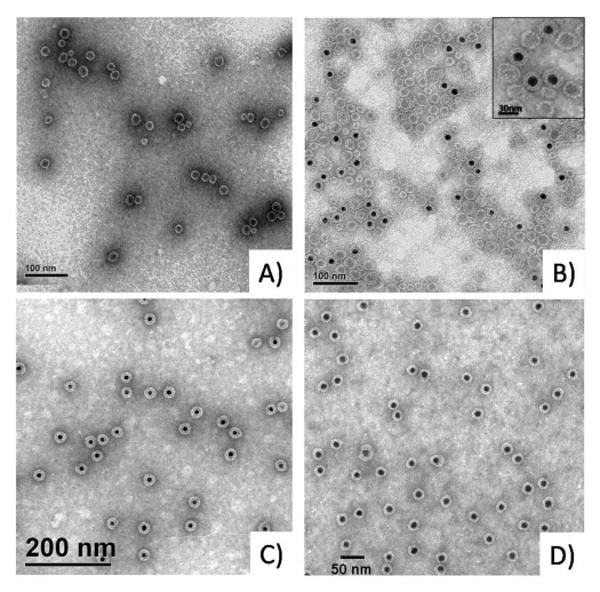
TEM pictures of assembly products: (A) Empty NΔ34 capsids showing significant size variability. (B) NΔ34 VLPs from an unpurified assembly reaction showing incorporation of gold cores although at a lower efficiency. Inset: higher magnification micrograph for a more detailed view of the complexes. (C) VLPs from an unpurified assembly reaction with wild-type CCMV capsid. (D) NΔ34 VLPs purified over a sucrose density gradient.
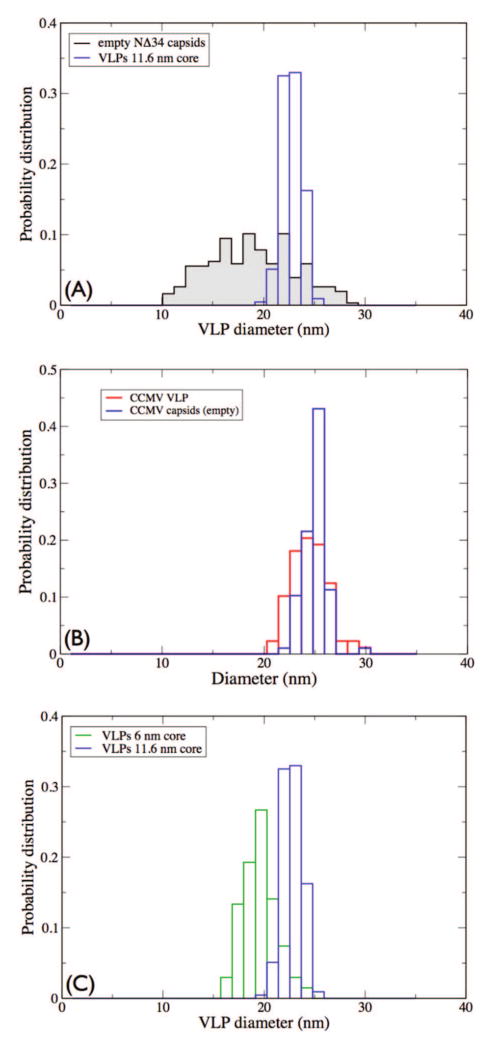
Probability distributions of diameters for empty and nanoparticle-encapsulating capsids: (A) mutant complexes showing a broader variation for empty capsids (solid) compared to VLPs; (B) wild-type empty capsids (solid) and VLPs (11.6 nm core) with similar size distributions; (C) mutant VLP complexes with 11.6 and 6 nm cores indicating the effect on the mean diameter of the complexes of varying the core size.
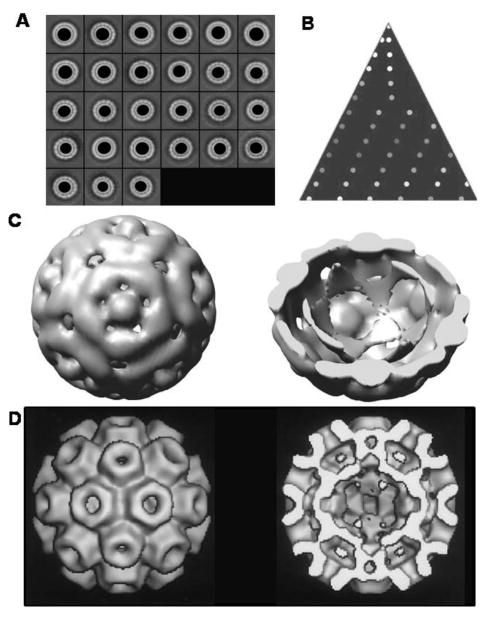
Negative-stain TEM reconstruction of the VLPs formed by NΔ34. (A) Class averages generated from ∼3800 VLPs formed with the 11.7 nm cores.(B) An asymmetric triangle depicting anisotropy with regards to the sampling of the 3D space. (C) 3D reconstruction of the VLPs formed with 11.7 nm showing the pentamer. The surface rendering threshold was set to correspond to a molecular mass of 240 kDa. The model to the right shows a cut-away structure of the VLP. (D) The structure of the CCMV particle generated by Wikoff et al.
References
-
- Suttle CA. Viruses in the sea. Nature. 2005;437:356–361. - PubMed
-
- Casjens S, editor. Virus Structure and Assembly. Jones and Bartlett; Boston: 1985.
-
- Edelstein ML, Abedi MR, Wixon J, Edelstein RM. Gene therapy clinical trials worldwide 1989–2004–an overview. J Gene Med. 2004;6:597–602. - PubMed
-
- Kumar M, Hellermann G, Lockey RF, Mohapatra SS. Nanoparticle-mediated gene delivery: state of the art. Expert Opin Biol Ther. 2004;4:1213–1224. - PubMed
Publication types
MeSH terms
Substances
Grants and funding
LinkOut - more resources
Full Text Sources
