


Oral detection of short-, medium-, and long-chain free fatty acids in humans
- PMID: 19091695
- PMCID: PMC2639481
- DOI: 10.1093/chemse/bjn072
Oral detection of short-, medium-, and long-chain free fatty acids in humans
Abstract
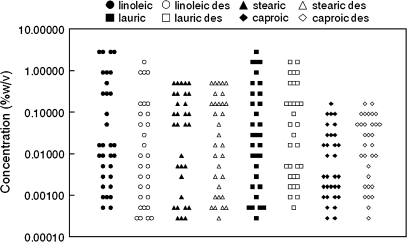
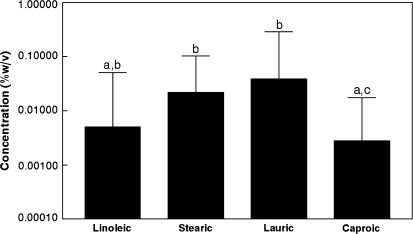
There is increasing evidence supporting an oral chemosensory detection system for free fatty acids (FFA). The presumptive transduction mechanisms have different ligand specificities. Psychophysical studies with FFA varying in chain length and saturation may aid in identifying the presence and functionality of these mechanisms in humans. Oral detection thresholds were measured for linoleic, stearic, lauric, and caproic acids in 32 healthy adults by an ascending, 3-alternative, forced-choice, sip and spit procedure. Thresholds were obtained for all fatty acids from all participants, but the distributions were wide and nonnormal. Thresholds were not correlated between fatty acids nor with thresholds for sucrose (taste), butanol (olfactory), mineral oil, or gum acacia (both somatosensory). These data demonstrate human oral sensitivity to short-, medium-, and long-chain FFA and suggest the presence of multiple transduction mechanisms. The findings are consistent with, but do not definitively demonstrate, a role for taste that may have a genetic basis.
Figures
References
-
- Aponte GW, Fink AS, Meyer JH, Tatemoto K, Taylor IL. Regional distribution of release of peptide YY with fatty acids of different chain length. Am J Physiol. 1985;249:G745–G750. - PubMed
-
- Bertran E, Blanco M, Doello J, Iturriaga H, Maspoch S, Montoliu I. Determination of olive oil free fatty acid by fourier transform infrared spectroscopy. J Am Oil Chem Soc. 1999;76:611–616.
-
- Briscoe CP, Tadayyon M, Andrews JL, Benson WG, Chambers JK, Eilert MM, Ellis C, Elshourbagy NA, Goetz AS, Minnick DT, et al. The orphan G protein-coupled receptor GPR40 is activated by medium and long chain fatty acids. J Biol Chem. 2003;278:11303–11311. - PubMed
-
- Brown AJ, Goldsworthy SM, Barnes AA, Eilert MM, Teheang L, Daniels D, Muir AI, Wigglesworth IK, Fraser NJ, Pike NB, et al. The orphan G protein-coupled receptors GPR 41 and GPR 43 are activated by propionate and other short chain carboxylic acids. J Biol Chem. 2003;278:11312–11319. - PubMed
-
- Chale-Rush A, Burgess JR, Mattes RD. Evidence for human orosensory (taste?) sensitivity to free fatty acids. Chem Senses. 2007a;32:423–431. - PubMed
Publication types
MeSH terms
Substances
Grants and funding
LinkOut - more resources
Full Text Sources
Medical
Miscellaneous
