


Precision and recall estimates for two-hybrid screens
- PMID: 19091773
- PMCID: PMC2639075
- DOI: 10.1093/bioinformatics/btn640
Precision and recall estimates for two-hybrid screens
Abstract
Motivation: Yeast two-hybrid screens are an important method to map pairwise protein interactions. This method can generate spurious interactions (false discoveries), and true interactions can be missed (false negatives). Previously, we reported a capture-recapture estimator for bait-specific precision and recall. Here, we present an improved method that better accounts for heterogeneity in bait-specific error rates.
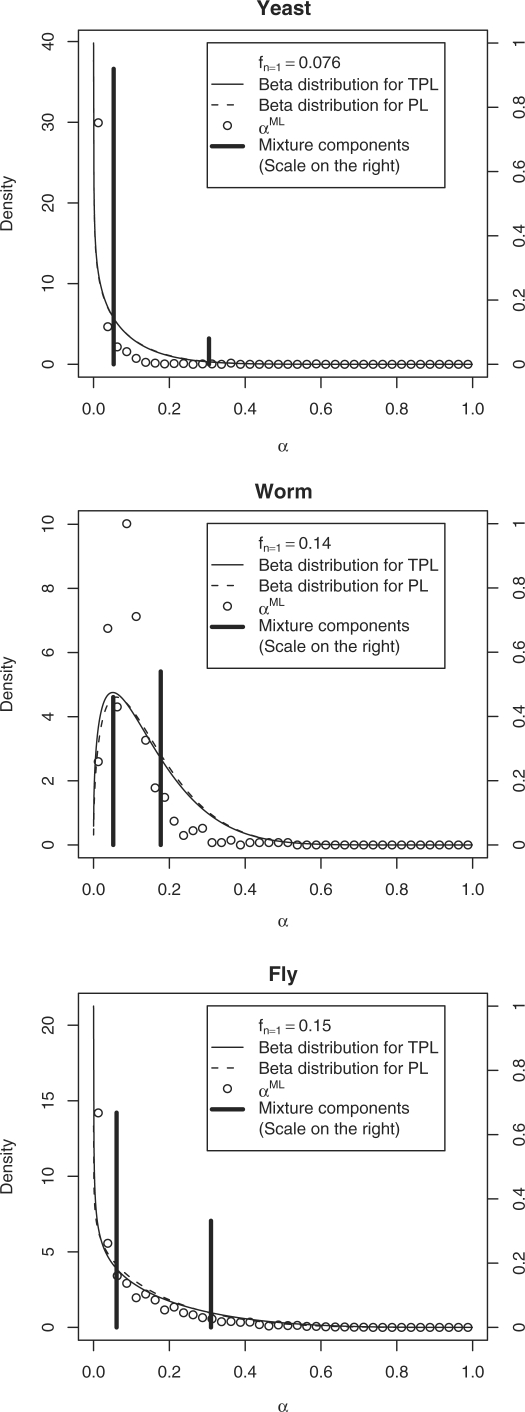
Result: For yeast, worm and fly screens, we estimate the overall false discovery rates (FDRs) to be 9.9%, 13.2% and 17.0% and the false negative rates (FNRs) to be 51%, 42% and 28%. Bait-specific FDRs and the estimated protein degrees are then used to identify protein categories that yield more (or fewer) false positive interactions and more (or fewer) interaction partners. While membrane proteins have been suggested to have elevated FDRs, the current analysis suggests that intrinsic membrane proteins may actually have reduced FDRs. Hydrophobicity is positively correlated with decreased error rates and fewer interaction partners. These methods will be useful for future two-hybrid screens, which could use ultra-high-throughput sequencing for deeper sampling of interacting bait-prey pairs.
Availability: All software (C source) and datasets are available as supplemental files and at http://www.baderzone.org under the Lesser GPL v. 3 license.
Figures
References
-
- Bader JS, Chant J. Systems biology. When proteomes collide. Science. 2006;311:187–188. - PubMed
-
- Cornette JL, et al. Hydrophobicity scales and computational techniques for detecting amphipathic structures in proteins. J. Mol. Biol. 1987;195:659–685. - PubMed
-
- Deane CM, et al. Protein interactions: two methods for assessment of the reliability of high throughput observations. Mol. Cell Proteomics. 2002;1:349–356. - PubMed
Publication types
MeSH terms
Substances
Grants and funding
LinkOut - more resources
Full Text Sources
Molecular Biology Databases
