


Adjustments of motor pattern for load compensation via modulated activations of muscle synergies during natural behaviors
- PMID: 19091930
- PMCID: PMC2666413
- DOI: 10.1152/jn.01387.2007
Adjustments of motor pattern for load compensation via modulated activations of muscle synergies during natural behaviors
Abstract
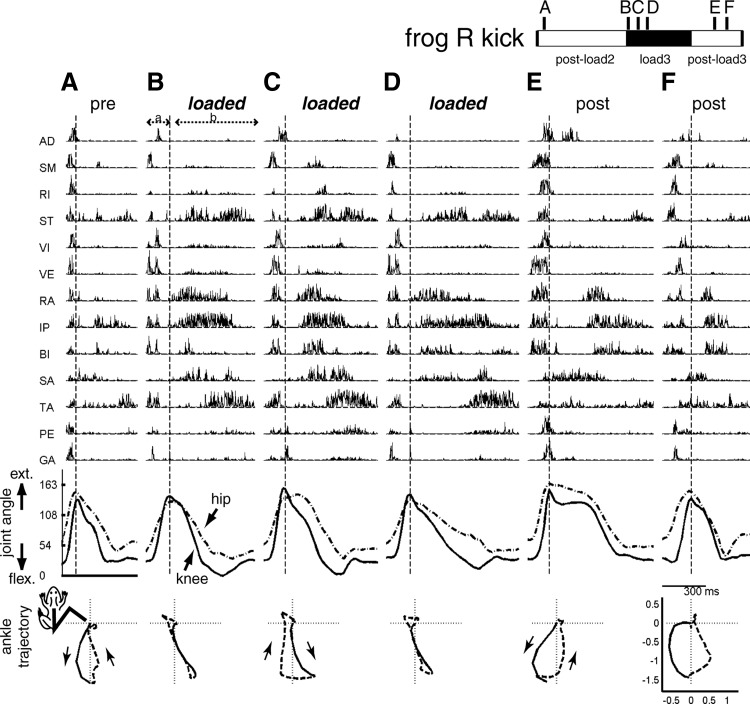
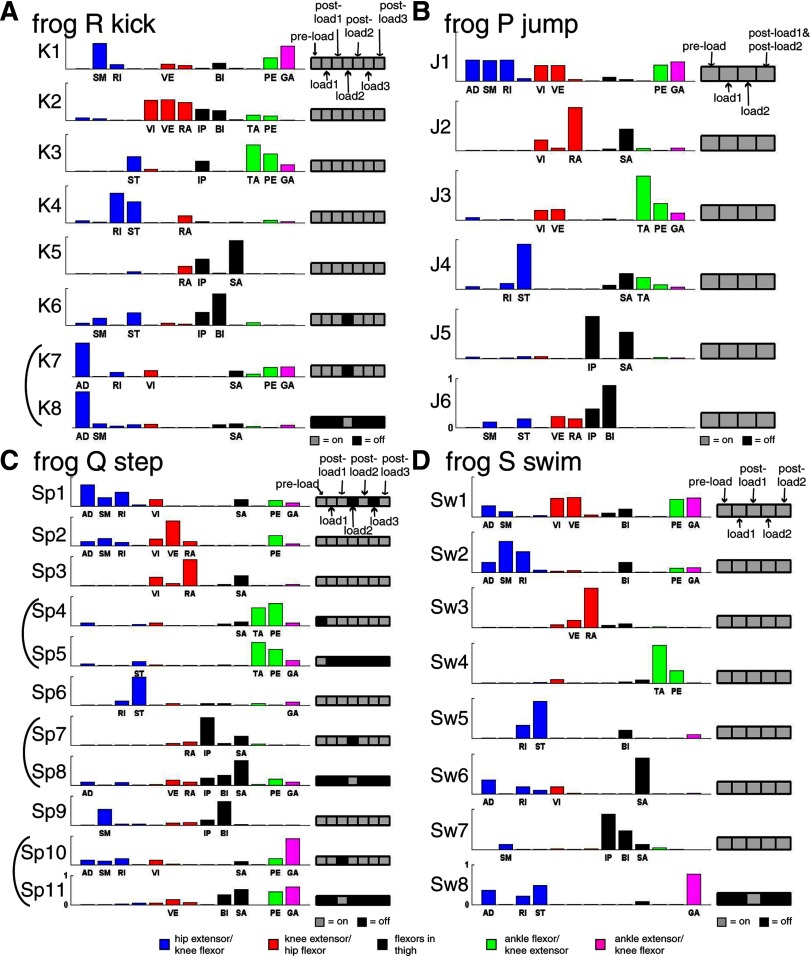
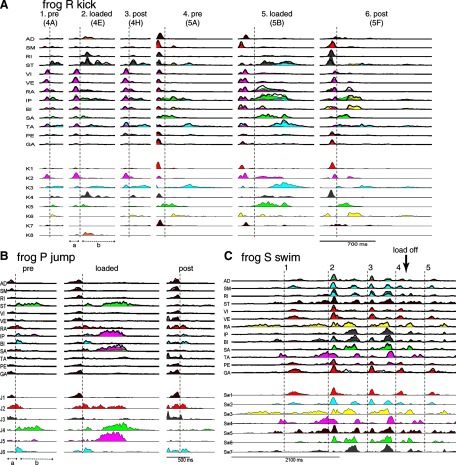
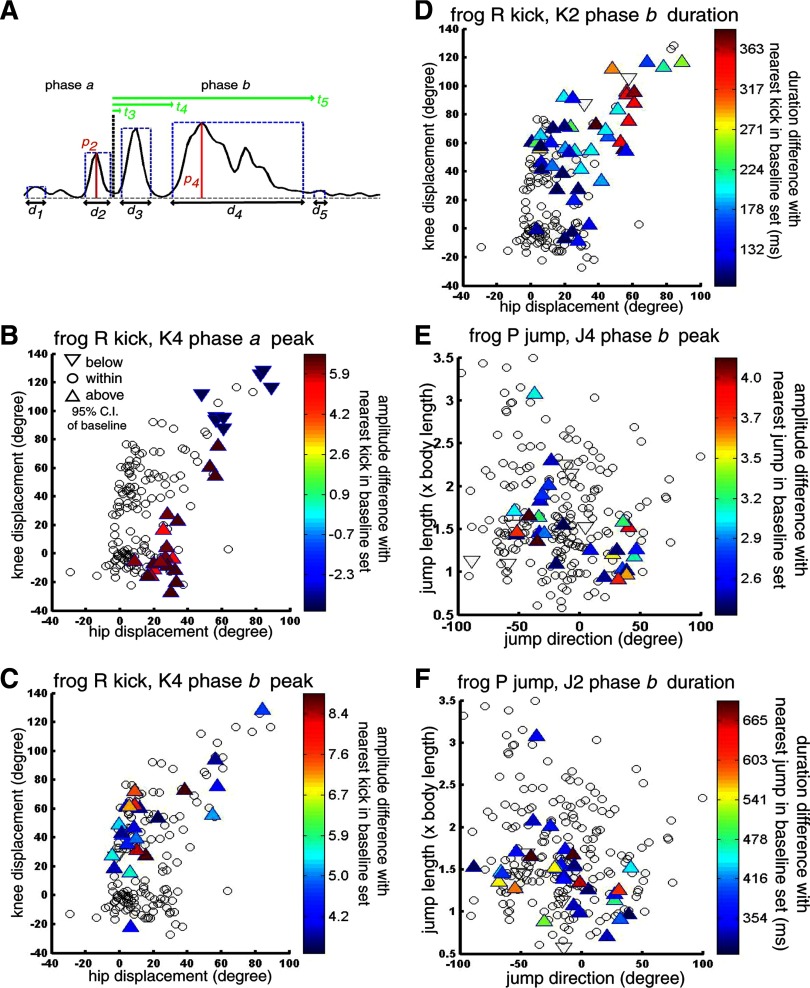
It has been suggested that the motor system may circumvent the difficulty of controlling many degrees of freedom in the musculoskeletal apparatus by generating motor outputs through a combination of discrete muscle synergies. How a discretely organized motor system compensates for diverse perturbations has remained elusive. Here, we investigate whether motor responses observed after an inertial-load perturbation can be generated by altering the recruitment of synergies normally used for constructing unperturbed movements. Electromyographic (EMG, 13 muscles) data were collected from the bullfrog hindlimb during natural behaviors before, during, and after the same limb was loaded by a weight attached to the calf. Kinematic analysis reveals the absence of aftereffect on load removal, suggesting that load-related EMG changes were results of immediate motor pattern adjustments. We then extracted synergies from EMGs using the nonnegative matrix factorization algorithm and developed a procedure for assessing the extent of synergy sharing across different loading conditions. Most synergies extracted were found to be activated in all loaded and unloaded conditions. However, for certain synergies, the amplitude, duration, and/or onset time of their activation bursts were up- or down-modulated during loading. Behavioral parameterizations reveal that load-related modulation of synergy activations depended on the behavioral variety (e.g., kick direction and amplitude) and the movement phase performed. Our results suggest that muscle synergies are robust across different dynamic conditions and immediate motor adjustments can be accomplished by modulating synergy activations. An appendix describes the novel procedure we developed, useful for discovering shared and specific features from multiple data sets.
Figures
References
-
- Bernstein N The Co-ordination and Regulation of Movements. Oxford, UK: Pergamon, 1967.
-
- Bizzi E, Hogan N, Mussa-Ivaldi FA, Giszter S. Does the nervous system use equilibrium-point control to guide single and multiple joint movements? Behav Brain Sci 15: 603–613, 1992. - PubMed
-
- Bizzi E, Mussa-Ivaldi FA, Giszter S. Computations underlying the execution of movement: a biological perspective. Science 253: 287–291, 1991. - PubMed
-
- Burke RE The use of state-dependent modulation of spinal reflexes as a tool to investigate the organization of spinal interneurons. Exp Brain Res 128: 263–277, 1999. - PubMed
-
- Cajigas-González I Linear Control Model of the Spinal Processing of Descending Neural Signals (Masters thesis). Cambridge, MA: Massachusetts Institute of Technology, 2003.
Publication types
MeSH terms
Grants and funding
LinkOut - more resources
Full Text Sources
Medical
