First morning voids are more reliable than spot urine samples to assess microalbuminuria
- PMID: 19092125
- PMCID: PMC2637059
- DOI: 10.1681/ASN.2008030292
First morning voids are more reliable than spot urine samples to assess microalbuminuria
Abstract
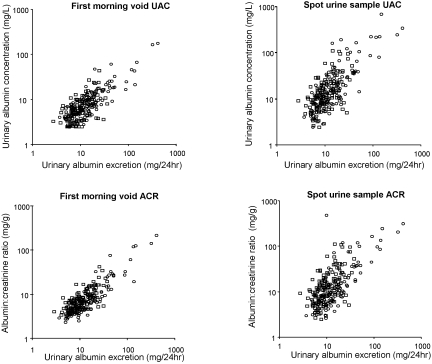
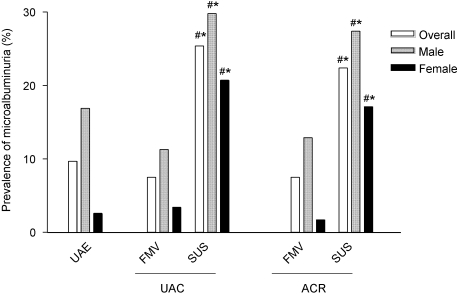
Measurement of urinary albumin excretion (UAE) in a 24-h collection is the gold standard method to determine the presence of microalbuminuria. We sought to compare more practical alternatives--measurement of urinary albumin concentration (UAC) or albumin:creatinine ratio (ACR)--in a first morning void or in a spot urine sample with this gold standard. We asked 241 participants of a prospective cohort study to make three 24-h urine collections, a first morning void, and a spot urine sample. Regression analysis showed that the ACR in a first morning void best agreed with 24-h UAE. The prevalence of microalbuminuria determined by data from a first morning void (7.5%, whether by UAC or ACR) nearly equaled the prevalence of microalbuminuria determined by 24-h UAE (10.0%), whereas the prevalence was higher when determined by spot urine samples (25.4% for UAC and 22.4% for ACR; both P < 0.001 versus 24-h UAE). The intraindividual coefficients of variation of the ACR in a first morning void and 24-h UAE were similar (19%). Intraindividual coefficients of variations of all other measurements of albuminuria were significantly greater. In conclusion, measurement of albuminuria in a first morning void, preferably as the ACR, is more reliable than a spot urine sample to diagnose and monitor microalbuminuria.
Figures
References
-
- Keane WF, Eknoyan G: Proteinuria, albuminuria, risk, assessment, detection, elimination (PARADE): A position paper of the National Kidney Foundation. Am J Kidney Dis 33: 1004–1010, 1999 - PubMed
-
- Chobanian AV, Bakris GL, Black HR, Cushman WC, Green LA, Izzo JL Jr, Jones DW, Materson BJ, Oparil S, Wright JT Jr, Roccella EJ: The Seventh Report of the Joint National Committee on Prevention, Detection, Evaluation, and Treatment of High Blood Pressure: The JNC 7 report. JAMA 289: 2560–2572, 2003 - PubMed
-
- National Kidney Foundation: K/DOQI clinical practice guidelines for chronic kidney disease: Evaluation, classification, and stratification. Am J Kidney Dis 39: S1–266, 2002 - PubMed
-
- American Diabetes Association: Standards of medical care in diabetes—2007. Diabetes Care 30[Suppl 1]: S4–S41, 2007 - PubMed
-
- Mogensen CE, Vestbo E, Poulsen PL, Christiansen C, Damsgaard EM, Eiskjaer H, Froland A, Hansen KW, Nielsen S, Pedersen MM: Microalbuminuria and potential confounders: A review and some observations on variability of urinary albumin excretion. Diabetes Care 18: 572–581, 1995 - PubMed
MeSH terms
Substances
LinkOut - more resources
Full Text Sources
Medical
Miscellaneous