Editorial
doi: 10.1056/NEJMe0808667.
MicroRNA in cancer prognosis
- PMID: 19092157
- PMCID: PMC10035200
- DOI: 10.1056/NEJMe0808667
Item in Clipboard
Editorial
MicroRNA in cancer prognosis
N Engl J Med.
.
No abstract available
Conflict of interest statement
Dr. Slack reports holding two pending patents for the use of microRNAs as potential therapeutic and diagnostic markers in cancer, and Dr. Weidhaas, two pending patents for the use of microRNAs in predicting the risk of ovarian cancer and response to chemotherapy. No other potential conflict of interest relevant to this article was reported.
Figures
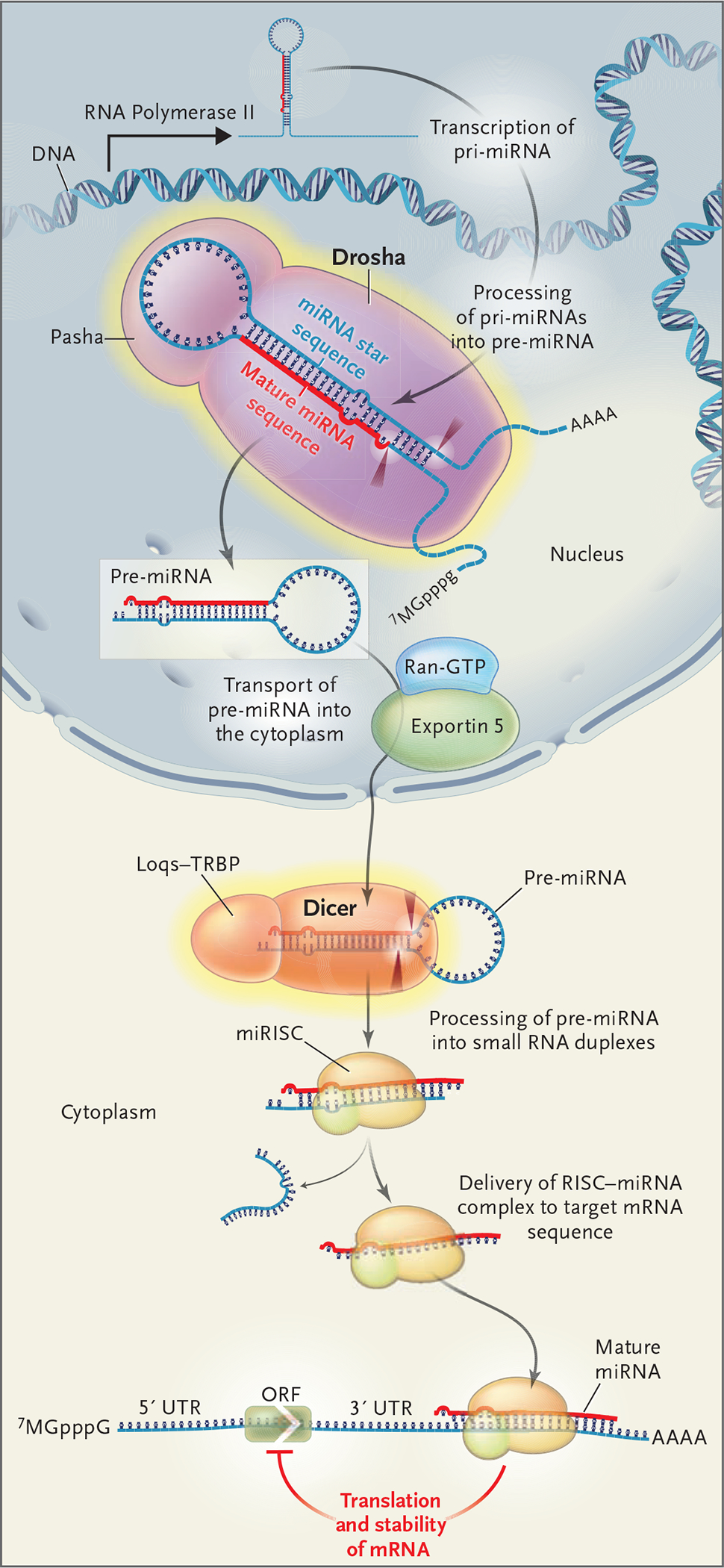
Pri-miRNAs, large miRNA precursors, are transcribed from the genome by RNA polymerase II and fold into a hairpin structure that is the substrate for RNA processing by Drosha (cleavage sites shown as dark red arrows) to a pre-miRNA. Pre-miRNAs enter the cytoplasm, where they are further processed by Dicer (and its partner, Loqs–TRBP), resulting in an RNA duplex containing the mature miRNA and the miRNA star sequences. The mature miRNA preferentially enters the miRNA-associated, multiprotein RNA–induced silencing complex (miRISC) and guides it to partially complementary sequences in target messenger RNA (mRNA), leading to repression of their translation. AAAA represents the poly-A tail, and MGpppG denotes the 5′ cap. ORF denotes open reading frame, Ran-GTP Ran guanosine triphosphate, and UTR untranslated region.
Comment on
-
Dicer, Drosha, and outcomes in patients with ovarian cancer.N Engl J Med. 2008 Dec 18;359(25):2641-50. doi: 10.1056/NEJMoa0803785. N Engl J Med. 2008. PMID: 19092150 Free PMC article.
References
-
- Chi DS, Palayekar MJ, Sonoda Y, et al. Nomogram for survival after primary surgery for bulky stage IIIC ovarian carcinoma. Gynecol Oncol 2008;108:191–4. - PubMed
-
- Esquela-Kerscher A, Slack FJ. Oncomirs — microRNAs with a role in cancer. Nat Rev Cancer 2006;6:259–69. - PubMed
-
- Bartel DP. MicroRNAs: genomics, biogenesis, mechanism, and function. Cell 2004;116:281–97. - PubMed
-
- Lagos-Quintana M, Rauhut R, Lendeckel W, Tuschl T. Identification of novel genes coding for small expressed RNAs. Science 2001;294:853–8. - PubMed
Publication types
MeSH terms
Substances
Grants and funding
LinkOut - more resources
Full Text Sources
Other Literature Sources
Medical