


CB1 expression is attenuated in Fallopian tube and decidua of women with ectopic pregnancy
- PMID: 19093002
- PMCID: PMC2601032
- DOI: 10.1371/journal.pone.0003969
CB1 expression is attenuated in Fallopian tube and decidua of women with ectopic pregnancy
Abstract
Background: Embryo retention in the Fallopian tube (FT) is thought to lead to ectopic pregnancy (EP), a considerable cause of morbidity. In mice, genetic/pharmacological silencing of cannabinoid receptor Cnr1, encoding CB1, causes retention of embryos in the oviduct. The role of the endocannabinoids in tubal implantation in humans is not known.
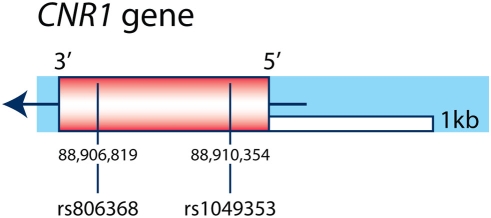
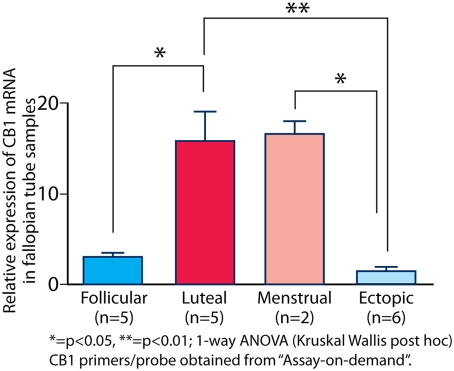
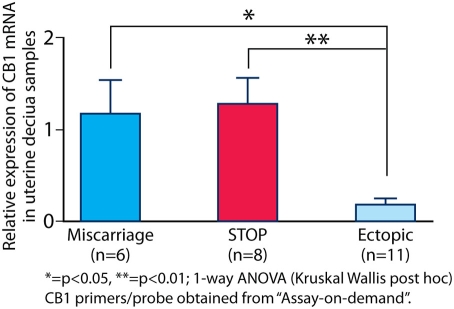
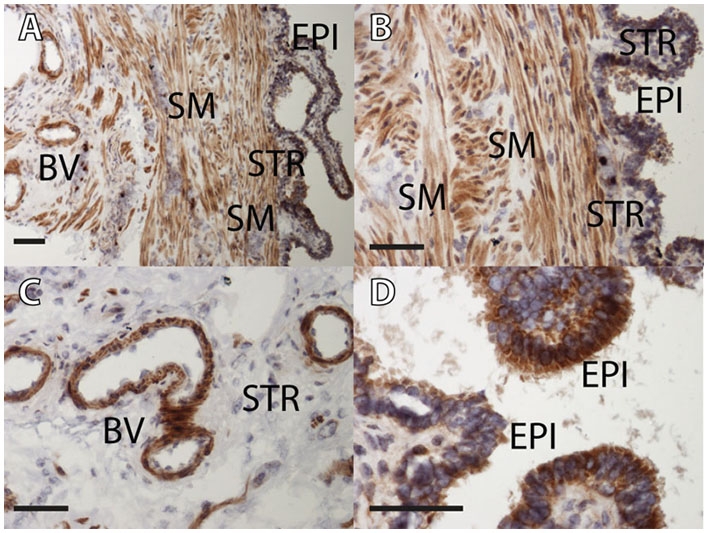
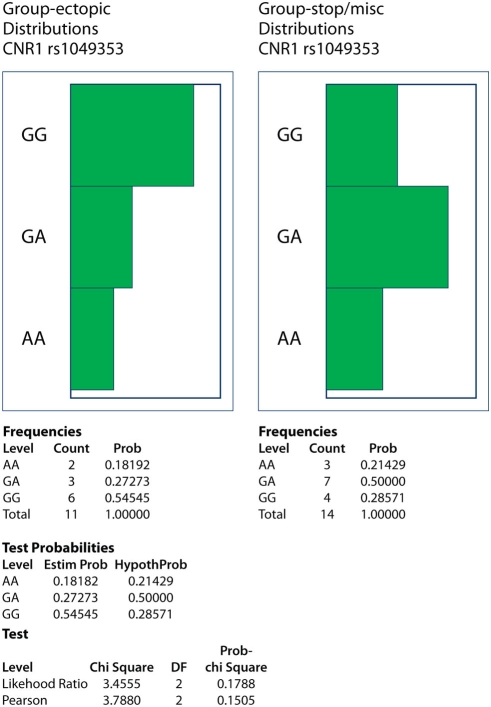
Methods and findings: Timed FT biopsies (n = 18) were collected from women undergoing gynecological procedures for benign conditions. Endometrial biopsies and whole blood were collected from women undergoing surgery for EP (n = 11); management of miscarriage (n = 6), and termination of pregnancy (n = 8). Using RT-PCR and immunohistochemistry, CB1 mRNA and protein expression levels/patterns were examined in FT and endometrial biopsies. The distribution of two polymorphisms of CNR1 was examined by TaqMan analysis of genomic DNA from the whole blood samples. In normal FT, CB1 mRNA was higher in luteal compared to follicular-phase (p<0.05). CB1 protein was located in smooth muscle of the wall and of endothelial vessels, and luminal epithelium of FT. In FT from women with EP, CB1 mRNA expression was low. CB1 mRNA expression was also significantly lower (p<0.05) in endometrium of women with EP compared to intrauterine pregnancies (IUP). Although of 1359G/A (rs1049353) polymorphisms of CNR1 gene suggests differential distribution of genotypes between the small, available cohorts of women with EP and those with IUP, results were not statistically significant.
Conclusions: CB1 mRNA shows temporal variation in expression in human FT, likely regulated by progesterone. CB1 mRNA is expressed in low levels in both the FT and endometrium of women with EP. We propose that aberrant endocannabinoid-signaling in human FT leads to EP. Furthermore, our finding of reduced mRNA expression along with a possible association between polymorphism genotypes of the CNR1 gene and EP, suggests a possible genetic predisposition to EP that warrants replication in a larger sample pool.
Conflict of interest statement
Figures
References
-
- Farquhar CM. Ectopic pregnancy. Lancet. 2005;366(9485):583–91. - PubMed
-
- Saving Mothers' Lives. Confidential Enquiry into Maternal Deaths 2003–5. ISBN: 978-0-9533536-8-2.
-
- Mukul LV, Teal SB. Current management of ectopic pregnancy. Obstet Gynecol Clin North Am. 2007;3:403–19. - PubMed
-
- Wang H, Guo Y, Wang D, Kingsley PJ, Marnett LJ, et al. Aberrant cannabinoid signaling impairs oviductal transport of embryos. Nat Med. 2004;10(10):1074–80. - PubMed
-
- Wang H, Dey SK. Roadmap to embryo implantation: clues from mouse models. Nat Rev Genet. 2006;7(3):185–99. - PubMed
