. 2008 Dec 18:8:229.
doi: 10.1186/1471-2180-8-229.

Mannose binding lectin plays a crucial role in innate immunity against yeast by enhanced complement activation and enhanced uptake of polymorphonuclear cells

Affiliations

Mannose binding lectin plays a crucial role in innate immunity against yeast by enhanced complement activation and enhanced uptake of polymorphonuclear cells

Eveline C van Asbeck et al. BMC Microbiol. .

Abstract

Background: Mannose binding lectin (MBL) is an important host defence protein against opportunistic fungal pathogens. This carbohydrate-binding protein, an opsonin and lectin pathway activator, binds through multiple lectin domains to the repeating sugar arrays displayed on the surface of a wide range of clinically relevant microbial species. We investigated the contribution of MBL to antifungal innate immunity towards C. parapsilosis in vitro.

Results: High avidity binding was observed between MBL and C. albicans and C. parapsilosis. Addition of MBL to MBL deficient serum increased the deposition of C4 and C3b and enhanced the uptake of C. albicans, C. parapsilosis and acapsular C. neoformans by polymorphonuclear cells (PMNs). Compared to other microorganisms, such as Escherichia coli, Staphylococcus aureus and Cryptococcus neoformans, C. parapsilosis and Candida albicans were potent activators of the lectin pathway.

Conclusion: Our results suggest that MBL plays a crucial role in the innate immunity against infections caused by yeast by increasing uptake by PMN.


Figures
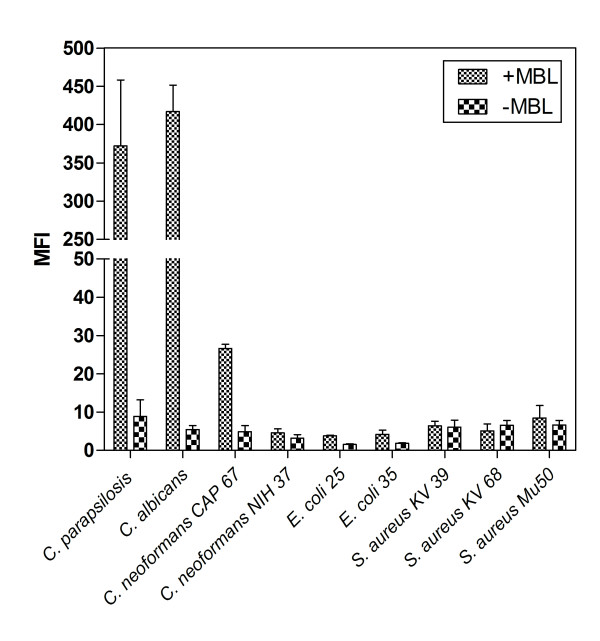
Figure 1
Figure 1
Ca2+-dependent interaction between mannose-binding lectin (MBL) and C. parapsilosis and reference strains C. albicans, C. neoformans, S. aureus and E. coli. Microorganisms were incubated in the presence of 5 μg/mL purified human MBL in VSB2+. After incubation with mouse anti-MBL monoclonal antibody and FITC-labeled goat anti mouse IgG, binding of MBL to these microorganisms was analyzed by flow cytometry. Results are expressed as median fluorescence intensity (MFI). Data are the mean ± SEM of 3 separate experiments. Solid bars, addition of human purified MBL; open bars, no addition of human purified MBL.
Figure 2
Figure 2
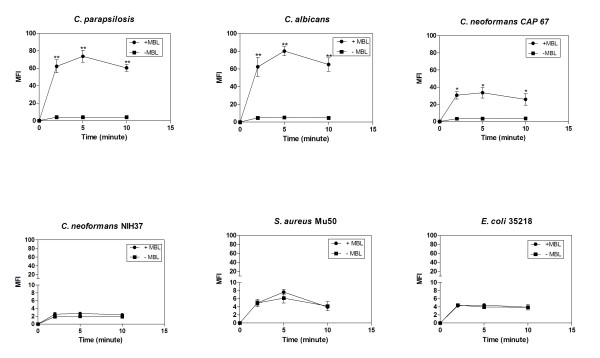
Time-dependent C4 deposition on C. parapsilosis and reference strains C. albicans, C. neoformans, S. aureus and E. coli in MBL-deficient serum supplemented with exogenous purified human MBL. Microorganisms were incubated with 10% MBL-deficient serum with or without 2.5 μg/mL purified human MBL, at 37°C over a time course of 10 min. Results are expressed as median fluorescence (MFI). Data are the mean ± SEM of 3 separate experiments. *P < 0.05 and ** P< 0.005 unpaired Student's t test of MFI.
Figure 3
Figure 3
Time-dependent C3b deposition on C. parapsilosis and reference strains C. albicans, C. neoformans, S. aureus and E. coli in MBL-deficient serum supplemented with exogenous purified human MBL. Microorganisms were incubated with 10% MBL-deficient serum with or without 2.5 μg/mL purified human MBL, at 37°C for 30 min. Results are expressed as median fluorescence (MFI). Data are the mean ± SEM of 3 separate experiments. *P < 0.05 and ** P< 0.005 unpaired Student's t test of MFI.
Figure 4
Figure 4
Opsonophagocytosis of C. parapsilosis and reference strains C. albicans, C. neoformans, S. aureus and E. coli by human polymorphonuclear (PMN) cells. Microorganisms were labelled with fluorescein isothiocyanate (FITC) and preincubated in the absence (control) or presence of 20% mannose-binding lectin (MBL)-deficient serum supplemented with 5 μg/mL human purified MBL, for 20 min. The yeast:phagocyte ratio was 2:1. Phagocytosis was analyzed by the use of flow cytometry and expressed as percentage of microorganisms-ingested PMN. Data are the mean ± SEM of 3 separate experiments. *P < 0.05 and ** P< 0.005 unpaired Student's t test of phagocytosis % gated.

References

    1. Brouwer N, Dolman KM, van Zwieten R, Nieuwenhuys E, Hart M, Aarden LA, Roos D, Kuijpers TW. Mannan-binding lectin (MBL)-mediated opsonization is enhanced by the alternative pathway amplification loop. Mol Immunol. 2006;43:2051–2060. doi: 10.1016/j.molimm.2006.01.003. - DOI - PubMed
    1. Ezekowitz RA. Role of the mannose-binding lectin in innate immunity. J Infect Dis. 2003;187:S335–339. doi: 10.1086/374746. - DOI - PubMed
    1. Kuipers S, Aerts PC, van Dijk H. Differential microorganism-induced mannose-binding lectin activation. FEMS Immunol Med Microbiol. 2003;36:33–39. doi: 10.1016/S0928-8244(03)00032-4. - DOI - PubMed
    1. Neth O, Jack DL, Dodds AW, Holzel H, Klein NJ, Turner MW. Mannose-binding lectin binds to a range of clinically relevant microorganisms and promotes complement deposition. Infect Immun. 2000;68:688–693. doi: 10.1128/IAI.68.2.688-693.2000. - DOI - PMC - PubMed
    1. Turner MW. The role of mannose-binding lectin in health and disease. Mol Immunol. 2003;40:423–429. doi: 10.1016/S0161-5890(03)00155-X. - DOI - PubMed

Substances