


The effects of local anesthetic concentration and dose on continuous infraclavicular nerve blocks: a multicenter, randomized, observer-masked, controlled study
- PMID: 19095871
- PMCID: PMC2745828
- DOI: 10.1213/ane.0b013e31818c7da5
The effects of local anesthetic concentration and dose on continuous infraclavicular nerve blocks: a multicenter, randomized, observer-masked, controlled study
Abstract
Background: It remains unclear whether local anesthetic concentration or total drug dose is the primary determinant of continuous peripheral nerve block effects. The only previous investigation, involving continuous popliteal-sciatic nerve blocks, specifically addressing this issue reported that insensate limbs were far more common with higher volumes of relatively dilute ropivacaine compared with lower volumes of relatively concentrated ropivacaine. However, it remains unknown if this relationship is specific to the sciatic nerve in the popliteal fossa or whether it varies depending on anatomic location. We therefore tested the null hypothesis that providing ropivacaine at different concentrations and rates, but at an equal total basal dose, produces comparable effects when used in a continuous infraclavicular brachial plexus block.
Methods: Preoperatively, an infraclavicular catheter was inserted using the coracoid approach in patients undergoing moderately painful orthopedic surgery distal to the elbow. Patients were randomly assigned to receive a postoperative perineural ropivacaine infusion of either 0.2% (basal 8 mL/h, bolus 4 mL) or 0.4% (basal 4 mL/h, bolus 2 mL) through the second postoperative day. Both groups, therefore, received 16 mg of ropivacaine each hour with a possible addition of 8 mg every 30 min via a patient-controlled bolus dose. Our primary end point was the incidence of an insensate limb during the 24-h period beginning the morning after surgery. Secondary end points included analgesia and patient satisfaction.
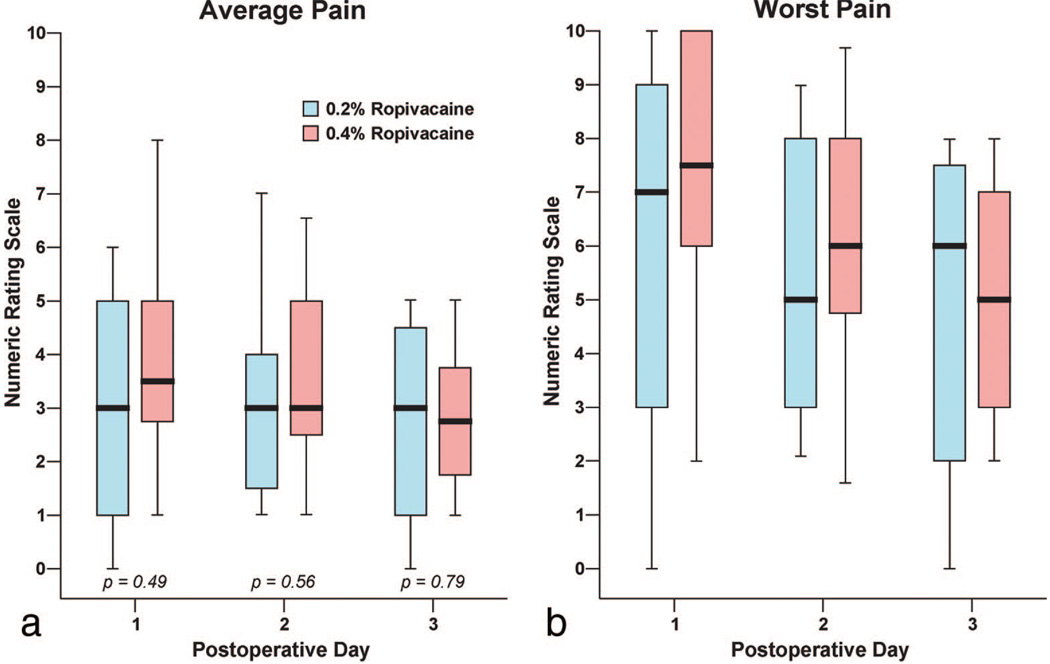
Results: Patients given 0.4% ropivacaine (n = 27) experienced an insensate limb, a mean (sd) of 1.8 (1.6) times, compared with 0.6 (0.9) times for subjects receiving 0.2% ropivacaine (n = 23; estimated difference = 1.2 episodes, 95% confidence interval, 0.5-1.9 episodes; P = 0.001). Satisfaction with postoperative analgesia (scale 0-10, 10 = highest) was scored a median (25th-75th percentiles) of 10.0 (8.0-10.0) in Group 0.2% and 7.0 (5.3-8.9) in Group 0.4% (P = 0.018). Analgesia was similar in each group.
Conclusions: For continuous infraclavicular nerve blocks, local anesthetic concentration and volume influence perineural infusion effects in addition to the total mass of local anesthetic administered. Insensate limbs were far more common with smaller volumes of relatively concentrated ropivacaine. This is the opposite of the relationship previously reported for continuous popliteal-sciatic nerve blocks. The interaction between local anesthetic concentration and volume is thus complex and varies among catheter locations.
Figures
Comment in
-
Continuous infraclavicular plexus blockade.Anesth Analg. 2009 Oct;109(4):1347-8; author reply 1348-9. doi: 10.1213/ane.0b013e3181b10103. Anesth Analg. 2009. PMID: 19762771 No abstract available.
References
-
- Ilfeld BM, Morey TE, Enneking FK. Infraclavicular perineural local anesthetic infusion: a comparison of three dosing regimens for postoperative analgesia. Anesthesiology. 2004;100:395–402. - PubMed
-
- van Oven H, Agnoletti V, Borghi B, Montone N, Stagni F. [Patient controlled regional analgesia (PCRA) in surgery of stiff elbow: elastomeric vs electronic pump] Minerva Anestesiol. 2001;67:117–120. - PubMed
-
- Ilfeld BM, Wright TW, Enneking FK, Vandenborne K. Total elbow arthroplasty as an outpatient procedure using a continuous infraclavicular nerve block at home: a prospective case report. Reg Anesth Pain Med. 2006;31:172–176. - PubMed
-
- Ilfeld BM, Loland VJ, Gerancher JC, Wadhwa AN, Renehan EM, Sessler DI, Shuster JJ, Theriaque DW, Maldonado RC, Mariano ER. Effects of varying local anesthetic concentration and volume on continuous popliteal sciatic nerve blocks: dual-center, randomized, controlled study. Anesth Analg. 2008;107:701–707. - PMC - PubMed
-
- Wilson JL, Brown DL, Wong GY, Ehman RL, Cahill DR. Infraclavicular brachial plexus block: parasagittal anatomy important to the coracoid technique. Anesth Analg. 1998;87:870–873. - PubMed
Publication types
MeSH terms
Substances
Grants and funding
LinkOut - more resources
Full Text Sources
Other Literature Sources
