


Variants in TGFB1, dust mite exposure, and disease severity in children with asthma
- PMID: 19096005
- PMCID: PMC2648908
- DOI: 10.1164/rccm.200808-1268OC
Variants in TGFB1, dust mite exposure, and disease severity in children with asthma
Abstract
Rationale: Polymorphisms in the gene for transforming growth factor-beta1 (TGFB1) have been associated with asthma, but not with airway responsiveness or disease exacerbations in subjects with asthma.
Objectives: To test for association between single nucleotide polymorphisms (SNPs) in TGFB1 and markers of asthma severity in childhood.
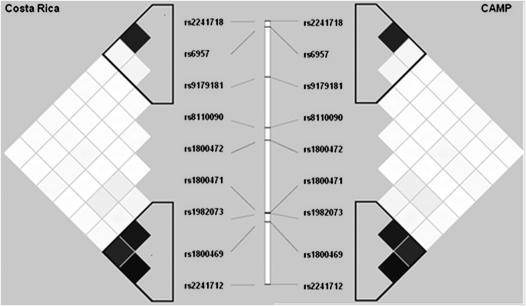
Methods: We tested for the association between nine SNPs in TGFB1 and indicators of asthma severity (lung function, airway responsiveness, and disease exacerbations) in two cohorts: 416 Costa Rican parent-child trios and 465 families of non-Hispanic white children in the Childhood Asthma Management Program (CAMP). We also tested for the interaction between these polymorphisms and exposure to dust mite allergen on asthma severity.
Measurements and main results: The A allele of promoter SNP rs2241712 was associated with increased airway responsiveness in Costa Rica (P = 0.0006) and CAMP (P = 0.005), and the C allele of an SNP in the promoter region (rs1800469) was associated with increased airway responsiveness in both cohorts (P <or= 0.01). Dust mite exposure modified the effect of the C allele of exonic SNP rs1800471 on airway responsiveness (P = 0.03 for interactions in both cohorts). The T allele of a coding SNP (rs1982073) was associated with a reduced risk of asthma exacerbations in Costa Rica (P = 0.009) and CAMP (P = 0.005). Dust mite exposure also significantly modified the effect of the A allele of the promoter SNP rs2241712 on asthma exacerbations in both cohorts.
Conclusions: SNPs in TGFB1 are associated with airway responsiveness and disease exacerbations in children with asthma. Moreover, dust mite exposure may modify the effect of TGFB1 SNPs on airway responsiveness and asthma exacerbations.
Figures
References
-
- Masoli M, Fabian D, Holt S, Beasley R. The global burden of asthma: executive summary of the GINA Dissemination Committee Report. Allergy 2004;59:469–478. - PubMed
-
- Monica J, Federico MJ, Wamboldt FS, Carter R, Mansell A, Wamboldt MZ. History of serious asthma exacerbations should be included in guidelines of asthma severity. J Allergy Clin Immunol 2007;119:50–56. - PubMed
-
- Fuhlbrigge AL, Weiss ST, Kuntz KM, Paltiel AD. Forced expiratory volume in 1 second percentage improves the classification of severity among children with asthma. Pediatrics 2006;118:e347–e355. - PubMed
-
- Kitch BT, Paltiel AD, Kuntz KM, Dockery DW, Schouten JP, Weiss ST, Fuhlbrigge AL. A single measure of FEV1 is associated with risk of asthma attacks in long-term follow-up. Chest 2004;126:1875–1882. - PubMed
-
- Sporik R, Chapman MD, Platts-Mills TAE. House dust mite exposure as a cause of asthma. Clin Exp Allergy 1992;22:897–906. - PubMed
Publication types
MeSH terms
Substances
Grants and funding
- P01 HL083069/HL/NHLBI NIH HHS/United States
- N01-HR16049/HR/NHLBI NIH HHS/United States
- P50 HL67664/HL/NHLBI NIH HHS/United States
- U01 HL065899/HL/NHLBI NIH HHS/United States
- R37 HL066289/HL/NHLBI NIH HHS/United States
- K08 HL092222/HL/NHLBI NIH HHS/United States
- U01 HL075419/HL/NHLBI NIH HHS/United States
- R01 HL066289/HL/NHLBI NIH HHS/United States
- R01 HL086601/HL/NHLBI NIH HHS/United States
- T32 HL007427/HL/NHLBI NIH HHS/United States
- K01 HL004370/HL/NHLBI NIH HHS/United States
- U01 HL65899/HL/NHLBI NIH HHS/United States
- HL04370/HL/NHLBI NIH HHS/United States
- HL66289/HL/NHLBI NIH HHS/United States
- P50 HL067664/HL/NHLBI NIH HHS/United States
- T32 HL07427/HL/NHLBI NIH HHS/United States
LinkOut - more resources
Full Text Sources
Medical
Molecular Biology Databases
Miscellaneous
