


Molecular and cellular mechanisms of the thrombotic complications of atherosclerosis
- PMID: 19096046
- PMCID: PMC2674742
- DOI: 10.1194/jlr.R800099-JLR200
Molecular and cellular mechanisms of the thrombotic complications of atherosclerosis
Abstract
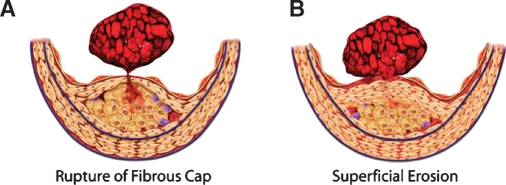
Clinicians have traditionally regarded the complications of atherosclerosis as a consequence of progressive arterial stenosis leading to critical narrowings that impede blood flow. Our contemporary understanding of the thrombotic complications of atherosclerosis has undergone a transformation based on a body of observations by pathologists and clinicians. In the late 1980s, clinicians had to confront the counterintuitive notion that plaques that cause acute myocardial infarction often do not produce high-grade stenoses (Smith, S. C., Jr. 1996. Risk-reduction therapy: the challenge to change. Circulation. 93: 2205-2211.). Observations from serial angiographic studies and on culprit lesions of acute myocardial infarction postthrombolysis highlighted this apparent paradox. These contrarian clinical findings prompted cardiologists to consider more carefully the findings of generations of pathologists that plaques that cause fatal coronary thrombi often result from a physical disruption of the atheromatous plaque that may not indeed cause critical arterial narrowing. This convergence of clinical and pathological observations highlighted the importance of understanding the mechanisms of disruption of plaques that can precipitate thromboses.
Figures
References
-
- Virmani R., A. P. Burke, A. Farb, and F. D. Kolodgie. 2006. Pathology of the vulnerable plaque. J. Am. Coll. Cardiol. 47 C13–C18. - PubMed
-
- Davies M. J. 1996. Stability and instability: the two faces of coronary atherosclerosis. The Paul Dudley White Lecture, 1995. Circulation. 94 2013–2020. - PubMed
-
- Libby P. 1995. The molecular bases of the acute coronary syndromes. Circulation. 91 2844–2850. - PubMed
-
- Amento E. P., N. Ehsani, H. Palmer, and P. Libby. 1991. Cytokines and growth factors positively and negatively regulate intersitial collagen gene expression in human vascular smooth muscle cells. Arterioscler. Thromb. Vasc. Biol. 11 1223–1230. - PubMed
-
- Galis Z. S., M. Muszynski, G. Sukhova, E. Simon-Morrisey, E. Unemori, M. Lark, E. Amento, and P. Libby. 1994. Cytokine-stimulated human vascular smooth muscle cells synthesize a complement of enzymes required for extracellular matrix digestion. Circ. Res. 75 181–189. - PubMed
MeSH terms
Substances
LinkOut - more resources
Full Text Sources
Medical
