


Review
doi: 10.1038/nmat2344.
Physical approaches to biomaterial design
Affiliations
- PMID: 19096389
- PMCID: PMC2793340
- DOI: 10.1038/nmat2344
Item in Clipboard
Review
Physical approaches to biomaterial design
Nat Mater.
2009 Jan.
Abstract
The development of biomaterials for drug delivery, tissue engineering and medical diagnostics has traditionally been based on new chemistries. However, there is growing recognition that the physical as well as the chemical properties of materials can regulate biological responses. Here, we review this transition with regard to selected physical properties including size, shape, mechanical properties, surface texture and compartmentalization. In each case, we present examples demonstrating the significance of these properties in biology. We also discuss synthesis methods and biological applications for designer biomaterials, which offer unique physical properties.
Figures
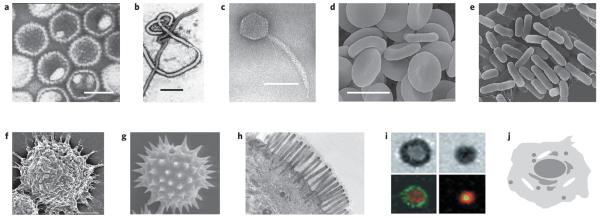
a, Human herpesvirus 3; scale bar, 100 nm (image: Frank Fenner). b, Ebola virus; scale bar, 500 nm (image: Frederick A. Murphy). c, Enterobacteria phage λ; scale bar, 50 nm (image: University of Wisconsin-Madison). d, Human erythrocytes; scale bar approximately 10 μm. e, Escherichia coli; image size approximately 7 μm × 6 μm. (Panels d and e © Dennis Kunkel Microscopy.) f, Surface texture in alveolar macrophages; scale bar, 5 μm (© 2008 STM). g, Pollen; image size approximately 50 μm × 45 μm (Dartmouth Electron Microscope Facility). h, Intestinal villi; approximate magnification μ5,950 (© Dennis Kunkel Microscopy). i, The immunological synapse; T cell forming a synapse with a supported membrane containing GPI-linked pMHC and ICAM (ref. 134); © 1999 AAAS). j, A schematic of cellular compartmentalization showing several organelles surrounding the nucleus. The images clearly establish that nature uses physical parameters such as size, shape, texture and compartmentalization in designing life.
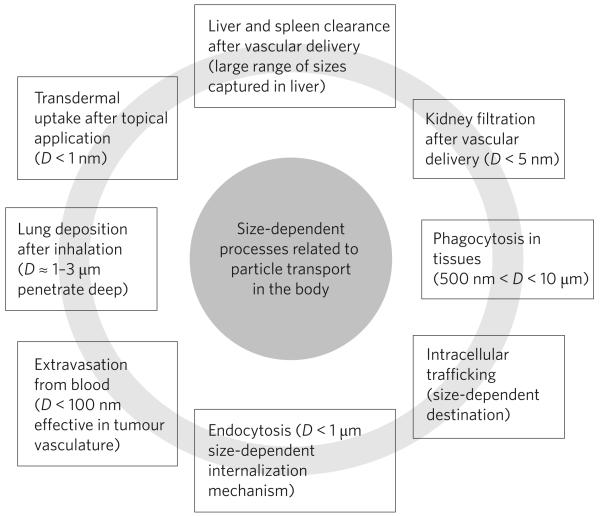
Particles can pass through biological barriers by a number of different processes. These include passive (diffusive) and active processes ranging from extravasation to transdermal uptake. Most of these processes affect distribution and clearance of micro- and nanoparticles in the human body and they strongly depend on particle size.
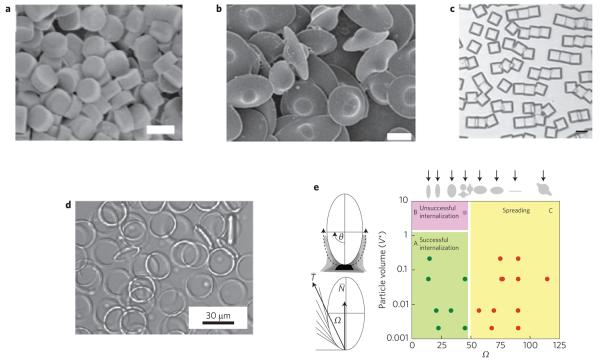
a, Cylindrical particles prepared using PRINT method; scale bar, 5 μm (© 2008 PNAS). b, UFO-shaped particles prepared by film-stretching; scale bar, 5 μm (© 2007 PNAS). c, Rectangular discs of SU-8 (ref. 53); scale bar, 150 μm (© 2006 NPG). d, Polymer rings (© 2006 NPG). e, Phagocytosis of particles depends on shape (© 2006 PNAS).
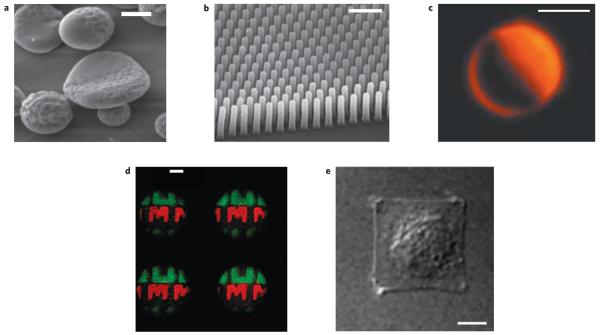
a, Biphasic discs with smooth and rough surface; scale bar, 1 μm (image: Joerg Lahann). b, Pillar arrays for mapping force of epithelial cell migration; scale bar, 5 μm (© 2005 PNAS). c, Asymmetrically coated particles; scale bar, 5 μm (© 2003 RSC). d, Micropatterned particles; scale bar, 100 μm (© 2007 PNAS). e, Control of spreading of an endothelial cell through a micropatterned substrate; scale bar, 10 μm (© 1997 AAAS).
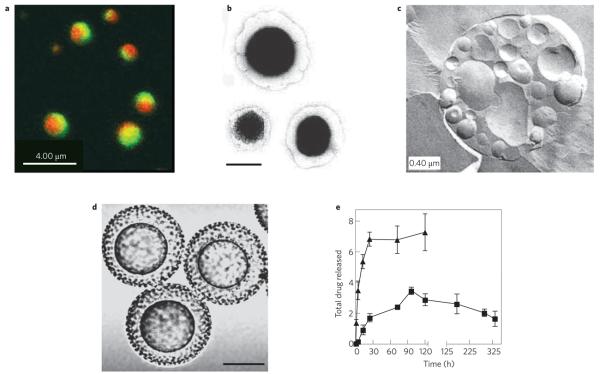
a, Biphasic particles (© 2005 NPG). b, Composite liposome-nanoparticle carriers; nanocells, scale bar 100 nm (© 2005 NPG). c, Vesosomes (© 2002 ACS). d, Core–shell microparticles; scale bar 25 μm (© 2007 STM). e, Differential release of two drugs from two compartments of nanocell particles (© 2005 NPG).
References
-
- Peppas NA, Langer R. New challenges in biomaterials. Science. 1994;263:1715–1720. - PubMed
-
- Langer R, Tirrell DA. Designing materials for biology and medicine. Nature. 2004;428:487–492. - PubMed
-
- Karp JM, Langer R. Development and therapeutic applications of advanced biomaterials. Curr. Opin. Biotechnol. 2007;18:454–459. - PubMed
-
- Mooney DJ, Mikos AG. Growing new organs. Sci. Am. 1999;280:60–65. - PubMed
-
- Gref R, et al. Biodegradable long-circulating polymeric nanospheres. Science. 1994;263:1600–1603. - PubMed
Publication types
MeSH terms
Substances
Grants and funding
LinkOut - more resources
Full Text Sources
Other Literature Sources
