


CD8+ T-cell interleukin-7 receptor alpha expression as a potential indicator of disease status in HIV-infected children
- PMID: 19096522
- PMCID: PMC2599882
- DOI: 10.1371/journal.pone.0003986
CD8+ T-cell interleukin-7 receptor alpha expression as a potential indicator of disease status in HIV-infected children
Abstract
Background: Initiation and modification of antiretroviral therapy in HIV-infected children depend on viral load and CD4+ T-cell count. However, these surrogates have limitations, and complementary immunological markers to assess therapeutic response are needed. Our aim was to evaluate CD8+ T-cell expression of CD127 as a marker of disease status in HIV-infected children, based on adult data suggesting its usefulness. We hypothesized that CD127 expression on CD8+ T-cells is lower in children with more advanced disease.
Methods: In a cross-sectional evaluation, we used flow cytometry to measure CD127+ expression on CD8+ T-cells in whole blood from HIV-infected children with varying disease status. This was compared with expression of CD38 on this subset, currently used in clinical practice as a marker of disease status.
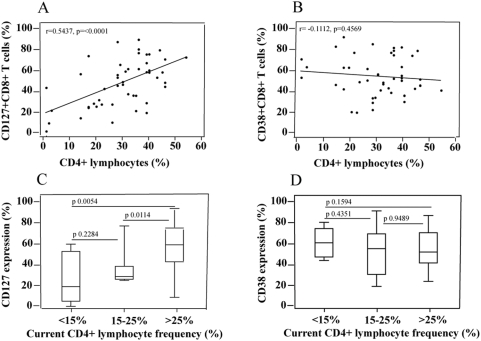
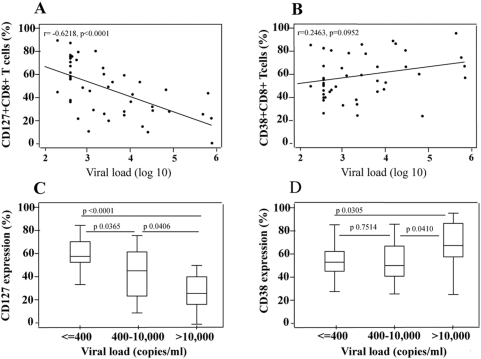
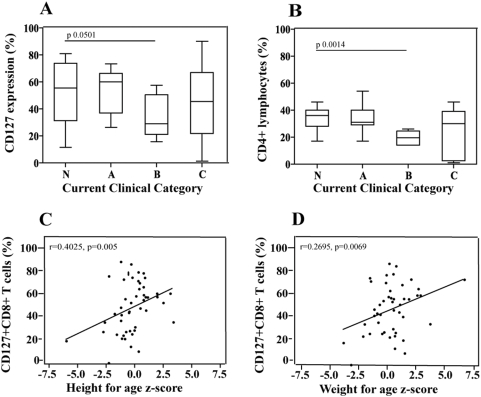
Results: 51 HIV-infected children were enrolled. There was a strong positive correlation between CD127 expression on CD8+ T-cells and CD4+ T-cell count, and height and weight z-scores, and a strong negative correlation between CD127 expression and viral load. In contrast, we found no association between CD38 expression and these disease status markers.
Conclusions: CD8+ T-cell CD127 expression is significantly higher in children with better HIV disease control, and may have a role as an immunologic indicator of disease status. Longitudinal studies are needed to determine the utility of this marker as a potential indicator of HIV disease progression.
Conflict of interest statement
Figures
References
-
- Essajee SM, Kim M, Gonzalez C, Rigaud M, Kaul A, et al. Immunologic and virologic responses to HAART in severely immunocompromised HIV-1-infected children. Acquir Immune Defic Syndr. 1999;13:2523–2532. - PubMed
-
- Bohler T, Walcher J, Holzl-Wenig G, Geiss M, Buchholz B, et al. Early effects of antiretroviral combination therapy on activation, apoptosis and regeneration of T cells in HIV-1-infected children and adolescents. Acquir Immune Defic Syndr. 1999;13:779–789. - PubMed
-
- Harari A, Petitpierre S, Vallelian F, Pantaleo G. Skewed representation of functionally distinct populations of virus-specific CD4 T cells in HIV-1-infected subjects with progressive disease: changes after antiretroviral therapy. Blood. 2004;103:966–972. - PubMed
-
- Borkowsky W, Stanley K, Douglas SD, Lee S, Wiznia A, et al. Immunologic response to combination nucleoside analogue plus protease inhibitor therapy in stable antiretroviral therapy-experienced human immunodeficiency virus-infected children. J Infect Dis. 2000;182:96–103. - PubMed
Publication types
MeSH terms
Substances
Grants and funding
LinkOut - more resources
Full Text Sources
Medical
Research Materials
