Review
. 2009:(190):309-25.
doi: 10.1007/978-3-540-79885-9_16.

Aquaglyceroporins and metalloid transport: implications in human diseases

Affiliations
Review

Aquaglyceroporins and metalloid transport: implications in human diseases

Hiranmoy Bhattacharjee et al. Handb Exp Pharmacol. 2009.

Abstract

Aquaglyceroporin (AQP) channels facilitate the diffusion of a wide range of neutral solutes, including water, glycerol, and other small uncharged solutes. More recently, AQPs have been shown to allow the passage of trivalent arsenic and antimony compounds. Arsenic and antimony are metalloid elements. At physiological pH, the trivalent metalloids behave as molecular mimics of glycerol, and are conducted through AQP channels. Arsenicals and antimonials are extremely toxic to cells. Despite their toxicity, both metalloids are used as chemotherapeutic agents for the treatment of cancer and protozoan parasitic diseases. The metalloid homeostasis property of AQPs can be a mixed blessing. In some cases, AQPs form part of the detoxification pathway, and extrude metalloids from cells. In other instances, AQPs allow the transport of metalloids into cells, thereby conferring sensitivity. Understanding the factors that modulate AQP expression will aid in a better understanding of metalloid toxicity and also provide newer approaches to metalloid based chemotherapy.


Figures
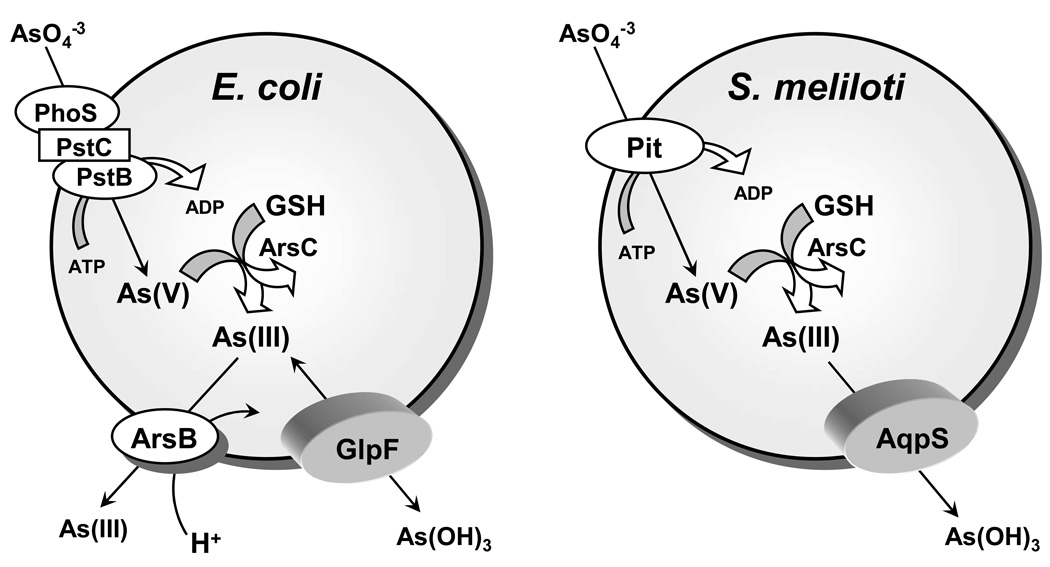
Fig. 1
Fig. 1. Metalloid transport in bacteria
In both E. coli and S. meliloti arsenate is brought into cells by the phosphate transporters. The first step of detoxification involves reduction of arsenate to arsenite by either E. coli or S. meliloti ArsC (Bhattacharjee and Rosen, 2007). Subsequent detoxification steps in E. coli involves removal of the trivalent form of the metalloid from the cytosol by active extrusion through the As(OH)3/H+ antiporter ArsB (Meng et al., 2004), while in S. meliloti, the AqpS channel facilitates downhill transport of As(III) (Yang et al., 2005). Since arsenite can be taken up directly by cells, using either GlpF in E. coli or AqpS in S. meliloti, the detoxification mechanism functions when S. meliloti cells are exposed to arsenate.
Fig. 2
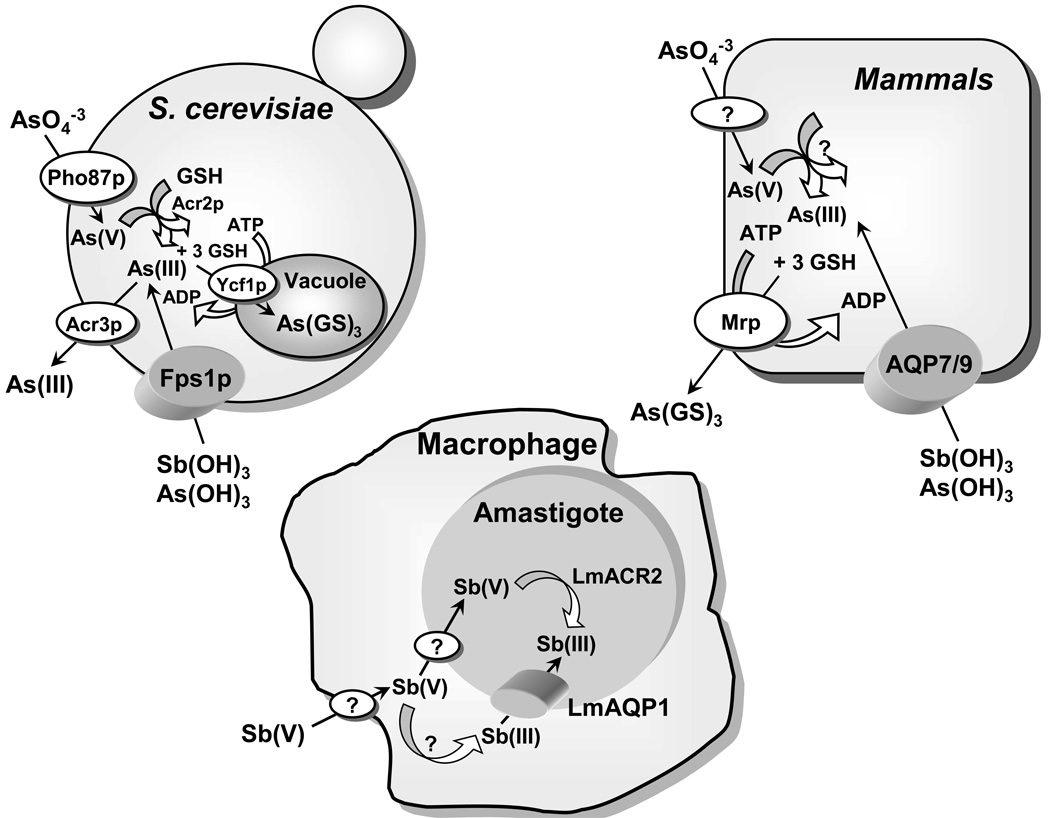
Fig. 2. Metalloid transport in eukaryotes
Arsenate (As(V)) is taken up by phosphate transporters (Bun-ya et al., 1996), and As(III) is taken up by aquaglyceroporins (Fps1p in yeast (Wysocki et al., 2001) and Aqp7 and Aqp9 in mammals (Liu et al., 2002)). In yeast, arsenate is reduced to arsenite by the Acr2p (Mukhopadhyay et al., 2000). Glutathione and glutaredoxin serve as the source of reducing potential (Mukhopadhyay et al., 2000). The proteins responsible for arsenate uptake and reduction in mammals have not yet been identified. In yeast, Acr3p is a plasma membrane arsenite efflux protein (Bobrowicz et al., 1997; Wysocki et al., 1997), and Ycf1p, which is a member of the MRP family of the ABC superfamily of drug-resistance pumps, transports As(GS)3 into the vacuole (Ghosh et al., 1999). In mammals, Mrp isoforms pump As(GS)3 out of cells (Cole et al., 1994; Zaman et al., 1995). In leishmania, Sb(V) is taken up by macrophages, and a portion is reduced to Sb(III), which is then transported into the amastigote by the leishmania aquaglyceroporin LmAQP1 (Gourbal et al., 2004). The other portion of the Sb(V) is taken into the amastigote and reduced to Sb(III) by LmACR2 (Zhou et al., 2004) and perhaps other enzymes such as TDR1 (Denton et al., 2004).
Fig. 3
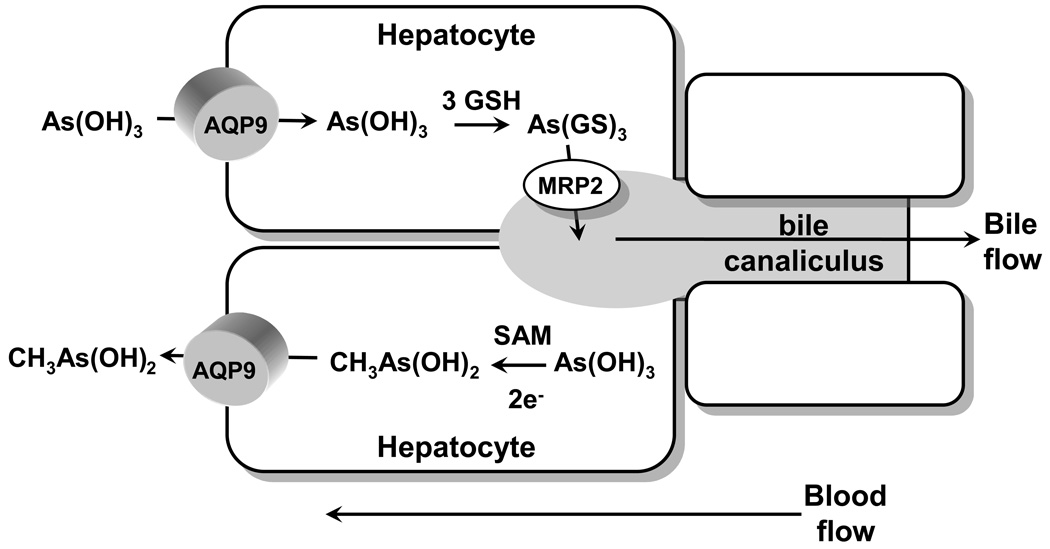
Fig. 3. Proposed pathways of metalloid transport in liver
Arsenite in the form of As(OH)3 flows down a concentration gradient from blood into hepatocytes through AQP9, which is the major aquaglyceroporin in liver (Carbrey et al. 2003). In the cytosol of the hepatocyte, As(OH)3 can be either glutathionylated to As(GS)3 or methylated to MAs(V), which is reduced to MAs(III). As(GS)3 is pumped into bile by MRP2 (Liu et al. 2001), and perhaps by other members of the ABC superfamily of ATPases. Alternatively, As(OH)3 can be methylated and reduced to CH3As(OH)2, which then flows down its concentration gradient via AQP9 into blood.

References

    1. Abedin MJ, Cresser MS, Meharg AA, Feldmann J, Cotter-Howells J. Arsenic accumulation and metabolism in rice (Oryza sativa L.) Environ Sci Technol. 2002;36:962–968. - PubMed
    1. Abernathy CO, Thomas DJ, Calderon RL. Health effects and risk assessment of arsenic. J Nutr. 2003;133:1536S–1538S. - PubMed
    1. Agre P, Kozono D. Aquaporin water channels: molecular mechanisms for human diseases. FEBS Lett. 2003;555:72–78. - PubMed
    1. Aribi A, Kantarjian HM, Estey EH, Koller CA, Thomas DA, Kornblau SM, Faderl SH, Laddie NM, Garcia-Manero G, Cortes JE. Combination therapy with arsenic trioxide, all-trans retinoic acid, and gemtuzumab ozogamicin in recurrent acute promyelocytic leukemia. Cancer. 2007;109:1355–1359. - PubMed
    1. Arima H, Yamamoto N, Sobue K, Umenishi F, Tada T, Katsuya H, Asai K. Hyperosmolar mannitol simulates expression of aquaporins 4 and 9 through a p38 mitogen-activated protein kinase-dependent pathway in rat astrocytes. J Biol Chem. 2003;278:44525–44534. - PubMed

Publication types

LinkOut - more resources