. 2008 Dec 30;105(52):20647-52.
doi: 10.1073/pnas.0807514106. Epub 2008 Dec 19.

Single-molecule DNA detection with an engineered MspA protein nanopore

Affiliations

Single-molecule DNA detection with an engineered MspA protein nanopore

Tom Z Butler et al. Proc Natl Acad Sci U S A. .

Abstract

Nanopores hold great promise as single-molecule analytical devices and biophysical model systems because the ionic current blockades they produce contain information about the identity, concentration, structure, and dynamics of target molecules. The porin MspA of Mycobacterium smegmatis has remarkable stability against environmental stresses and can be rationally modified based on its crystal structure. Further, MspA has a short and narrow channel constriction that is promising for DNA sequencing because it may enable improved characterization of short segments of a ssDNA molecule that is threaded through the pore. By eliminating the negative charge in the channel constriction, we designed and constructed an MspA mutant capable of electronically detecting and characterizing single molecules of ssDNA as they are electrophoretically driven through the pore. A second mutant with additional exchanges of negatively-charged residues for positively-charged residues in the vestibule region exhibited a factor of approximately 20 higher interaction rates, required only half as much voltage to observe interaction, and allowed ssDNA to reside in the vestibule approximately 100 times longer than the first mutant. Our results introduce MspA as a nanopore for nucleic acid analysis and highlight its potential as an engineerable platform for single-molecule detection and characterization applications.


Conflict of interest statement

The authors declare no conflict of interest.

Figures
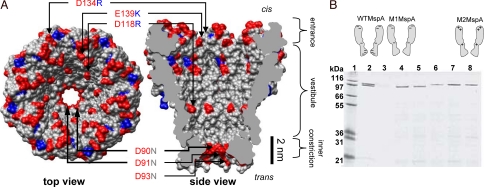
Fig. 1.
Fig. 1.
MspA structure and expression of MspA mutants. (A) Structure and charge distribution of wild-type MspA. Aspartate and glutamate residues are colored red, and argenine and lysine residues are colored blue. At our experimental pH 8, we expect the acidic (red) residues to be predominantly negatively charged and the basic (blue) residues to be positively charged. Locations and identities of mutations are indicated by arrows and labels. (B) Expression of MspA mutant porins. Raw extract (13 μL) was added to each lane. Gel was stained with Coomassie blue. Lane 1, protein mass marker. Lane 2, WTMspA. Lane 3, no MspA. Lane 4, mutant D90N/D91N/D93N (M1MspA). Lane 5, mutant D90N/D91N/D93N/D118R. Lane 6, mutant D90N/D91N/D93N/D118R/E139R. Lane 7, mutant D90N/D91N/D93N/D118R/E139K. Lane 8, mutant D90N/D91N/D93N/D118R/E139K/D134R (M2MspA). Mutants in lanes 5–7 were constructed, extracted, and assayed to ensure that expression and channel-forming activity were retained for each successive amino acid replacement. Diagrams above the gel show schematically the approximate location and polarity of the amino acids that we mutated in this investigation.
Fig. 2.
Fig. 2.
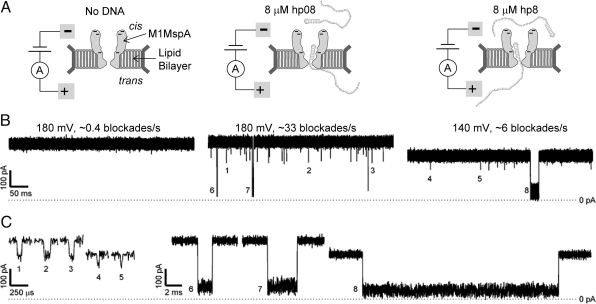
Detection of ssDNA hairpin constructs with M1MspA. (A) Schematic diagram of experiments. (B) Representative ionic current signal observed for M1MspA in the absence of DNA and the presence of 8 μM hp08 hairpin DNA at 180 and 140 mV. (C) Numbered blockades from traces in B shown at expanded time scales.
Fig. 3.
Fig. 3.
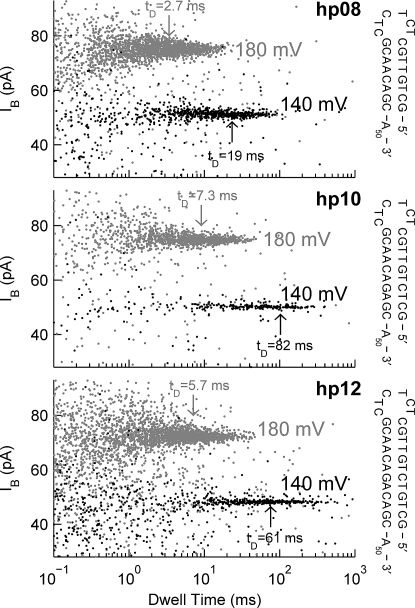
Characteristics of deep blockades from hairpin constructs in M1MspA. The coordinates of each point give the duration and average current of 1 deep blockade. Black and gray data were acquired at 140 and 180 mV, respectively. The mode of the log10 of the deep blockade dwell times, tD, is indicated for each dataset. Diagrams at right show the sequence of each hairpin construct.
Fig. 4.
Fig. 4.
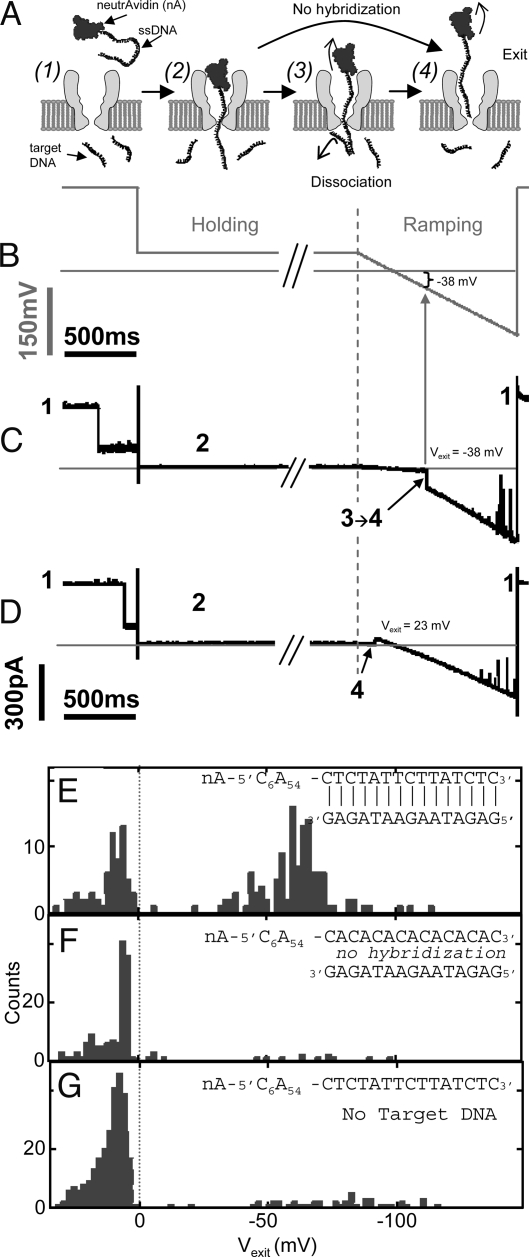
Transbilayer probe experiments. (A) Animation of molecular configurations. (1) An unblocked pore. (2) A threaded ssDNA with nA arresting translocation of the nA–ssDNA complex. (3) Target DNA hybridized with nA–ssDNA disassociating at negative voltage. (4) The nA–ssDNA complex exiting from the pore at a voltage depending on the hybridization of the target DNA. (B) Time series of the applied voltage. A current blockade triggers a change from the 180-mV capture voltage to a holding voltage of 40 mV after delay of ≈200 ms. The holding voltage is maintained for 5 s to allow hybridization, and is then ramped negatively. (C and D) Current time series demonstrating nA–ssDNA exit at negative and positive voltages, respectively. Large current spikes occur because of instantaneous voltage changes and spontaneous pore closure at large negative voltage. (E–G) Exit voltage (Vexit) histograms. (E) Experiment where the probe is complementary to the target ssDNA molecules. (F) The same pore as in E, but with a probe that is not complementary to the target DNA. (G) A separate control using the same probe as in E, but without target DNA present in the trans compartment. A significant number of negative Vexit events are observed only in E, where the probe is complementary to the target. The infrequent occurance of negative Vexit events in F and G rule out the possibility that a majority of negative Vexit in E is caused by nonspecific probe–target association or by binding of the probe to the pore.
Fig. 5.
Fig. 5.
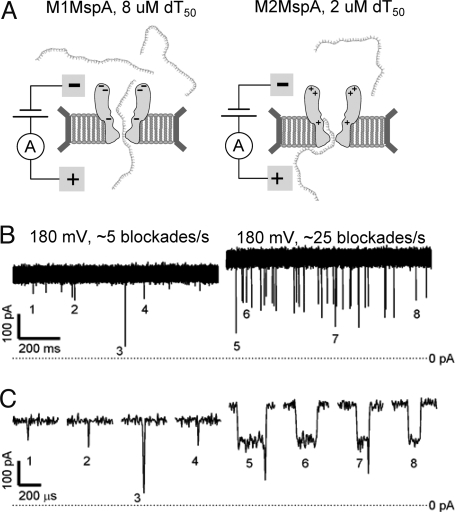
Comparison of dT50 homopolymer blockades for M1MspA and M2MspA. (A) Schematic diagram of experiments. (B) Representative ionic current signals observed for M1MspA with 8 μM dT50 (Left) and M2MspA with 2 μM dT50 (Right). (C) Numbered blockades from traces in B shown at expanded time scales.

References

    1. Kasianowicz JJ, Brandin E, Branton D, Deamer DW. Characterization of individual polynucleotide molecules using a membrane channel. Proc Natl Acad Sci USA. 1996;93:13770–13773. - PMC - PubMed
    1. Bezrukov SM, Vodyanoy I, Brutyan RA, Kasianowicz JJ. Dynamics and free energy of polymers partitioning into a nanoscale pore. Macromolecules. 1996;29:8517–8522.
    1. Braha O, et al. Designed protein pores as components for biosensors. Chem Biol. 1997;4:497–505. - PubMed
    1. Li J, et al. Ion-beam sculpting at nanometer-length scales. Nature. 2001;412:166–169. - PubMed
    1. Heng JB, et al. Sizing DNA using a nanometer-diameter pore. Biophys J. 2004;87:2905–2911. - PMC - PubMed

Publication types

MeSH terms