


A public health model for the molecular surveillance of HIV transmission in San Diego, California
- PMID: 19098493
- PMCID: PMC2644048
- DOI: 10.1097/QAD.0b013e32831d2a81
A public health model for the molecular surveillance of HIV transmission in San Diego, California
Abstract
Background: Current public health efforts often use molecular technologies to identify and contain communicable disease networks, but not for HIV. Here, we investigate how molecular epidemiology can be used to identify highly related HIV networks within a population and how voluntary contact tracing of sexual partners can be used to selectively target these networks.
Methods: We evaluated the use of HIV-1 pol sequences obtained from participants of a community-recruited cohort (n = 268) and a primary infection research cohort (n = 369) to define highly related transmission clusters and the use of contact tracing to link other individuals (n = 36) within these clusters. The presence of transmitted drug resistance was interpreted from the pol sequences (Calibrated Population Resistance v3.0).
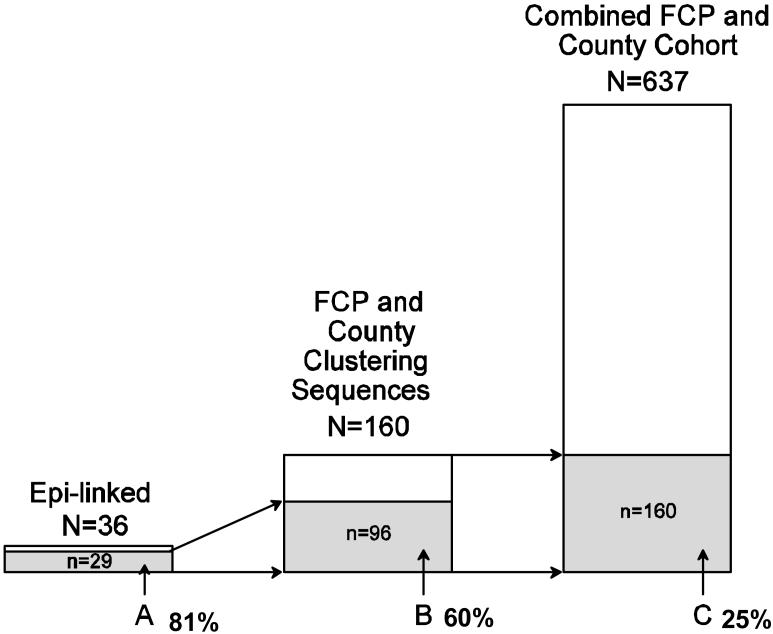
Results: Phylogenetic clustering was conservatively defined when the genetic distance between any two pol sequences was less than 1%, which identified 34 distinct transmission clusters within the combined community-recruited and primary infection research cohorts containing 160 individuals. Although sequences from the epidemiologically linked partners represented approximately 5% of the total sequences, they clustered with 60% of the sequences that clustered from the combined cohorts (odds ratio 21.7; P < or = 0.01). Major resistance to at least one class of antiretroviral medication was found in 19% of clustering sequences.
Conclusion: Phylogenetic methods can be used to identify individuals who are within highly related transmission groups, and contact tracing of epidemiologically linked partners of recently infected individuals can be used to link into previously defined transmission groups. These methods could be used to implement selectively targeted prevention interventions.
Figures
References
-
- van Deutekom H, Gerritsen JJ, van Soolingen D, van Ameijden EJ, van Embden JD, Coutinho RA. A molecular epidemiological approach to studying the transmission of tuberculosis in Amsterdam. Clin Infect Dis. 1997;25:1071–1077. - PubMed
-
- Sutton MY, Liu H, Steiner B, Pillay A, Mickey T, Finelli L, et al. Molecular subtyping of Treponema pallidum in an Arizona County with increasing syphilis morbidity: use of specimens from ulcers and blood. J Infect Dis. 2001;183:1601–1606. - PubMed
-
- Thompson DK, Deal CD, Ison CA, Zenilman JM, Bash MC. A typing system for neisseria gonorrhoeae based on biotinylated oligonucleotide probes to PIB gene variable regions. J Infect Dis. 2000;181:1652–1660. - PubMed
-
- Hecht FM, Wolf LE, Lo B. Lessons from an HIV transmission pair. J Infect Dis. 2007;195:1239–1241. - PubMed
-
- Robertson DL, Sharp PM, McCutchan FE, Hahn BH. Recombination in HIV-1. Nature. 1995;374:124–126. - PubMed
Publication types
MeSH terms
Substances
Grants and funding
- R01 AI057167/AI/NIAID NIH HHS/United States
- R21 AI077304/AI/NIAID NIH HHS/United States
- R01 AI047745/AI/NIAID NIH HHS/United States
- AI047745/AI/NIAID NIH HHS/United States
- MH083552/MH/NIMH NIH HHS/United States
- R21 AI047745/AI/NIAID NIH HHS/United States
- AI29164/AI/NIAID NIH HHS/United States
- 5K23AI055276/AI/NIAID NIH HHS/United States
- R56 AI047745/AI/NIAID NIH HHS/United States
- P30 MH062512/MH/NIMH NIH HHS/United States
- MH62512/MH/NIMH NIH HHS/United States
- P30 AI036214/AI/NIAID NIH HHS/United States
- R01 MH083552/MH/NIMH NIH HHS/United States
- AI57167/AI/NIAID NIH HHS/United States
- R24 AI106039/AI/NIAID NIH HHS/United States
- UM1 AI069432/AI/NIAID NIH HHS/United States
- 200-2002-00656/PHS HHS/United States
- AI38858/AI/NIAID NIH HHS/United States
- R01 AI043752/AI/NIAID NIH HHS/United States
- AI36214/AI/NIAID NIH HHS/United States
- R37 AI029164/AI/NIAID NIH HHS/United States
- U01 AI069432/AI/NIAID NIH HHS/United States
- K23 AI055276/AI/NIAID NIH HHS/United States
- U01 AI038858/AI/NIAID NIH HHS/United States
- U01 AI043638/AI/NIAID NIH HHS/United States
- AI43638/AI/NIAID NIH HHS/United States
- AI43752/AI/NIAID NIH HHS/United States
- AI077304/AI/NIAID NIH HHS/United States
- AI47745/AI/NIAID NIH HHS/United States
- AI69432/AI/NIAID NIH HHS/United States
- P01 AI074621/AI/NIAID NIH HHS/United States
LinkOut - more resources
Full Text Sources
Medical
Molecular Biology Databases
