. 2009 Mar;46(6):1149-62.
doi: 10.1016/j.molimm.2008.11.001. Epub 2008 Dec 18.

The human complement fragment receptor, C5L2, is a recycling decoy receptor

Affiliations

The human complement fragment receptor, C5L2, is a recycling decoy receptor

Anne-Marie Scola et al. Mol Immunol. 2009 Mar.

Abstract

C5L2 is a 7 transmembrane domain receptor for complement fragment C5a that, unlike the classical C5a receptor, C5aR, does not couple to G proteins. However, in mice where C5L2 has been deleted, the response to C5a is altered, suggesting that C5L2 may have a signaling function. In order to investigate whether human C5L2 also has some capacity to transduce signals, we have attempted to produce a signaling competent form of human C5L2 by inserting C5aR sequences at three key G protein activation motifs. However, we detected neither an intracellular Ca(2+) response nor beta-arrestin redistribution in mutated C5L2, suggesting that the potential for G protein coupling is completely absent in this receptor and that, in humans, C5L2 may have functions that are unrelated to signaling. In confirmation of this, we detected constitutive ligand-independent internalization of C5L2 that resulted in the rapid accumulation of C5a and its stable metabolite, C5a des Arg, within the cell with only a small net change in cell surface receptor levels. Internalization was found to be through a clathrin-dependent mechanism that led to the retention and, in cells natively expressing C5L2, the degradation of the ligand within an intracellular compartment. In contrast, the classical C5a receptor, C5aR, internalized ligand much more slowly and a majority of this ligand was released back into the extracellular environment in an apparently undegraded form. These data suggest that a major function of human C5L2 is to remove active complement fragments from the extracellular environment.


Figures

Fig. 1
Fig. 1
C5a does not stimulate increases in intracellular Ca2+ or translocation of β-arrestin in RBL cells transfected with C5L2. (A) Fluo4-AM loaded RBL cells transfected with C5aR, wild type C5L2, C5L2 with C5aR-like sequences at three key signaling motifs (C5L2+++) or untransfected controls (NX) were stimulated with C5a (left panel) or C5a des Arg (right panel). Changes in the intracellular Ca2+ concentration were measured by flow cytometry as changes in fluorescence integrated over 70 s and shown as a percentage of fluorescence in unstimulated cells. Results shown are means of three separate experiments performed in duplicate ± S.E.M. (B) Transfected RBL cells adhered to coverslips were treated with 100 nM C5a for 15 min, fixed, permeabilized, incubated with antibody specific for β-arrestin 1. Arrows show intracellular accumulation of β-arrestin 1 in C5aR-transfected cells. Bar equal to 10 μm.
Fig. 2
Fig. 2
C5L2 has a primarily intracellular location in transfected RBL cells. (A) The expression pattern of receptor in RBL cells transfected with C5aR, wild type or mutant C5L2 (NPXXY) was measured by incubating permeabilized and intact cells with anti-receptor antibodies. The percentage surface expression was calculated as the ratio of antibody binding to intact cells to that in permeabilized cells. The data shown are the mean ± S.E.M. of three to four separate determinations performed in duplicate. Significantly different by ANOVA with Bonferroni post-test, *p < 0.05; ns: not significant. (B) Intracellular and surface receptor expression was visualized in RBL cells transfected adhered to coverslips, incubated with antibody specific for the N-terminus of C5aR or the N-terminal HA tag of C5L2 with or without a permeabilization step; nuclei are counter-stained in blue. Bar equal to 10 μm. (C) CHO cells transfected with GFP tagged constructs of C5aR or C5L2 mutants were adhered to coverslips. Bar equal to 10 μm.
Fig. 3
Fig. 3
C5L2 does not undergo ligand-dependent internalization in transfected RBL cells. Transfected RBL cells were incubated with 100 nM C5a at 37 °C for 15 min and then fixed and permeabilized. Receptor was visualized with antibody specific for the N termini of C5aR or the N-terminal HA tag of C5L2. Bar equal to 10 μm.
Fig. 4
Fig. 4
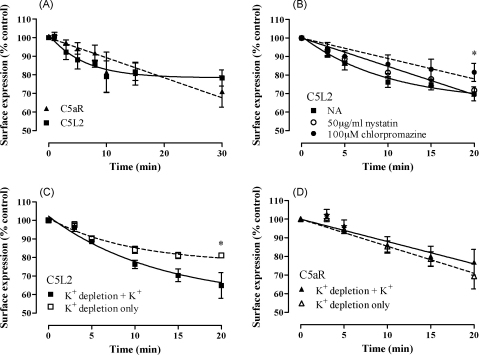
Different mechanisms are involved in the turnover of surface C5aR and C5L2 in transfected RBL cells. (A) RBL cells transfected with C5aR or C5L2 were incubated with monoclonal antibodies specific for the N-terminus of C5aR or the N-terminal HA tag of C5L2 for 1 h at 4 °C then washed extensively. Cells were warmed to 37 °C for the indicated times before quenching in ice-cold buffer. Surface antibody was quantified by flow cytometry. Data shown are mean ± S.E.M. from six experiments. (B) RBL cells transfected with C5L2 were incubated with buffer only (NA), 50 μg/ml nystatin or 100 μM chlorpromazine prior determination of surface anti-C5L2 antibody. Data shown are mean ± S.E.M. from three to six separate experiments; (C and D) RBL cells transfected with C5aR (C) or C5L2 (D) were incubated in DMEM/H2O (1:1) for 5 min and then incubated in K+ free buffer for 30 min at 37 °C prior to incubation with antibodies specific for the N-terminal HA tag of C5L2 (C) and the N terminus of C5aR (D) for 1 h at 4 °C in buffer with K+ (shaded symbols) or without K+ (open symbols). Excess antibody was removed by extensive washing and then cells incubated at 37 °C in buffer with K+ (shaded symbols) or without K+ (open symbols) for the times indicated. After quenching, surface antibody was quantified by flow cytometry. Data shown are mean ± S.E.M. from three to seven experiments. Significantly different from control cells at the same time-point by two-way ANOVA with Bonferroni post-test; *p < 0.05. In all cases, data fitting to straight line (null hypothesis) or one-phase decay models was compared. Data is shown fitted to a straight line unless null hypothesis rejected, p < 0.05.
Fig. 5
Fig. 5
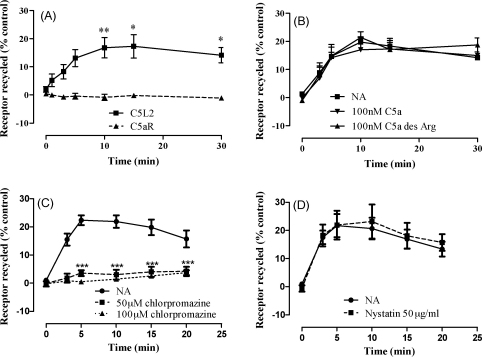
C5L2 but not C5aR undergoes constitutive recycling in transfected RBL cells. Transfected RBL cells were incubated with antibodies specific for the N termini of C5aR and the N-terminal HA tag of C5L2 for 1 h at 4 °C. Excess antibody was removed by extensive washing with ice-cold PBS and then cells warmed to 37 °C for 30 min. Cells were then washed in ice-cold acid medium before incubation at 37 or 4 °C for the indicated times in the presence of buffer alone (A), 100 nM C5a or C5a des Arg (B), the indicated concentrations of chlorpromazine (C) or nystatin (D). After quenching, surface antibody was detected by flow cytometry. The results are shown as a percentage increase in receptor expression at 37 °C relative to cells maintained at 4 °C and are the mean ± S.E.M. of three to six separate experiments performed in duplicate. Significantly different from controls or C5aR at the same time-point by two-way ANOVA with Bonferroni post-test; *p < 0.05, **p < 0.01, ***p < 0.005.
Fig. 6
Fig. 6
C5L2 in transfected CHO cells is more efficient than C5aR at internalizing and retaining C5a and C5a des Arg but ligand degradation does not occur in these cells. (Panels A and B) Ligand internalization: transfected cells expressing equal levels of receptor were loaded with 125I-C5a (A) or 100 nM 125I-C5a des Arg (B) at 4 °C for 1 h, then extensively washed and warmed to 37 °C for the indicated times. Cells were then washed in either ice-cold PBS or acidic medium to strip cell-surface ligand. Results are shown as percentage of radioactivity in acid-washed cells compared to cells washed in PBS and are the mean ± S.E.M. of 8–10 separate experiments performed in duplicate. (C–F) Ligand fate: cells expressing equal levels of receptor were loaded with 0.1 nM 125I-C5a (C and D) or 100 nM 125I-C5a des Arg (E and F) at 4 °C for 1 h, then extensively washed and shifted to 37 °C for the specified times. Cells were harvested and the supernatant subjected to TCA precipitation. The results are shown as a percentage of total radioactivity per sample found in cell pellet, precipitated and non-precipitated protein from supernatant and are the mean ± S.E.M. of four separate experiments performed in duplicate. Significantly different from zero-time by two-way ANOVA with Bonferroni post-test *p < 0.05; ***p < 0.005, Student's t-test.
Fig. 7
Fig. 7
Ligand uptake in HEK cells transfected with C5L2 is sensitive to inhibitors of clathrin-mediated internalization HEK cells were transiently transfected with either human C5L2 or C5aR, treated with NA = no addition; Ama = amantadine; CPZ = chlorpromazine; PAO = phenylarsine oxide; Nys = nystatin and incubated with 0.1 nM 125I-C5a for 2 h at either 4 or 37 °C, as indicated. The cells were subjected to extensive washing with either buffer at pH7.4 (buffer wash) or pH3 (acid wash). The data shown are from two separate experiments, mean ± S.D.
Fig. 8
Fig. 8
C5L2 in differentiated HL-60 and HeLa cells is responsible for internalizing C5a. Bt2cAMP-differentiated HL-60 and HeLa cells were loaded with 125I-C5a at 4 °C for 1 h and (where indicated) 10 μM of the C5aR antagonist AcF[OPdChaWR], 100 μM of phenylarsine oxide or 50 μg/ml nystatin, then extensively washed and shifted to 37 °C for the specified times. Cells were harvested and washed in acidic buffer to strip surface bound ligand. The results show uptake of radioactivity compared to controls incubated at 4 °C and are the mean ± S.E.M. of three to six separate experiments performed in duplicate. The amount of radioactivity actually internalized by HL-60 cells is shown for each condition. Significantly different from control at the same time-point by two-way ANOVA with Bonferroni post-test; *p < 0.05, ***p < 0.005.
Fig. 9
Fig. 9
C5L2 in differentiated HL-60 cells is responsible for internalizing, retaining and degrading C5a and C5a des Arg. Bt2cAMP-differentiated HL-60 cells were loaded with 125I-C5a or 125I-C5a des Arg at 4 °C for 1 h and (where indicated) 10 μM of the C5aR antagonist AcF[OPdChaWR] or 100 μM of phenylarsine oxide or 10 mM sodium azide plus 10 mM 2-deoxy-d-glucose, then extensively washed and shifted to 37 °C for the specified times. Cells were harvested and the supernatant subjected to TCA precipitation. The total radioactivity in each sample is given for A–D and the bars show the percentage of the total radioactivity per sample found in cell pellet, precipitated or non-precipitated protein from supernatant and are the mean ± S.E.M. of two to four separate experiments performed in duplicate. Significantly different from controls at the zero time-point by two-way ANOVA with Bonferroni post-test; ns: not significant, *p < 0.05, **p < 0.01, ***p < 0.005.
Fig. 10
Fig. 10
C5L2 in HeLa cells is responsible for internalizing, retaining and degrading C5a and C5a des Arg. HeLa cells were loaded with 125I-C5a or 125I-C5a des Arg at 4 °C for 1 h, then extensively washed and shifted to 37 °C for the specified times. Cells were harvested and the supernatant subjected to TCA precipitation. The results are shown as a percentage of the total radioactivity per sample found in cell pellet, precipitated and non-precipitated protein from supernatant and are the mean ± S.E.M. of two to three separate experiments performed in duplicate. Significantly different from controls at the zero time-point by two-way ANOVA with Bonferroni post-test; ns: not significant, *p < 0.05, **p < 0.01, ***p < 0.005.
Fig. 11
Fig. 11
C5L2 in polymorponuclear neutrophils is responsible for internalizing, retaining and degrading C5a and C5a des Arg. Neutrophils were loaded with 125I-C5a or 125I-C5a des Arg at 4 °C for 1 h and (where indicated) 10 μM of the C5aR antagonist AcF[OPdChaWR], then extensively washed and shifted to 37 °C for the specified times. Cells were harvested and the supernatant subjected to TCA precipitation. The total radioactivity in each sample is given for A–D and the bars show the percentage of the total radioactivity per sample found in cell pellet, precipitated or non-precipitated protein from supernatant and are the mean ± S.E.M. of two separate experiments performed in duplicate. Significantly different from controls at the zero time-point by two-way ANOVA with Bonferroni post-test; ns: not significant, *p < 0.05, ***p < 0.005.

References

    1. Barak L.S., Tiberi M., Freedman N.J., Kwatra M.M., Lefkowitz R.J., Caron M.G. A highly conserved tyrosine residue in G protein-coupled receptors is required for agonist-mediated beta 2-adrenergic receptor sequestration. J. Biol. Chem. 1994;269:2790–2795. - PubMed
    1. Bokisch V.A., Muller-Eberhard H.J. Anaphylatoxin inactivator of human plasma: its isolation and characterization as a carboxypeptidase. J. Clin. Invest. 1970;49:2427–2436. - PMC - PubMed
    1. Bonecchi R., Borroni E.M., Anselmo A., Doni A., Savino B., Mirolo M., Fabbri M., Jala V.R., Haribabu B., Mantovani A., Locati M. Regulation of D6 chemokine scavenging activity by ligand and Rab11-dependent surface upregulation. Blood. 2008;112:493–503. - PubMed
    1. Borroni E.M., Buracchi C., de la Torre Y.M., Galliera E., Vecchi A., Bonecchi R., Mantovani A., Locati M. The chemoattractant decoy receptor D6 as a negative regulator of inflammatory responses. Biochem. Soc. Trans. 2006;34:1014–1017. - PubMed
    1. Boulay F., Mery L., Tardif M., Brouchon L., Vignais P. Expression cloning of a receptor for C5a anaphylatoxin on differentiated HL-60 cells. Biochemistry. 1991;30:2993–2999. - PubMed

Publication types