


Synthesis and evaluation of Hsp90 inhibitors that contain the 1,4-naphthoquinone scaffold
- PMID: 19101151
- PMCID: PMC2669315
- DOI: 10.1016/j.bmc.2008.11.064
Synthesis and evaluation of Hsp90 inhibitors that contain the 1,4-naphthoquinone scaffold
Abstract
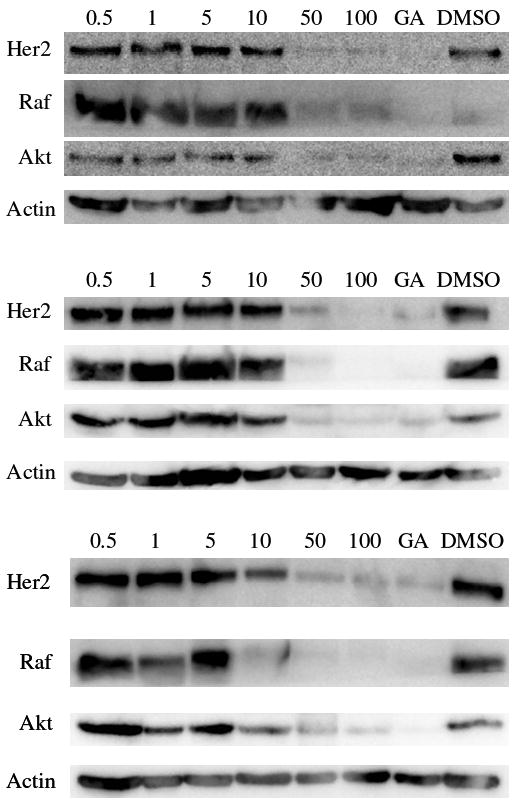
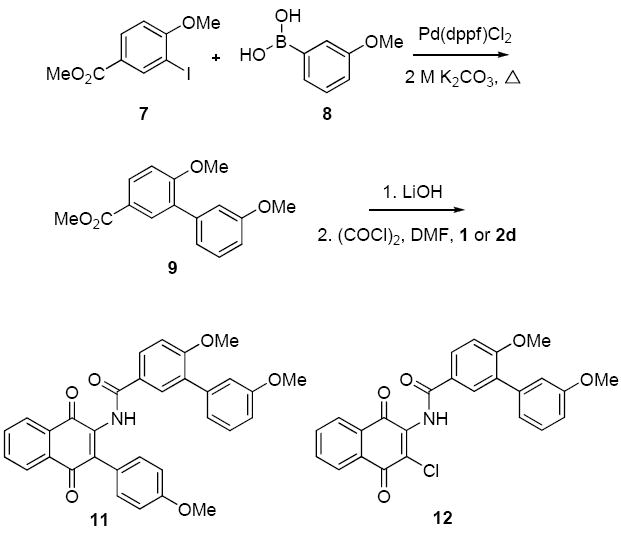
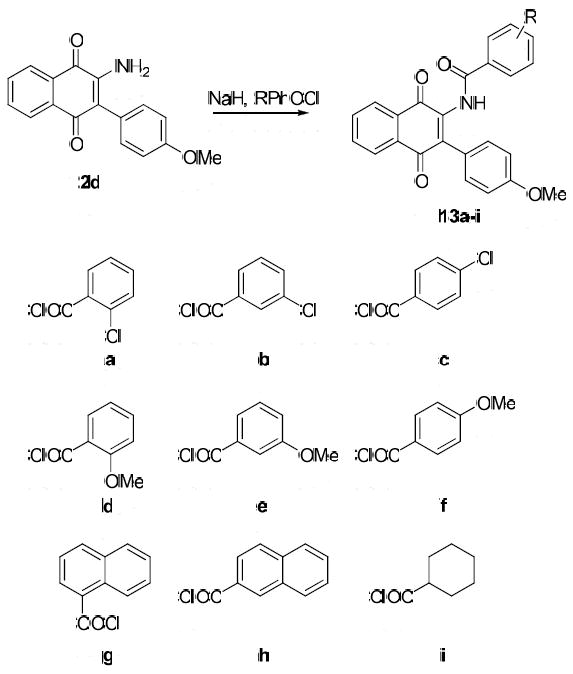
High-throughput screening of a library of diverse molecules has identified the 1,4-naphthoquinone scaffold as a new class of Hsp90 inhibitors. The synthesis and evaluation of a rationally-designed series of analogues containing the naphthoquinone core scaffold has provided key structure-activity relationships for these compounds. The most active inhibitors exhibited potent in vitro activity with low micromolar IC(50) values in anti-proliferation and Her2 degradation assays. In addition, 3g, 12, and 13a induced the degradation of oncogenic Hsp90 client proteins, a hallmark of Hsp90 inhibition. The identification of these naphthoquinones as Hsp90 inhibitors provides a new scaffold upon which improved Hsp90 inhibitors can be developed.
Figures

References
-
- Blagg BS, Kerr TD. Med Res Rev. 2006;26:310–338. - PubMed
-
- Marcu MG, Schulte TW, Neckers L. J Natl Cancer Inst. 2000;92:242–248. - PubMed
-
- Marcu MG, Chadli A, Bouhouche I, Catelli M, Neckers L. J Biol Chem. 2000;276:37181–37186. - PubMed
-
- Allan RK, Mok D, Ward BK, Ratajczak T. J Biol Chem. 2006;281:7161–7171. - PubMed
Publication types
MeSH terms
Substances
Grants and funding
LinkOut - more resources
Full Text Sources
Other Literature Sources
Chemical Information
Research Materials
Miscellaneous
