


Premarin improves memory, prevents scopolamine-induced amnesia and increases number of basal forebrain choline acetyltransferase positive cells in middle-aged surgically menopausal rats
- PMID: 19101559
- PMCID: PMC2775815
- DOI: 10.1016/j.yhbeh.2008.11.008
Premarin improves memory, prevents scopolamine-induced amnesia and increases number of basal forebrain choline acetyltransferase positive cells in middle-aged surgically menopausal rats
Abstract
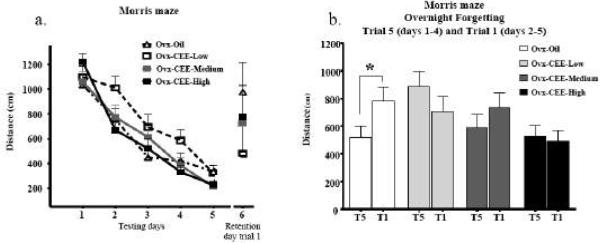
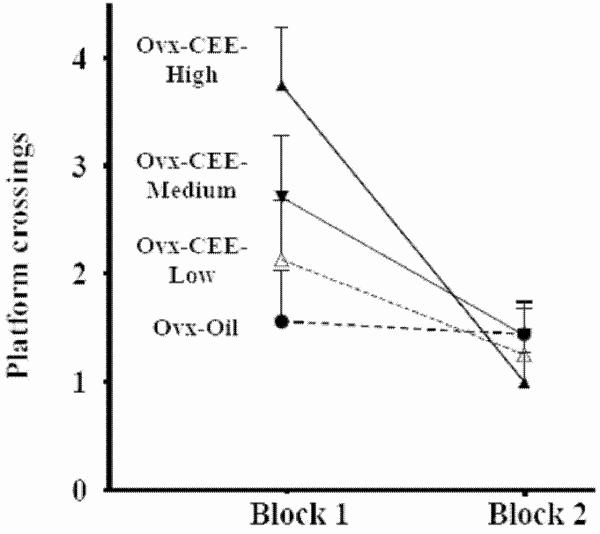
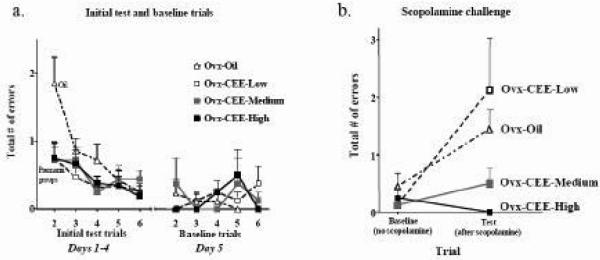
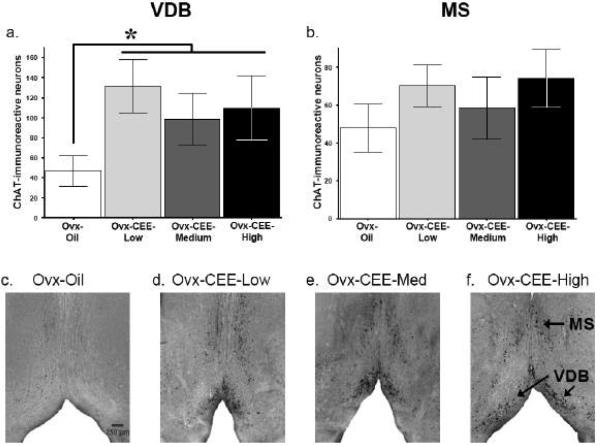
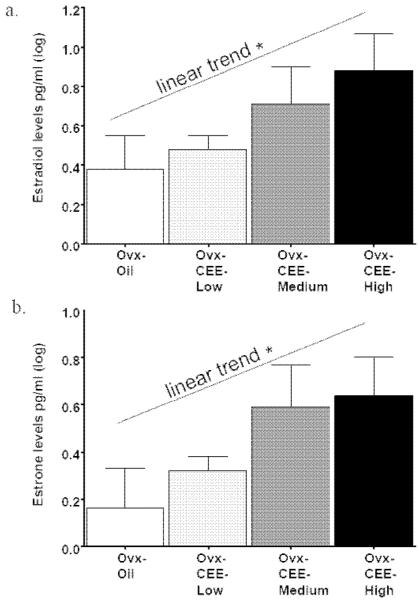
Conjugated equine estrogen (CEE) is the most commonly prescribed estrogen therapy, and is the estrogen used in the Women's Health Initiative study. While in-vitro studies suggest that CEE is neuroprotective, no study has evaluated CEE's effects on a cognitive battery and brain immunohistochemistry in an animal model. The current experiment tested whether CEE impacted: I) spatial learning, reference memory, working memory and long-term retention, as well as ability to handle mnemonic delay and interference challenges; and, II) the cholinergic system, via pharmacological challenge during memory testing and ChAT-immunoreactive cell counts in the basal forebrain. Middle-aged ovariectomized (Ovx) rats received chronic cyclic injections of either Oil (vehicle), CEE-Low (10 microg), CEE-Medium (20 microg) or CEE-High (30 microg) treatment. Relative to the Oil group, all three CEE groups showed less overnight forgetting on the spatial reference memory task, and the CEE-High group had enhanced platform localization during the probe trial. All CEE groups exhibited enhanced learning on the spatial working memory task, and CEE dose-dependently protected against scopolamine-induced amnesia with every rat receiving the highest CEE dose maintaining zero errors after scopolamine challenge. CEE also increased number of ChAT-immunoreactive neurons in the vertical diagonal band of the basal forebrain. Neither the ability to remember after a delay nor interference, nor long-term retention, was influenced by the CEE regimen used in this study. These findings are similar to those reported previously for 17 beta-estradiol, and suggest that CEE can provide cognitive benefits on spatial learning, reference and working memory, possibly through cholinergic mechanisms.
Figures
References
-
- Ashby J, Odum J, Foster JR. Activity of raloxifene in immature and ovariectomized rat uterotrophic assays. Regul Toxicol Pharmacol. 1997;25:226–31. - PubMed
-
- Bhavnani BR. Estrogens and menopause: pharmacology of conjugated equine estrogens and their potential role in the prevention of neurodegenerative diseases such as Alzheimer's. J Steroid Biochem Mol Biol. 2003;85:473–82. - PubMed
-
- Bimonte-Nelson HA, Francis KR, Umphlet CD, Granholm AC. Progesterone reverses the spatial memory enhancements initiated by tonic and cyclic oestrogen therapy in middle-aged ovariectomized female rats. Eur J Neurosci. 2006;24:229–42. - PubMed
-
- Bimonte HA, Denenberg VH. Estradiol facilitates performance as working memory load increases. Psychoneuroendocrinology. 1999;24:161–73. - PubMed
-
- Bohacek J, Bearl AM, Daniel JM. Long-term ovarian hormone deprivation alters the ability of subsequent oestradiol replacement to regulate choline acetyltransferase protein levels in the hippocampus and prefrontal cortex of middle-aged rats. J Neuroendocrinol. 2008;20:1023–7. - PubMed
Publication types
MeSH terms
Substances
Grants and funding
LinkOut - more resources
Full Text Sources
Medical
