


Misperceived pre-pregnancy body weight status predicts excessive gestational weight gain: findings from a US cohort study
- PMID: 19102729
- PMCID: PMC2639379
- DOI: 10.1186/1471-2393-8-54
Misperceived pre-pregnancy body weight status predicts excessive gestational weight gain: findings from a US cohort study
Abstract
Background: Excessive gestational weight gain promotes poor maternal and child health outcomes. Weight misperception is associated with weight gain in non-pregnant women, but no data exist during pregnancy. The purpose of this study was to examine the association of misperceived pre-pregnancy body weight status with excessive gestational weight gain.
Methods: At study enrollment, participants in Project Viva reported weight, height, and perceived body weight status by questionnaire. Our study sample comprised 1537 women who had either normal or overweight/obese pre-pregnancy BMI. We created 2 categories of pre-pregnancy body weight status misperception: normal weight women who identified themselves as overweight ('overassessors') and overweight/obese women who identified themselves as average or underweight ('underassessors'). Women who correctly perceived their body weight status were classified as either normal weight or overweight/obese accurate assessors. We performed multivariable logistic regression to determine the odds of excessive gestational weight gain according to 1990 Institute of Medicine guidelines.
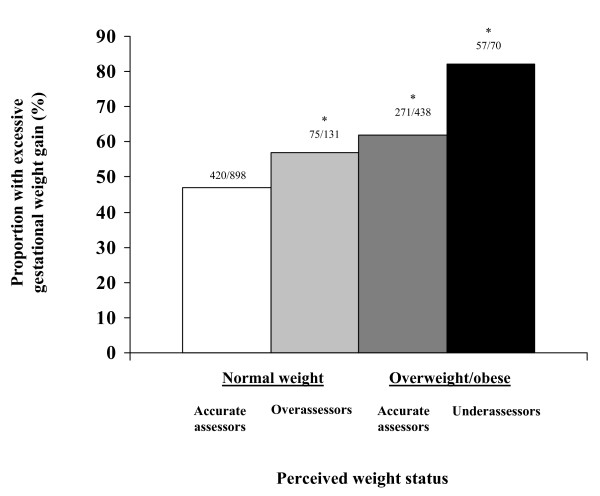
Results: Of the 1029 women with normal pre-pregnancy BMI, 898 (87%) accurately perceived and 131 (13%) overassessed their weight status. 508 women were overweight/obese, of whom 438 (86%) accurately perceived and 70 (14%) underassessed their pre-pregnancy weight status. By the end of pregnancy, 823 women (54%) gained excessively. Compared with normal weight accurate assessors, the adjusted odds of excessive gestational weight gain was 2.0 (95% confidence interval [CI]: 1.3, 3.0) in normal weight overassessors, 2.9 (95% CI: 2.2, 3.9) in overweight/obese accurate assessors, and 7.6 (95% CI: 3.4, 17.0) in overweight/obese underassessors.
Conclusion: Misperceived pre-pregnancy body weight status was associated with excessive gestational weight gain among both normal weight and overweight/obese women, with the greatest likelihood of excessive gain among overweight/obese underassessors. Future interventions should test the potential benefits of correcting misperception to reduce the likelihood of excessive gestational weight gain.
Figures
References
-
- Gunderson EP, Abrams B. Epidemiology of gestational weight gain and body weight changes after pregnancy. Epidemiol Rev. 2000;22:261–274. - PubMed
-
- Rhodes JC, Schoendorf KC, Parker JD. Contribution of excess weight gain during pregnancy and macrosomia to the cesarean delivery rate, 1999–2000. Pediatrics. 2003;111:1181–1185. - PubMed
Publication types
MeSH terms
Grants and funding
LinkOut - more resources
Full Text Sources
Medical
