. 2009 Mar;191(5):1656-65.
doi: 10.1128/JB.01555-08. Epub 2008 Dec 19.

sarZ, a sarA family gene, is transcriptionally activated by MgrA and is involved in the regulation of genes encoding exoproteins in Staphylococcus aureus

Affiliations

sarZ, a sarA family gene, is transcriptionally activated by MgrA and is involved in the regulation of genes encoding exoproteins in Staphylococcus aureus

Anand Ballal et al. J Bacteriol. 2009 Mar.

Abstract

The expression of genes involved in the pathogenesis of Staphylococcus aureus is controlled by global regulatory loci, including two-component regulatory systems and transcriptional regulators (e.g., sar family genes). Most members of the SarA family have been partially characterized and shown to regulate a large numbers of target genes. Here, we describe the characterization of sarZ, a sarA paralog from S. aureus, and its regulatory relationship with other members of its family. Expression of sarZ was growth phase dependent with maximal expression in the early exponential phase of growth. Transcription of sarZ was reduced in an mgrA mutant and returned to a normal level in a complemented mgrA mutant strain, which suggests that mgrA acts as an activator of sarZ transcription. Purified MgrA protein bound to the sarZ promoter region, as determined by gel shift assays. Among the sarA family of genes analyzed, inactivation of sarZ increased sarS transcription, while it decreased agr transcription. The expression of potential target genes involved in virulence was evaluated in single and double mutants of sarZ with mgrA, sarX, and agr. Northern and zymogram analyses indicated that the sarZ gene product played a role in regulating several virulence genes, particularly those encoding exoproteins. Gel shift assays demonstrated nonspecific binding of purified SarZ protein to the promoter regions of the sarZ-regulated target genes. These results demonstrate the important role played by SarZ in controlling regulatory and virulence gene expression in S. aureus.


Figures
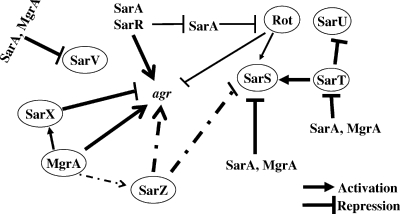
FIG. 1.
FIG. 1.
Overview of the predicted intertwined regulatory networks of 10 sar family genes and their relationship with the agr locus. This overview is mostly based on genetic and biochemical analyses in strain RN6390 under normal conditions of growth (8, 10, 28-36, 41, 49-52). Several members of the sar family of genes (e.g., sarV, sarT, and sarU) are not transcribed due to repression by other normally expressed sar family genes (32, 33, 49). The pathways identified in this study are depicted by dashed lines. The thickness of the line indicates the nature of regulation: thin, partially involved, and thick, completely involved.
FIG. 2.
FIG. 2.
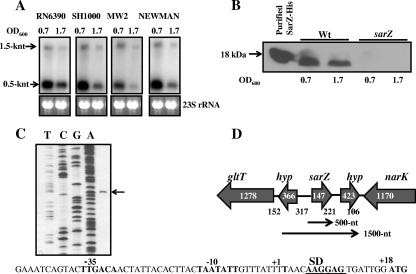
Transcription, expression, and promoter analysis of the sarZ gene in S. aureus. (A) Northern analysis of the sarZ transcripts in the different wild-type strains at various phases of growth (an OD600 of 0.7 is approximately the early exponential phase of growth, and an OD600 of 1.7 is approximately the postexponential phase of growth). The blots were probed with 500-bp sarZ DNA fragments containing the entire ORF of the sarZ gene. The region of 23S rRNA of the ethidium bromide-stained gel used for blotting is also shown as a loading control. (B) Cell extracts of the RN6390 strain were immunoblotted onto nitrocellulose and probed with anti-SarZ polyclonal antibodies. A purified His tag fusion of SarZ was loaded as a positive control. Wt, wild type. (C) Primer extension of the sarZ transcript with total RNA isolated from the wild-type RN6390 at the exponential phase of growth. The nucleotide sequence with the predicted promoter region of the sarZ ribosome-binding site (SD) and the translational start codon (ATG) are indicated. (D) Location of the sarZ gene (SA2174) on the S. aureus chromosome. The sarZ gene and the other ORFs in its vicinity are depicted. The number within each ORF indicates the size of the gene (in bp), and the number below the junction of two neighboring genes is the intergenic distance (in bp) between them. hyp, hypothetical ORF with unknown function. The location of a 500-nt transcript is mapped based on primer extension results, whereas the origin of the 1,500-nt transcript is hypothetical.
FIG. 3.
FIG. 3.
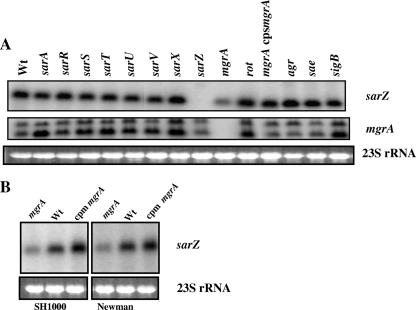
(A) Northern analysis of the sarZ and mgrA transcripts in the wild type (Wt), various isogenic mutants, and a single-copy complemented strain of the mgrA mutant at exponential phase (OD600, ∼0.7) of growth. DNA fragments (500 bp and 550 bp) containing sarZ and mgrA genes, respectively, were used for hybridization. cpsmgrA indicates the complementation in single copy of the mgrA gene on the lipase locus (geh) of the mgrA mutant. (B) Northern analysis with a 500-bp sarZ DNA probe of the mgrA mutants and complemented (cpm) strains from different S. aureus strains, as indicated. The region of 23S rRNA of the ethidium bromide-stained gel used for blotting is also shown as a loading control in both panels.
FIG. 4.
FIG. 4.
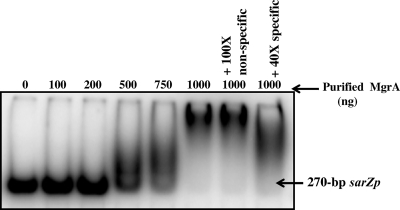
Autoradiogram of an 8.0% polyacrylamide gel showing gel shifts for purified MgrA protein with a γ-32P-labeled 270-bp sarZ promoter fragment (1 ng or 6 fmol per lane). The mobility of the band was noted in the presence of increasing amounts of MgrA protein, as indicated above the gel. The lanes containing competitor DNA, i.e., an unlabeled specific 270-bp sarZ promoter fragment (40-fold molar excess) and a nonspecific 185-bp internal DNA fragment of the sarX ORF (100-fold molar excess) are indicated.
FIG. 5.
FIG. 5.
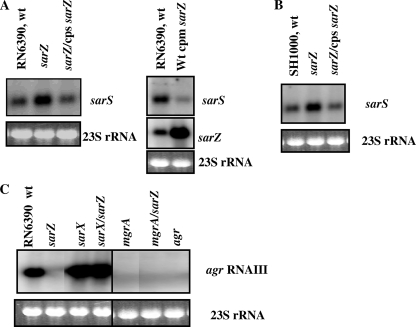
Analysis of the expression of sarS and agr transcripts in various mutant strains. (A) Northern blots of sarS transcript in the wild-type (wt), sarZ mutant, and single-copy (cps) complemented strains from the mid-exponential (OD600, ∼1.1) phase of growth in an RN6390 background. (Right) Blots of sarS and sarZ transcripts in the wild type and the wild type expressing the sarZ gene in a multicopy shuttle vector, pSK236 (cpm), from the mid-exponential (OD600, ∼1.1) phase of growth. The blots were hybridized with 750-bp and 500-bp DNA fragments containing ORFs of sarS and sarZ, respectively. (B) Northern blots of sarS transcript in the wild-type, sarZ mutant, and single-copy (cps) complemented strains from the mid-exponential (OD600, ∼1.1) phase of growth in an SH1000 background. (C) Northern blots of agr RNAIII transcript in the wild type and various single and double mutants, as indicated, from the postexponential (OD600, ∼1.7) phase of growth. The blots were probed with 0.5-kb DNA fragments containing the agr RNAIII region. The region of 23S rRNA of the ethidium bromide-stained gel used for blotting is also shown as a loading control in all panels.
FIG. 6.
FIG. 6.
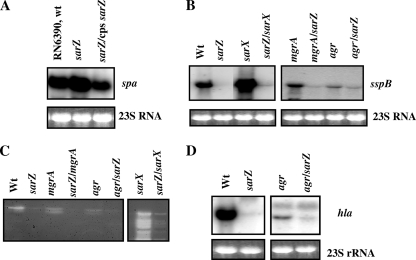
Analysis of target gene transcription (A, B, and D) and expression (C) in different isogenic single- and double-mutant strains of RN6390. (A) Northern blots of spa (protein A) transcript in the RN6390 wild-type (wt), sarZ mutant, and single-copy (cps) complemented strains from the mid-exponential (OD600, ∼1.1) phase of growth. (B) Northern blots of cysteine protease (sspB) transcript in the wild-type and isogenic single- and double-mutant strains, as indicated, from the postexponential phase of growth (OD600, ∼1.7). A 1.0-kb DNA fragment containing the sspB ORF was used for hybridization. In S. aureus, the V8 protease gene (sspA), the cysteine protease gene (sspB), and an unknown gene (sspC) are in a single transcriptional unit (39). (C) Gelatin zymogram of culture supernatants from various S. aureus RN6390 strains as indicated. Equal amounts of culture supernatant (OD600, ∼1.7) were used for all strains, except sarX and the sarZ sarX mutant, where one-fifth volume was applied. (D) Northern blot analysis for α-hemolysin (hla) transcript in assorted S. aureus RN6390 strains, as indicated, from the postexponential phase of growth. The Northern blot was hybridized with an hla fragment containing the coding region of the hemolysin gene. The region of 23S rRNA of the ethidium bromide-stained gel used for blotting is also shown as a loading control in panels A, B, and D.
FIG. 7.
FIG. 7.
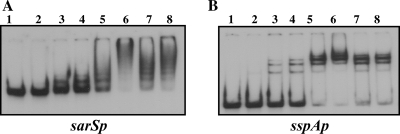
DNA binding activity of SarZ protein. Autoradiograms of 8.0% polyacrylamide gels showing the binding of SarZ protein to 287-bp and 250-bp promoter fragments (1 ng each or 5 and 6 fM, respectively) of sarS (A) and sspA (B), respectively. In panel A, lanes 1 to 5 correspond to 0 ng, 100 ng, 200 ng, 300 ng, and 500 ng, and lanes 6 to 8 correspond to 1.0 μg of purified SarZ protein. In panel B, lanes 1 to 5 correspond to 0 ng, 25 ng, 50 ng, 100 ng, and 200 ng, and lanes 6 to 8 correspond to 300 ng of purified SarZ protein. The mobilities of the bands were noted in the presence of increasing amounts of SarZ protein. A 50-fold excess (molar ratio) of specific unlabeled competitor DNA of the respective promoter fragments was used for competition in lanes 7 in both panels, whereas a 50-fold molar excess of a nonspecific competitor DNA (a 185-bp internal fragment of the sarX ORF region) is shown in lane 8 of each panel.

References

    1. Ausubel, F. M., R. Brent, R. E. Kingston, D. D. Moore, J. G. Seidman, J. A. Smith, and K. Struhl. 2000. Current protocols in molecular biology. John Wiley & Sons, New York, NY.
    1. Blevins, J. S., A. F. Gillaspy, T. M. Rechtin, B. K. Hurburt, and M. S. Smeltzer. 1999. The staphylococcal accessory regulator (sar) represses transcription of the S. aureus collagen adhesin gene (cna) in an agr-independent manner. Mol. Microbiol. 33317-326. - PubMed
    1. Brandenberger, M., M. Tschierske, P. Giachino, A. Wada, and B. Berger-Bachi. 2000. Inactivation of a novel three-cistronic operon tcaR-tcaA-tcaB increases teicoplanin resistance in Staphylococcus aureus. Biochim. Biophy. Acta 1523135-139. - PubMed
    1. Brunskill, E. W., and K. W. Bayles. 1996. Identification of LytSR-regulated genes from Staphylococcus aureus. J. Bacteriol. 1785810-5812. - PMC - PubMed
    1. Cassat, J., P. M. Dunman, E. Murphy, S. J. Projan, K. E. Beenken, K. J. Palm, S.-J. Yang, K. C. Rice, K. W. Bayles, and M. S. Smeltzer. 2006. Transcriptional profiling of a Staphylococcus aureus clinical isolate and its isogenic agr and sarA mutants reveals global differences in comparison to the laboratory strain RN6390. Microbiology 1523075-3090. - PubMed

Publication types

MeSH terms

LinkOut - more resources