Review
. 2008 Dec 23;105(51):20067-71.
doi: 10.1073/pnas.0806070105. Epub 2008 Dec 22.

Regulatory logic of neuronal diversity: terminal selector genes and selector motifs

Affiliations
Review

Regulatory logic of neuronal diversity: terminal selector genes and selector motifs

Oliver Hobert. Proc Natl Acad Sci U S A. .

Abstract

Individual neuronal cell types are defined by the expression of unique batteries of terminal differentiation genes. The elucidation of the cis-regulatory architecture of several distinct, single neuron type-specific gene batteries in Caenorhabditis elegans has revealed a strikingly simple cis-regulatory logic, in which small cis-regulatory motifs are activated in postmitotic neurons by autoregulating transcription factors (TFs). Loss of the TFs results in the loss of the identity of the individual neuron type. I propose to term these TFs "terminal selector genes" and their cognate cis-regulatory target sites "terminal selector motifs." Terminal selector genes assign individual neuronal identities by directly controlling the expression of downstream, terminal differentiation genes and act in specific regulatory network configurations. The simplicity of the cis-regulatory logic on which the terminal selector gene concept is based may contribute to the evolvability of neuronal diversity.


Conflict of interest statement

The author declares no conflict of interest.

Figures
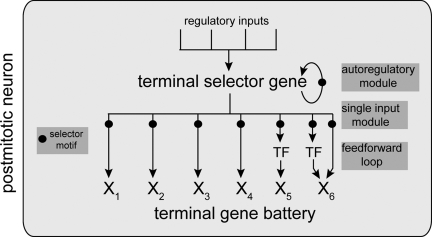
Fig. 1.
Fig. 1.
Network configuration of terminal selector genes. Terminal selector TFs (acting either alone or in synergistic combination) activate downstream target genes directly via terminal selector motifs and also autoregulate their own expression via those motifs. Autoregulated, maintained expression of a terminal selector is critical to maintain the differentiated features of the cell. Downstream targets of terminal selectors (X) define differentiated properties of a neuron, such as neurotransmitter receptor, ion channels, adhesion proteins etc. Targets may also include TFs that regulate specific “subroutines.” The targets of these TFs may not harbor terminal selector motifs; therefore, not all genes expressed in a given neuron type must have a selector motif in their regulatory region (4). TFs that are induced by terminal selectors may also cooperate with terminal selector proteins in a feed-forward loop configuration to jointly control specific terminal genes (39, 44). Besides activating the expression of identity-defining genes it is also possible that terminal selectors may repress alternative fates through repressing the expression of selector genes for other cell types. This would explain neuronal identity switches observed upon removing putative terminal selector genes (26).

References

    1. Cajal Ry. Histologie du Système Nerveux de L'Homme et des Vertébrés. Paris: Maloine; 1911.
    1. White JG, Southgate E, Thomson JN, Brenner S. The structure of the nervous system of the nematode Caenorhabditis elegans. Philos Trans R Soc London Ser B. 1986;314:1–340. - PubMed
    1. Hobert O The C. elegans Research Community, editor. Specification of the nervous system. WormBook. 2005 doi/ 10.1895/wormbook.1.12.1. - DOI - PMC - PubMed
    1. Etchberger JF, et al. The molecular signature and cis-regulatory architecture of a C. elegans gustatory neuron. Genes Dev. 2007;21:1653–1674. - PMC - PubMed
    1. Chang S, Johnston RJ, Jr, Hobert O. A transcriptional regulatory cascade that controls left/right asymmetry in chemosensory neurons of C. elegans. Genes Dev. 2003;17:2123–2137. - PMC - PubMed

Publication types

Substances

LinkOut - more resources
