


Islet transplantation with alemtuzumab induction and calcineurin-free maintenance immunosuppression results in improved short- and long-term outcomes
- PMID: 19104407
- PMCID: PMC2759396
- DOI: 10.1097/TP.0b013e31819025e5
Islet transplantation with alemtuzumab induction and calcineurin-free maintenance immunosuppression results in improved short- and long-term outcomes
Abstract
Background: Only a minority of islet transplant recipients maintain insulin independence at 5 years under the Edmonton protocol of immunosuppression. New immunosuppressive strategies are required to improve long-term outcomes.
Materials and methods: Three subjects with unstable type 1 diabetes mellitus underwent islet transplantation with alemtuzumab induction and sirolimus-tacrolimus maintenance for 3 months and then sirolimus-mycophenolic acid maintenance thereafter. Follow-up was more than 2 years. Comparison was with 16 historical subjects transplanted under the Miami version of the Edmonton protocol.
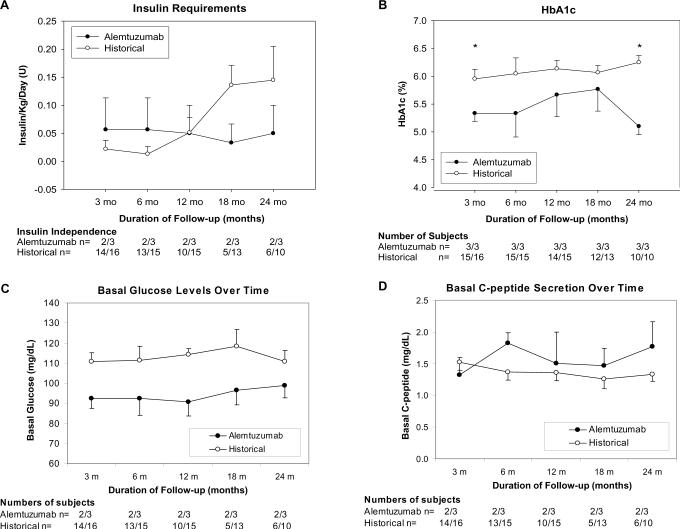
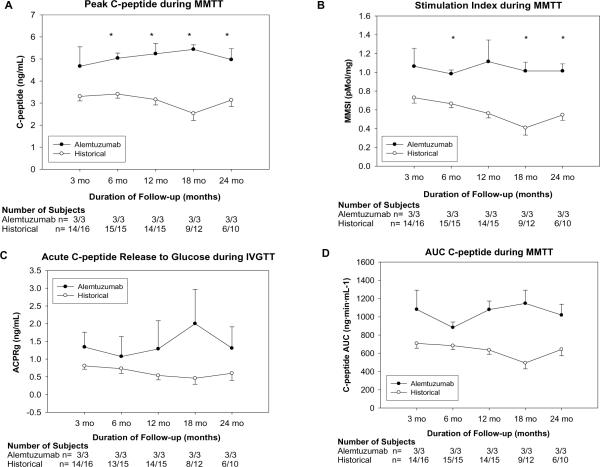
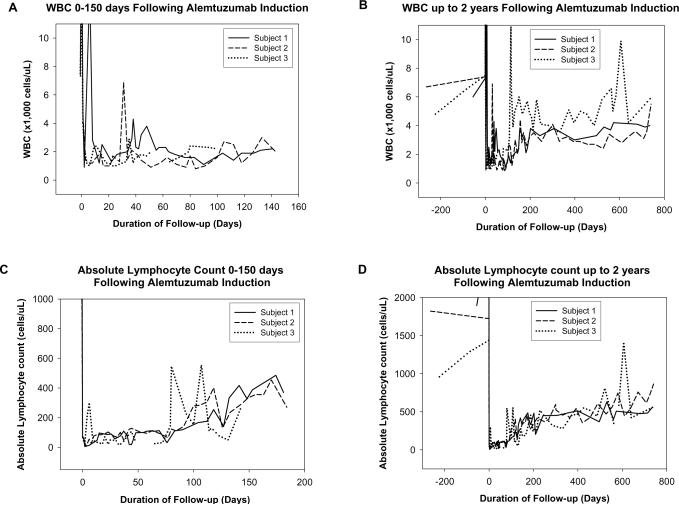
Results: Insulin independence was achieved in 2 of 3 alemtuzumab and 14 of 16 historical subjects. Those who did not achieve insulin independence only received a single islet infusion. Insulin-independence rates remained unchanged in the alemtuzumab group, but decreased from 14 of 16 (88%) to 6 of 16 (38%) in the historical group over 2 years. Insulin requirements increased in the historical group while remaining stable in the alemtuzumab group. Comparison of functional measures at 3 months suggested better engraftment with alemtuzumab (P=NS). Further comparison of alemtuzumab versus historical groups, up to 24 months, demonstrated significantly better: Mixed meal stimulation index (24 months, 1.0+/-0.08 [n=3] vs. 0.5+/-0.06 pmol/mL [n=6], P<0.01), mixed meal peak C-peptide (24 months, 5.0+/-0.5 [n=3] vs. 3.1+/-0.3 nmol/mL [n=6], P<0.05), HbA1c (24 months, 5.4+/-0.15 [n=3] vs. 6.3+/-0.12 pmol/mL [n=10], P<0.01). Administration of alemtuzumab was well tolerated. There was no increased incidence of infections in alemtuzumab subjects despite profound, prolonged lymphocyte depletion.
Conclusions: Islet transplantation with alemtuzumab induction was well tolerated and resulted in improved short- and long-term outcomes. Further investigation is underway for validation.
Figures
References
-
- Bennet W, Groth CG, Larsson R, Nilsson B, Korsgren O. Isolated human islets trigger an instant blood mediated inflammatory reaction: implications for intraportal islet transplantation as a treatment for patients with type 1 diabetes. Ups J Med Sci. 2000;105:125–133. - PubMed
-
- Bloom DD, Chang Z, Fechner JH, Dar W, Polster SP, Pascual J, et al. CD4+ CD25+ FOXP3+ regulatory T cells increase de novo in kidney transplant patients after immunodepletion with Campath-1H. Am J Transplant. 2008;8:793–802. - PubMed
-
- Fernandez LA, Lehmann R, Luzi L, Battezzati A, Angelico MC, Ricordi C, et al. The effects of maintenance doses of FK506 versus cyclosporin A on glucose and lipid metabolism after orthotopic liver transplantation. Transplantation. 1999;68:1532–1541. - PubMed
-
- Froud T, Ricordi C, Baidal DA, Hafiz MM, Ponte G, Cure P, et al. Islet transplantation in type 1 diabetes mellitus using cultured islets and steroid-free immunosuppression: Miami experience. Am J Transplant. 2005;5:2037–2046. - PubMed
-
- Huang E, Cho YW, Hayashi R, Bunnapradist S. Alemtuzumab induction in deceased donor kidney transplantation. Transplantation. 2007;84:821–828. - PubMed
Publication types
MeSH terms
Substances
Grants and funding
LinkOut - more resources
Full Text Sources
Medical
Miscellaneous
