. 2009 Apr;50 Suppl(Suppl):S183-8.
doi: 10.1194/jlr.R800069-JLR200. Epub 2008 Dec 22.

Apolipoprotein E: structure determines function, from atherosclerosis to Alzheimer's disease to AIDS

Affiliations

Apolipoprotein E: structure determines function, from atherosclerosis to Alzheimer's disease to AIDS

Robert W Mahley et al. J Lipid Res. 2009 Apr.

Abstract

Apolipoprotein (apo) E has roles beyond lipoprotein metabolism. The detrimental effects of apoE4 in cardiovascular, neurological, and infectious diseases correlate with its structural features (e.g., domain interaction) that distinguish it from apoE3 and apoE2. Structure/function studies revealed that apoE2 is severely defective in LDL receptor binding because of a structural difference that alters the receptor binding region and helped unravel the mechanism of type III hyperlipoproteinemia. ApoE4 is the major genetic risk factor for Alzheimer's disease and sets the stage for neuropathological disorders precipitated by genetic, metabolic, and environmental stressors. ApoE also influences susceptibility to parasitic, bacterial, and viral infections. In HIV-positive patients, apoE4 homozygosity hastens progression to AIDS and death and increases susceptibility to opportunistic infections. The next phase in our understanding of apoE will be characterized by clinical intervention to prevent or reverse the detrimental effects of apoE4 by modulating its structure or blocking the pathological processes it mediates.


Figures
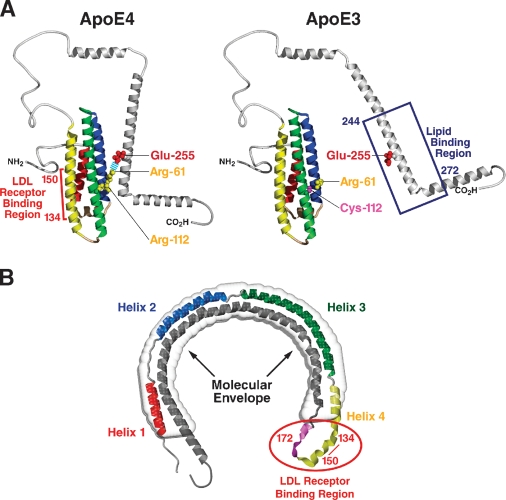
Fig. 1.
Fig. 1.
Structure of apoE. A: Model of domain interaction. In apoE4, Arg-112 orients the side chain of Arg-61 into the aqueous environment where it can interact with Glu-255, resulting in interaction between the N- and C-terminal domains. In apoE3, Arg-61 is not available to interact with glutamic acid–255. [Reproduced from (56).] B: Model of apoE bound to DMPC. X-ray analysis at 10Å resolution revealed that the molecular envelope of apoE bound to DMPC is in the shape of a circular horseshoe (gray), indicating that apoE undergoes extensive conformational change in binding to lipid. ApoE was modeled into the dimensions of the molecular envelope and is colored to show the known secondary structure of the N-terminal domain. red, helix 1; blue, helix II; green, helix III; yellow, helix IV and the connecting loop. Residues that contribute to the LDL receptor binding site are in pink, showing the juxtaposition of basic residues 134–150 with Arg-172. Residues in the C-terminal domain are shown in gray.
Fig. 2.
Fig. 2.
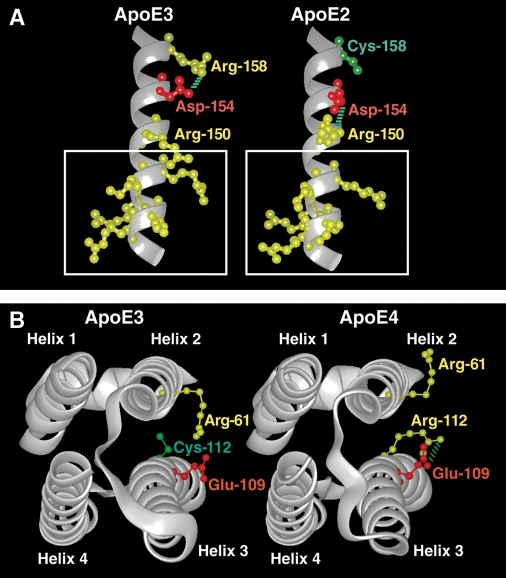
Three-dimensional structure of regions of apoE highlighting isoform differences. A: The region of helix 4 where a critical salt bridge rearrangement in apoE2 reduces the positive potential of the LDL receptor binding site (boxed). Asp-154 changes its ionic interaction to Arg-150 in apoE2 because of the Cys-158 substitution, pulling the side chain of Arg-150 out of the positive potential cloud, reducing its potential, and causing a 100-fold reduction in apoE receptor binding. (Courtesy of Karl H. Weisgraber.) B: Four-helix bundle of apoE showing rearrangement of the Arg-61 side chain. The substitution of Arg-112 in apoE4 leads to an ionic interaction with Glu-109 that excludes the Arg-61 side chain from its usual position, causing Arg-61 to be more exposed at the side of helix 2 and allowing it to become available for interaction with Glu-255 in the C-terminal domain of apoE (data not shown). [Reproduced from (57) and used by permission of Lippincott Williams & Wilkins.]

References

    1. Mahley R. W. 1988. Apolipoprotein E: cholesterol transport protein with expanding role in cell biology. Science. 240 622–630. - PubMed
    1. Weisgraber K. H. 1994. Apolipoprotein E: structure–function relationships. Adv. Protein Chem. 45 249–302. - PubMed
    1. Mahley R. W., and S. C. Rall, Jr. 2000. Apolipoprotein E: far more than a lipid transport protein. Annu. Rev. Genomics Hum. Genet. 1 507–537. - PubMed
    1. Mahley R. W., K. H. Weisgraber, and Y. Huang. 2006. Apolipoprotein E4: a causative factor and therapeutic target in neuropathology, including Alzheimer's disease. Proc. Natl. Acad. Sci. USA. 103 5644–5651. - PMC - PubMed
    1. Shore V. G., and B. Shore. 1973. Heterogeneity of human plasma very low density lipoproteins. Separation of species differing in protein components. Biochemistry. 12 502–507. - PubMed

Publication types

MeSH terms

Substances