Perceptions of smoking-related risks and benefits as predictors of adolescent smoking initiation
- PMID: 19106420
- PMCID: PMC2661432
- DOI: 10.2105/AJPH.2008.137679
Perceptions of smoking-related risks and benefits as predictors of adolescent smoking initiation
Abstract
Objectives: The predictive value of perceptions of smoking-related risks and benefits with regard to adolescent smoking initiation has not been adequately established. We used prospective, longitudinal data to directly test whether smoking-related perceptions predict smoking initiation among adolescents.
Methods: We administered surveys assessing perceptions of smoking-related risks and benefits to 395 high school students, beginning at the start of their ninth-grade year. We conducted follow-up assessments every 6 months until the end of 10th grade, obtaining 4 waves of data.
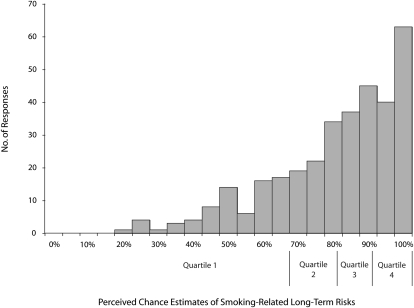
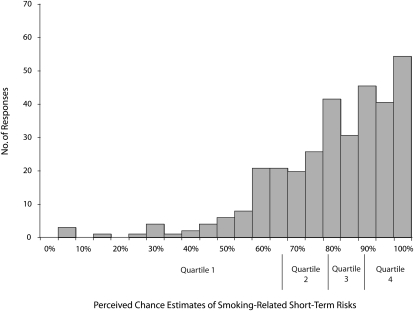
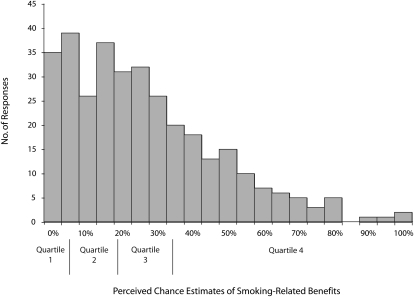
Results: Adolescents who held the lowest perceptions of long-term smoking-related risks were 3.64 times more likely to start smoking than were adolescents who held the highest perceptions of risk. Adolescents who held the lowest perceptions of short-term smoking-related risks were 2.68 times more likely to initiate. Adolescents who held the highest perceptions of smoking-related benefits were 3.31 times more likely to initiate.
Conclusions: Findings from this study provide one of the first sets of empirical evidence to show that smoking initiation is directly related to smoking-related perceptions of risks and benefits. Thus, efforts to reduce adolescent smoking should continue to communicate the health risks of smoking and counteract perceptions of benefits associated with smoking.
Figures
References
-
- Centers for Disease Control and Prevention Annual smoking-attributable mortality, years of potential life lost, and productivity losses—United States, 1997–2001. MMWR Morb Mortal Wkly Rep 2005;54(25):625–628 - PubMed
-
- Results from the 2006 National Survey on Drug Use and Health: National Findings. Rockville, MD: Substance Abuse and Mental Health Services Administration; 2007. DHHS publication SMA 07-4293
-
- Weinstein N. Unrealistic optimism about future life events. J Pers Soc Psychol 1980;39(5):806–820
-
- Weinstein N, Lachendro E. Egocentrism as a source of unrealistic optimism. Pers Soc Psychol Bull 1982;8(2):195–200
-
- Prochaska JO, DiClemente C. Stages and processes of self-change of smoking: toward an integrative model of change. J Consult Clin Psychol 1983;51(3):390–395 - PubMed
MeSH terms
Grants and funding
LinkOut - more resources
Full Text Sources
Medical