


Caveolin-3 regulates myostatin signaling. Mini-review
- PMID: 19108573
- PMCID: PMC2859606
Caveolin-3 regulates myostatin signaling. Mini-review
Abstract
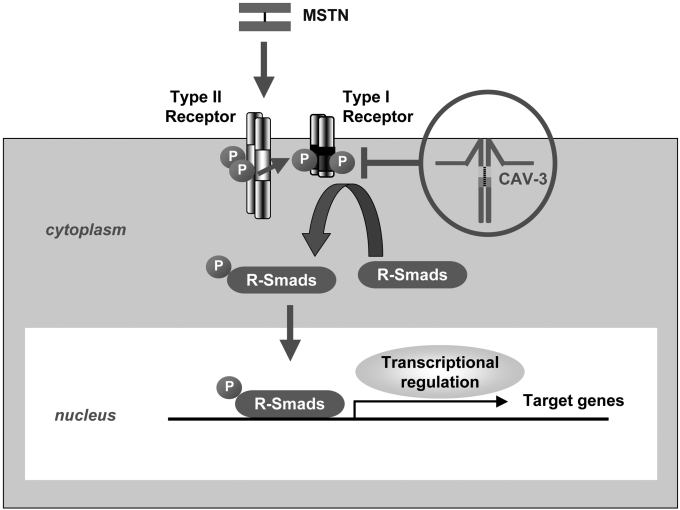
Caveolins, components of the uncoated invaginations of plasma membrane, regulate signal transduction and vesicular trafflicking. Loss of caveolin-3, resulting from dominant negative mutations of caveolin-3 causes autosomal dominant limb-girdle muscular dystrophy (LGMD) 1C and autosomal dominant rippling muscle disease (AD-RMD). Myostatin, a member of the muscle-specific transforming growth factor (TGF)-beta superfamily, negatively regulates skeletal muscle volume. Herein we review caveolin-3 suppressing of activation of type I myostatin receptor, thereby inhibiting subsequent intracellular signaling. In addition, a mouse model of LGMD1C has shown atrophic myopathy with enhanced myostatin signaling. Myostatin inhibition ameliorates muscular phenotype in the model mouse, accompanied by normalized myostatin signaling. Enhanced myostatin signaling by caveolin-3 mutation in human may contribute to the pathogenesis of LGMD1C. Therefore, myostatin inhibition therapy may be a promising treatment for patients with LGMD1C. More recent studies concerning regulation of TGF-beta superfamily signaling by caveolins have provided new insights into the pathogenesis of several human diseases.
Figures
References
-
- Parton RG. Caveolae-from ultrastructure to molecular mechanism. Nat Rev Mol Cell Biol 2003;4:162-7. - PubMed
-
- Parton RG, Hanzal-Bayer M, Hancock JF. Biogenesis of caveolae: a structural model for caveolin-induced domain formation. J Cell Sci 2006;119:787-96. - PubMed
-
- Parton GP, Simonds K. The multiple faces of caveolae. Nat Rev Mol Cell Biol 2007;8:185-94. - PubMed
-
- Razani B, Schlegel A, Lisanti MP. Caveolin proteins in signaling, oncogenic transformation and muscular dystrophy. J Cell Sci 2000;113:2103-9. - PubMed
Publication types
MeSH terms
Substances
LinkOut - more resources
Full Text Sources