


Neurological abnormalities among offspring of persons with schizophrenia: relation to premorbid psychopathology
- PMID: 19108992
- PMCID: PMC3163440
- DOI: 10.1016/j.schres.2008.11.019
Neurological abnormalities among offspring of persons with schizophrenia: relation to premorbid psychopathology
Abstract
Background: Neurological Examination Abnormalities (NEA, often called "neurological soft signs") have been observed in early schizophrenia and may be heritable. We investigated the prevalence, and neurocognitive and psychopathological correlates of NEA among offspring of schizophrenia patients who are at increased genetic risk for this illness.
Methods: Neurological examinations were conducted on high risk (HR, n=74) and healthy comparison subjects (HS, n=86), using the Heinrichs-Buchanan scale. Cognitive-perceptual (CogPer) and repetitive motor (RepMot) subscores, and total NEA scores were computed. All HR and HS were assessed using K-SADS/SCID for diagnoses. Schizotypy was measured using the Magical Ideation and the Perceptual Aberration subscales (Chapman scale), attention using Continuous Performance Test (CPT-IP) and executive functions using the Wisconsin Card Sorting Test (WCST).
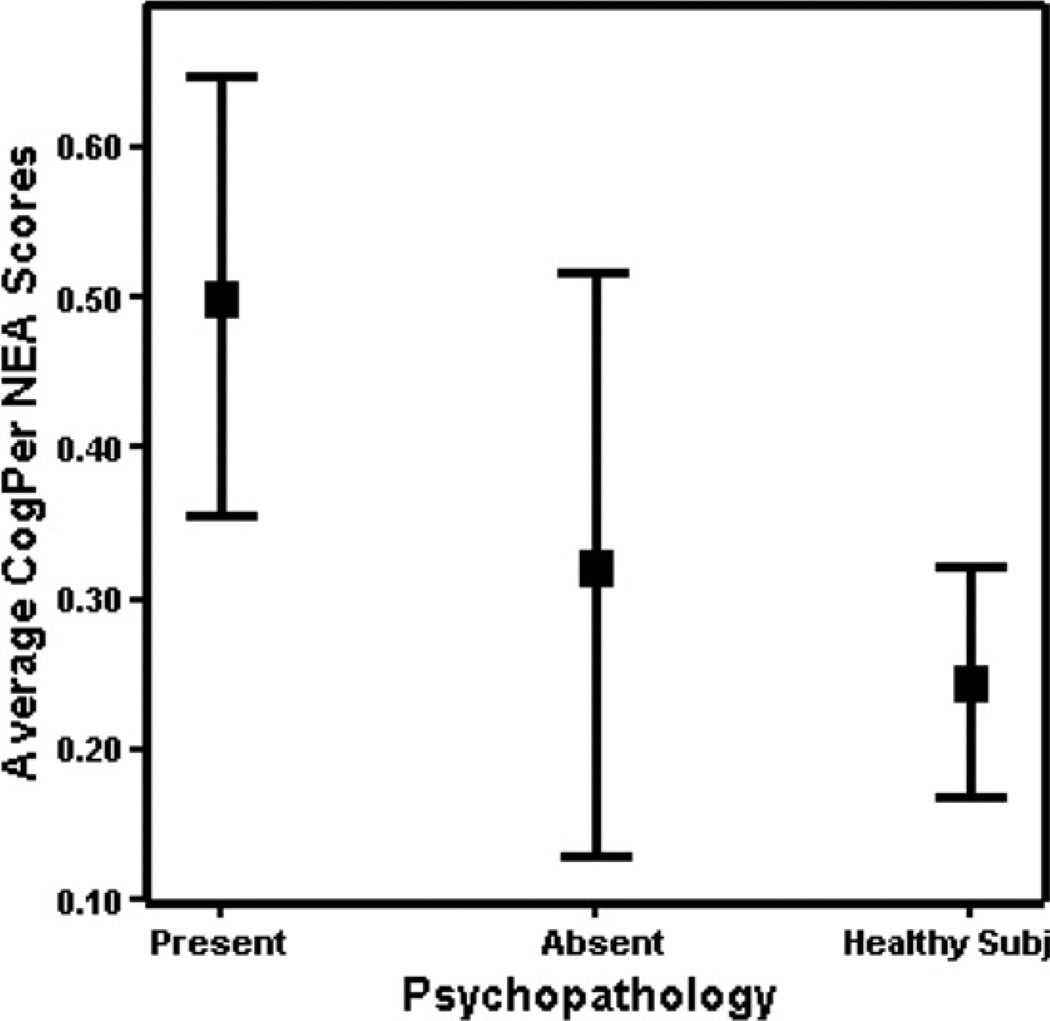
Results: CogPer (F(1,160)=7.14, p=0.008) but not RepMot NEA scores were higher in HR subjects compared to HS after controlling for age and sex. CogPer NEA scores were higher in HR subjects with axis I psychopathology compared to those without (F(2,170)-6.41, p=0.002). HR subjects had higher schizotypy scores (composite of the magical ideation and perceptual aberration scales) (F(1,141)=23.25, p=0.000004). Schizotypy scores were negatively correlated with sustained attention and executive functions. In addition, schizotypy was positively correlated with CogPer NEA scores.
Conclusions: Young relatives at increased genetic risk for schizophrenia show more frequent NEA. CogPer but not RepMot NEA scores were elevated, consistent with our prior observation of CogPer NEA being relatively specific for schizophrenia. The observed relationships between NEA, cognitive impairments, schizotypy and axis I disorders suggest that NEA may characterize a subgroup of HR offspring at an elevated risk for psychopathology.
Conflict of interest statement
All authors declare no conflict of interest with the design, collection, analyses and interpretation of the results of this manuscript.
Figures
References
-
- Almasy L, Blangero J. Endophenotypes as quantitative risk factors for psychiatric disease: rationale and study design. Am. J. Med. Genet. 2001;105(1):42–44. - PubMed
-
- Arango C, Bartko JJ, Gold JM, Buchanan RW. Prediction of neuropsychological performance by neurological signs in schizophrenia. Am. J. Psychiatry. 1999;156(9):1349–1357. - PubMed
-
- Arango C, Kirkpatrick B, Buchanan RW. Neurological signs and the heterogeneity of schizophrenia. Am. J. Psychiatry. 2000;157(4):560–565. - PubMed
-
- Bombin I, Arango C, Buchanan RW. Significance and meaning of neurological signs in schizophrenia: two decades later. Schizophr. Bull. 2005;31(4):962–977. - PubMed
-
- Buchanan RW, Heinrichs DW. The Neurological Evaluation Scale (NES): a structured instrument for the assessment of neurological signs in schizophrenia. Psychiatry Res. 1989;27(3):335–350. - PubMed
Publication types
MeSH terms
Grants and funding
LinkOut - more resources
Full Text Sources
Medical
Miscellaneous
