. 2008 Dec 26;60(6):1068-81.
doi: 10.1016/j.neuron.2008.10.046.

Mice with a "monoclonal nose": perturbations in an olfactory map impair odor discrimination

Affiliations

Mice with a "monoclonal nose": perturbations in an olfactory map impair odor discrimination

Alexander Fleischmann et al. Neuron. .

Abstract

We have altered the neural representation of odors in the brain by generating a mouse with a "monoclonal nose" in which greater than 95% of the sensory neurons express a single odorant receptor, M71. As a consequence, the frequency of sensory neurons expressing endogenous receptor genes is reduced 20-fold. We observe that these mice can smell, but odor discrimination and performance in associative olfactory learning tasks are impaired. However, these mice cannot detect the M71 ligand acetophenone despite the observation that virtually all sensory neurons and glomeruli are activated by this odor. The M71 transgenic mice readily detect other odors in the presence of acetophenone. These observations have implications for how receptor activation in the periphery is represented in the brain and how these representations encode odors.


Figures
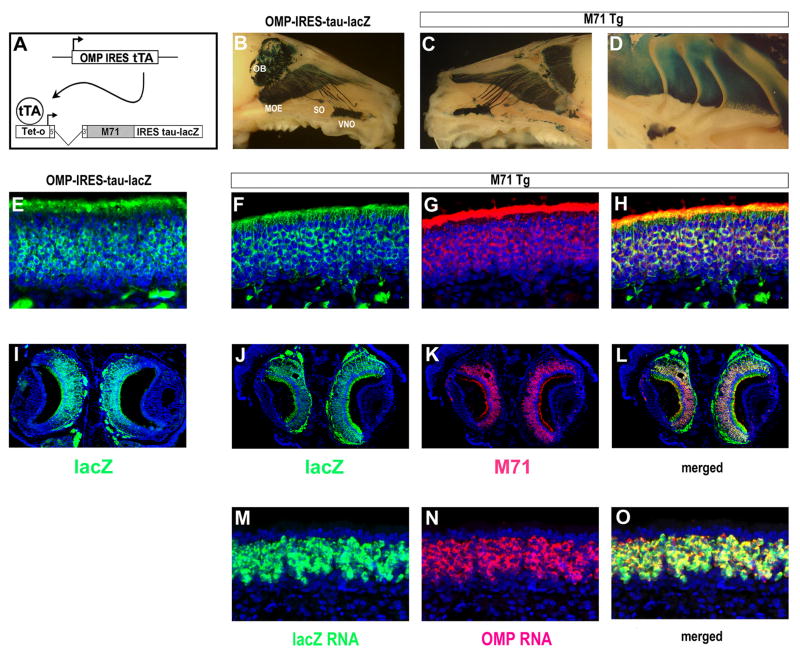
Figure 1
Figure 1
Expression of the teto-M71-IRES-tau-lacZ transgene (M71 Tg) in olfactory sensory epithelia. (A) Schematic of the genetic strategy to express the M71 odorant receptor in all olfactory sensory neurons. The transgene teto-M71-IRES-tau-lacZ can be activated in all sensory neurons by the expression of tTA from the OMP-IRES-tTA locus. (B) Expression of OMP-IRES-tau-lacZ (detected by x-gal staining, blue) marks olfactory sensory neurons in a whole mount preparation in: the main olfactory epithelium (MOE), septal organ (SO), and vomeronasal organ (VNO), as well as in axons of sensory neurons from these areas as they project to the main (OB) and accessory olfactory bulb. (C) The expression of the M71 transgene in all the sensory epithelia detected by x-gal staining (blue) of a whole mount preparation. (D) Expression of the M71 transgene across all zones of the MOE as detected by x-gal staining in a whole mount preparation. (E) Immunohistochemical detection of the expression of lacZ (green) in coronal sections through the olfactory epithelium of control, OMP-IRES-tau-lacZ mice, counterstained with Toto-3 (blue). (F-H) Immunohistochemical detection of the expression of lacZ and M71 in coronal sections through the main olfactory epithelium of M71 transgenic mice. (F) Staining with antibody to lacZ (green). (G) Staining with antibody directed against the M71 receptor (red). (H) Merged fields of F and G. Nuclei are counterstained with Toto-3 (blue). (I) Immunohistochemical detection of the expression of lacZ (green) in coronal sections through the VNO of control OMP-IRES-tau-lacZ mice, counterstained with Toto-3 (blue) (J-L) Immunohistochemical detection of the expression of lacZ and M71 in coronal sections through the VNO of M71 transgenic mice. (J) Staining with antibody to lacZ (green). (K) Staining with antibody directed against the M71 receptor (red). (L) Merged fields of J and K. Nuclei are counterstained with Toto-3 (blue). (M-O) Two-color RNA in situ hybridization detects the ubiquitous expression the M71-IRES-tau-lacZ transgene and the OMP gene in sections through the olfactory epithelium of M71 transgenic mice. (M) RNA in situ hybridization with antisense probe to lacZ RNA (green). (N) RNA in situ hybridization with antisense probe for OMP RNA (red). (O) Merged fields of G and H with nuclei counterstained by Toto-3 (blue).
Figure 2
Figure 2
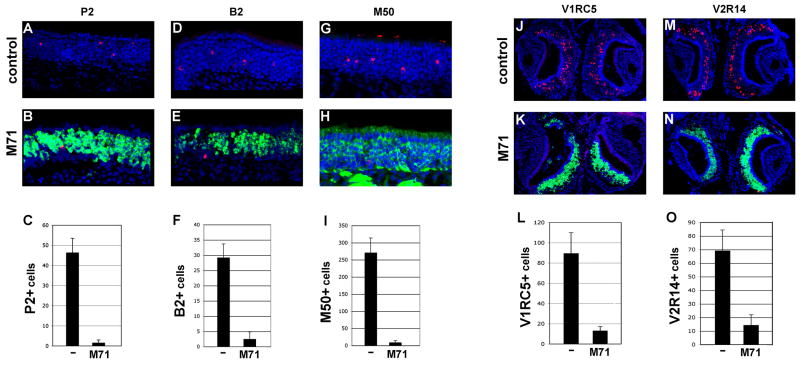
Expression of the endogenous odorant receptor genes in M71 transgenic and control mice detected in coronal sections through the main olfactory and vomeronasal epithelia. Average number of cells expressing the endogenous OR gene per section (n=10) is shown for each receptor in the graphs below. (A, B) Two-color RNA in situ hybridization with differentially labeled riboprobes, lacZ (green) and OR P2 (red), in sections from control (A) and M71 transgenic (B) mice. Nuclei are counterstained with Toto-3 (blue). (C) P2+ cells in controls = 46.5 +/- 7.1 (s.d.), in M71 transgenics = 1.6 +/-1.4 (s.d.). (D, E) Two-color RNA in situ hybridization with differentially labeled riboprobes, lacZ (green) and OR B2 (red), in sections from control (D) and M71 transgenic mice (E). (F) B2+ cells in controls = 29.2 +/- 4.2 (s.d.), in M71 transgenics = 2.5 +/- 1.7 (s.d.). (G, H) Immunohistochemical detection of lacZ and OR M50. Antibody directed against lacZ (green) and M50 receptor (red) in sections from control (G) and M71 transgenic mice (H). (I) M50+ cells in controls = 271 +/- 43 (s.d.), in M71 transgenics = 8.8 +/- 5.2 (s.d.). Nuclei are counterstained with Toto-3 (blue). (J, K) Two-color RNA in situ hybridization with differentially labeled RNA probes for lacZ (green) and the vomeronasal receptor V1RC5 RNA (red) in control (J) and M71 transgenic mice (K). (L) V1RC5+ cells in controls = 89.6+/- 20.4 (s.d.), in M71 transgenics = 13.2 +/- 4.0 (s.d.). (M, N) Two-color RNA in situ hybridization with riboprobes for lacZ RNA (green), and the vomeronasal receptor V2R14 RNA (red), in control (M) and M71 transgenic mice (N). (O) V2R14+ cells in controls = 69.2 +/- 15.3 (s.d.), and in M71 transgenics = 14.4 +/- 7.6 (s.d.).
Figure 3
Figure 3
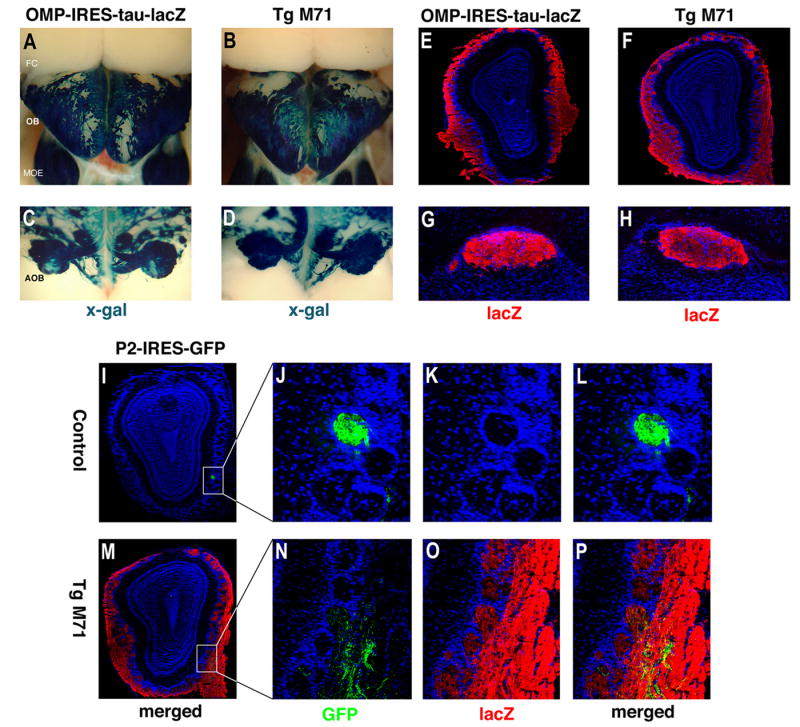
Pervasive innervation of the olfactory bulb in M71 transgenic mice. (A) Dorsal view of a x-gal stained (blue) whole mount preparation revealing the olfactory bulb (OB), main olfactory epithelium (MOE) and frontal cortex (FC) of a control OMP-IRES-tau-lacZ animal reveals the extent of sensory input to the bulb. (B) Dorsal view of an x-gal stained whole mount preparation of an M71 transgenic animal. (C) Dorsocaudal view of an x-gal stained whole mount preparation of a control OMP-IRES-tau-lacZ animal reveals the extent of sensory input to the accessory olfactory bulb (AOB). (D) Dorsocaudal view of an x-gal stained whole mount preparation of an M71 transgenic animal. (E) Immunohistochemical staining with antibody directed against lacZ (red) of a coronal section through the main olfactory bulb of a control OMP-IRES-tau-lacZ animal, counter stained for nuclei with Toto-3 (blue). (F) Immunohistochemical detection of lacZ+ fibers (red) in a coronal section through the main olfactory bulb of an M71 transgenic animal. (G) Immunohistochemical staining with antibody directed against lacZ (red) of a coronal section through the accessory olfactory bulb of a control OMP-IRES-tau-lacZ animal, counter stained for nuclei with Toto-3 (blue). (H) Immunohistochemical detection of lacZ+ fibers (red) in a coronal section through the accessory olfactory bulb of an M71 transgenic animal. (I-P) Diminished sensory input from fibers expressing endogenous OR and co-innervation of glomeruli in M71 transgenic animals. (I) Coronal sections of olfactory bulb of P2-IRES-GFP control mice reveal P2 axons converging to form a single glomerulus as visualized by antibody to GFP (green) and Toto-3 nuclear counterstain, in low-power and (J-L) high-power images of region (white box) of same section. (M) In a low power image of a coronal section through the olfactory bulb of an M71 transgenic animal, also bearing the P2-IRES-GFP allele, diminished numbers of P2+ axons (green) converge on the P2 glomerulus in the presence of lacZ+ axons (red). (N-P) High-power images of boxed region in M reveal co-innervation of P2 glomerulus, as detected by anti-GFP antibody (green, N), by lacZ+ fibers detected by antiserum to lacZ (red, O) and merged in P. Nuclei are counterstained by Toto-3 (blue).
Figure 4
Figure 4
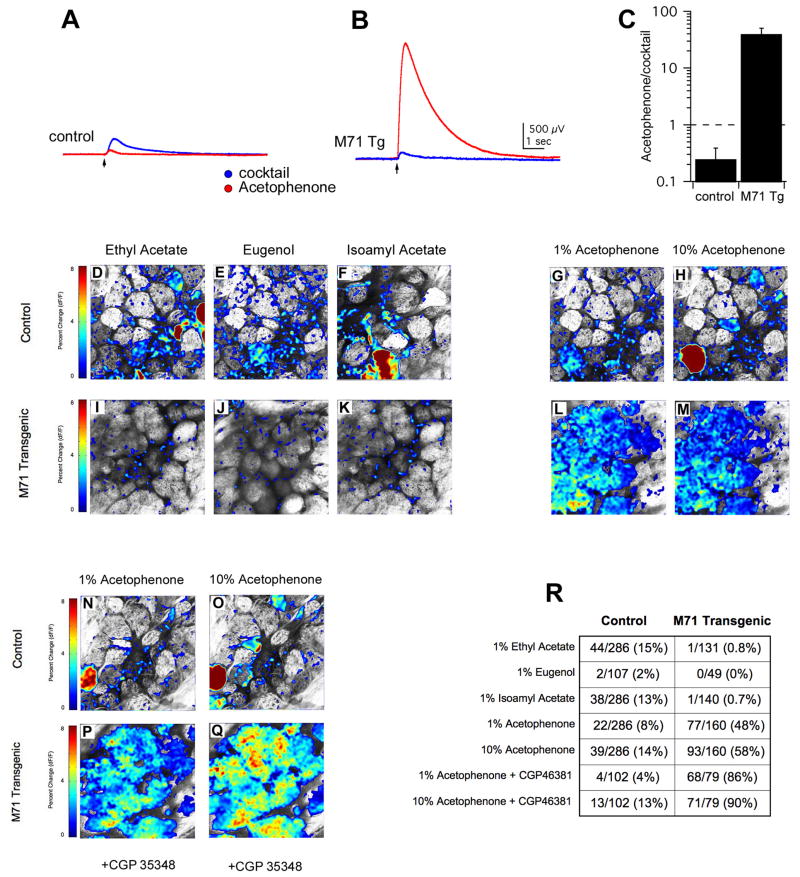
Odor-evoked activity in the epithelium and olfactory bulb of M71 transgenic mice. (A-C) Representative electro-olfactogram (EOG) recordings from control (A) and M71 transgenic (B) mice in response to either a cocktail of odorants (blue) or to acetophenone (red). (C) Acetophenone sensitivity in M71 transgenic and control mice, expressed as the ratio of integrated EOG responses to acetophenone and to an odorant cocktail. (D-R) Two-photon imaging of odor-evoked activity in the olfactory bulb in response to 1% ethyl acetate, 1% eugenol and 1% isoamyl acetate in control (D-F) and M71 transgenic animals (I-K). Pseudo-colored heat maps show mean percent change in fluorescence (ΔF/F) for each odor. Activity evoked by 1% acetophenone and 10% acetophenone in control (G, H) and M71 transgenic bulbs (L, M). Activity evoked by 1% acetophenone and 10% acetophenone in the presence of the GABAB-receptor antagonist CGP46381 in control (N,O) and M71 transgenic bulbs (P, Q); same image fields as before antagonist application as shown in G-M. Summary table of the fraction of glomeruli responding to each odor in control and M71 transgenic mice.
Figure 5
Figure 5
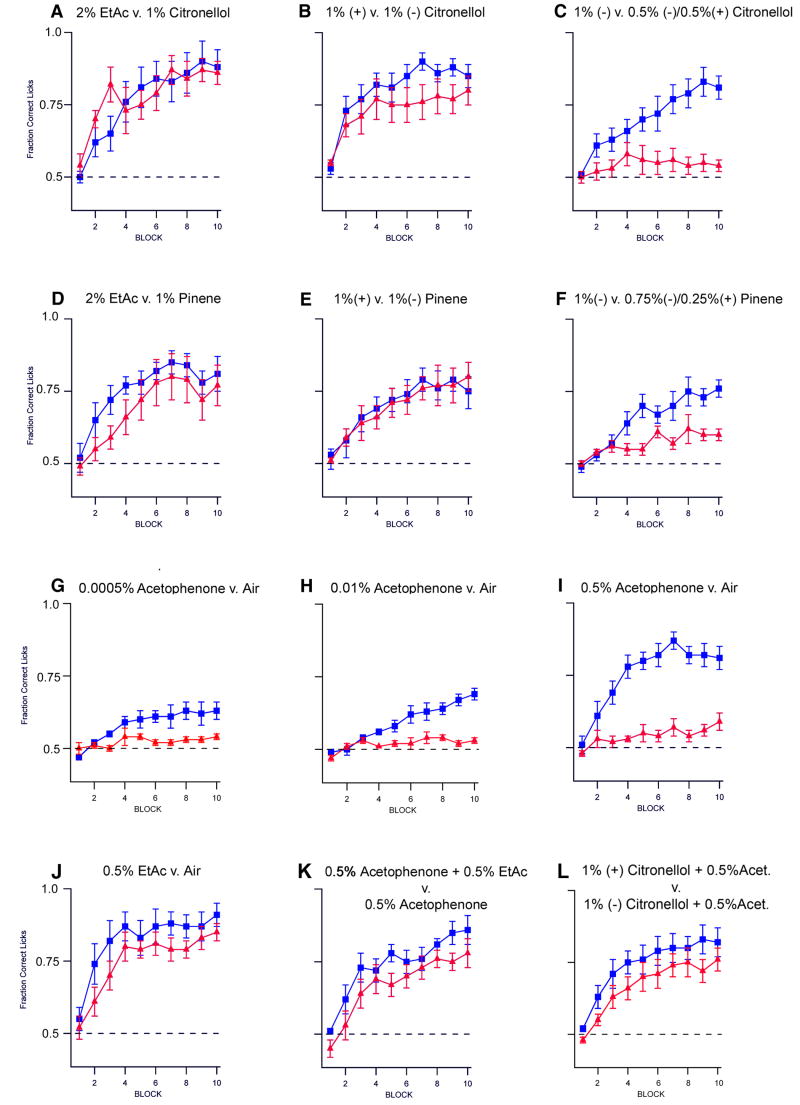
M71 transgenic mice display deficits in olfactory discrimination. (A-C) Control mice (blue) can discriminate between 2% ethyl acetate and 1% citronellol (A), between 1%(-) citronellol and 1%(+) citronellol (B), as well as between 1% (-) citronellol and a mix of 0.5% (+)/ 0.5% (-) citronellol (C). M71 transgenic mice (red) can discriminate between 2% ethyl acetate and 1% citronellol (A), between 1%(-) citronellol and 1%(+) citronellol (B), but fail to discriminate between 1% (-) citronellol and a mix of 0.5% (+)/ 0.5% (-) citronellol (C). (D-F) Control mice can discriminate between 2% ethyl acetate and 1% pinene (D), between 1%(-) pinene and 1%(+) pinene (E), as well as between 1% (-) pinene and a mix of 0.25% (+)/ 0.75% (-) pinene (F). M71 transgenic mice can discriminate between 2% ethyl acetate and 1% pinene (D), between 1%(-) pinene and 1%(+) pinene (E), but fail to discriminate between 1% (-) pinene and a mix of 0.25% (+)/ 0.75% (-) pinene (F). (G-I) Control mice (blue) show increasing accuracy in the discrimination of acetophenone and air (no odor stimulus) as acetophenone concentration is increased from 0.0005% to 0.5% (G-I). M71 transgenic mice (red) fail to discriminate between acetophenone and air at all concentrations tested (G-I). Both M71 transgenic (red) as well as control animals (blue) are capable of discriminating between 0.5% ethyl acetate and air (J), between 0.5% acetophenone and a mix of 0.5% acetophenone and 0.5% ethyl acetate (K), and between a mix of 1% (+) citronellol and acetophenone and a mix of 1% (-) citronellol and acetophenone (L). The fraction of correct licks in response to rewarded versus unrewarded odor is shown. For each discrimination task, n≧6 for control and M71 transgenic animals.
Figure 6
Figure 6
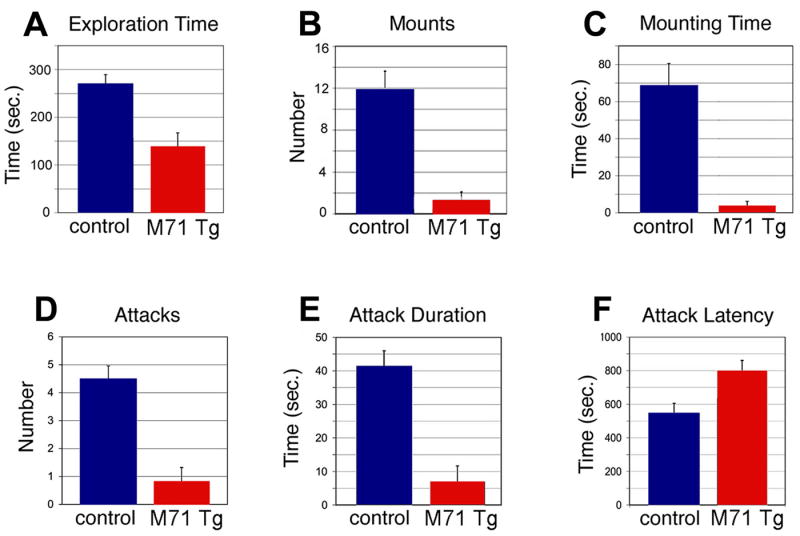
Innate male behaviors are drastically reduced in M71 transgenic mice. (A-C) Male sexual behavior is reduced in M71 transgenic mice (red bars) compared to controls (blue bars). Exploration time (A) in controls: 268.8 sec. ± 20.6 sec. (SEM) and in M71 transgenic males: 138 sec. ± 29.1 sec. (SEM), p=0.0009. Number of mounts (B) in controls: 11.8 ± 1.78 (SEM), and in M71 transgenic males: 1.27 ± 0.82 (SEM), p=0.00004. Total mounting time (C) in controls: 68 sec. ± 12.6 sec. (SEM), and in M71 transgenic males: 3.6 sec. ± 2.51 sec. (SEM), p=0.00015. (D-F) Aggressive behavior in a resident-intruder assay is reduced in M71 transgenic mice (red bars) compared to controls (blue bars). Number of attacks (D) in controls: 4.5 ± 0.7 (SEM), and in M71 transgenic males: 0.8 ± 0.5 (SEM), p=0.0002. Attack duration (E) in controls: 41.2 sec. ± 8.9 sec. (SEM), and in M71 transgenic males: 6.9 sec. ± 4.8 sec. (SEM), p=0.001. Attack latency (F) in controls: 542 sec. ± 63.2 sec. (SEM), and in M71 transgenic males: 797 sec. ± 63.1 sec. (SEM), p=0.0048.

References

    1. Aroniadou-Anderjaska V, Zhou FM, Priest CA, Ennis M, Shipley MT. Tonic and synaptically evoked presynaptic inhibition of sensory input to the rat olfactory bulb via GABA(B) heteroreceptors. Journal of neurophysiology. 2000;84:1194–1203. - PubMed
    1. Aungst JL, Heyward PM, Puche AC, Karnup SV, Hayar A, Szabo G, Shipley MT. Centre-surround inhibition among olfactory bulb glomeruli. Nature. 2003;426:623–629. - PubMed
    1. Barlow HB. Single units and sensation: a neuron doctrine for perceptual psychology? Perception. 1972;1:371–394. - PubMed
    1. Bodyak N, Slotnick B. Performance of mice in an automated olfactometer: odor detection, discrimination and odor memory. Chemical senses. 1999;24:637–645. - PubMed
    1. Bozza T, McGann JP, Mombaerts P, Wachowiak M. In vivo imaging of neuronal activity by targeted expression of a genetically encoded probe in the mouse. Neuron. 2004;42:9–21. - PubMed

Publication types

MeSH terms