. 2008 Dec 26;60(6):1142-52.
doi: 10.1016/j.neuron.2008.09.021.

Probabilistic population codes for Bayesian decision making

Affiliations

Probabilistic population codes for Bayesian decision making

Jeffrey M Beck et al. Neuron. .

Abstract

When making a decision, one must first accumulate evidence, often over time, and then select the appropriate action. Here, we present a neural model of decision making that can perform both evidence accumulation and action selection optimally. More specifically, we show that, given a Poisson-like distribution of spike counts, biological neural networks can accumulate evidence without loss of information through linear integration of neural activity and can select the most likely action through attractor dynamics. This holds for arbitrary correlations, any tuning curves, continuous and discrete variables, and sensory evidence whose reliability varies over time. Our model predicts that the neurons in the lateral intraparietal cortex involved in evidence accumulation encode, on every trial, a probability distribution which predicts the animal's performance. We present experimental evidence consistent with this prediction and discuss other predictions applicable to more general settings.


Figures

Figure 1
Figure 1
Task and network architecture. a. Binary decision making. The subject must decide whether the dots are moving to the right or to the left. Only a fraction of the dot are moving to the right or the left coherently (black arrows). The other dots move in random directions. The animal indicates its response by moving its eyes in the perceived direction (green arrow). b. Continuous decision making, for which the dots can move in any direction. The animal responds by making a saccade to the outside circle in the perceived direction. c. Network architecture. The network consists of three interconnected layers of neurons with Gaussian tuning curves. In MT, the tuning curves are for direction of motion, while in LIP and SCb, the tuning curves are for saccade direction. The layers differ by their connectivity and dynamics. The LIP neurons have long time constant (1s), allowing them to integrate their input, and lateral connections, allowing them to implement short range excitation and long range inhibition. The SCb layer forms an attractor network, for which smooth hills of activity are stable regardless of their position. The blue dots indicate representative patterns of activity 200 ms into a trial for the MT and LIP layer, and at the end of the trial for the SCb layer.
Figure 2
Figure 2
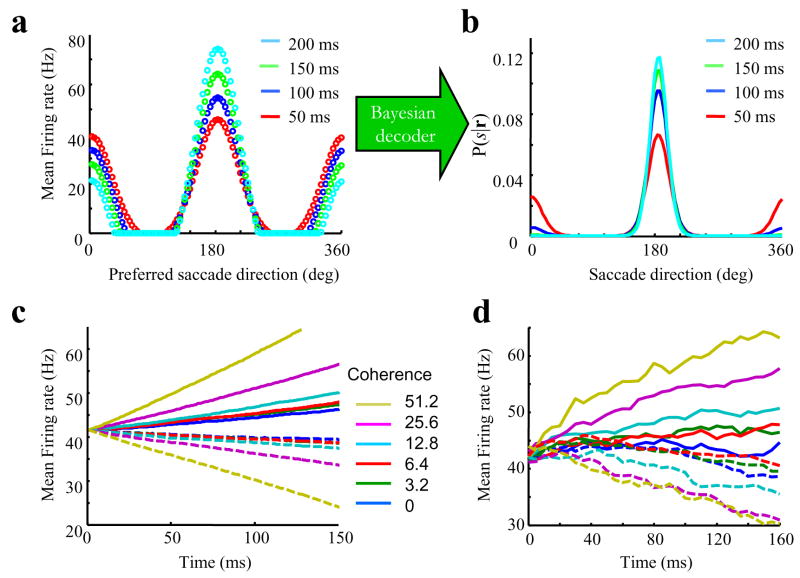
Binary decision making (as illustrated in Fig. 1a). Panels a–c: model; panel d: data. a Firing rate in LIP at four different times for a coherence of 51.2%. The direction of the moving dots is 180°. b. Probability distributions encoded by the firing rates shown in a averaged over 1000 trials. As expected, the probability of the 180° direction goes up while the probability of the 0° direction goes down. c. Firing rate over time for two units tuned to 180° (solid line) and 0° (dotted lines) for 6 different level of coherence. These averages were obtained over trials for which the model’s choice was 180°. d. Same as in b but for actual neurons in LIP (N= 45). Data from Roitman and Shadlen, 2002. The model and the data show similar trends.
Figure 3
Figure 3
Log odds and Fisher information as a function of time. The origin (t=0) on all plots corresponds to the start of the integration of evidence which about 220 ms after stimulus onset in the experimental data. Panels a–c: model; panel d: data. a. Log odds for a binary decision as a function of time for four different levels of coherence (solid lines). Blue and black dotted lines: the coherence increases to 51.2% at t=100 ms. After 100 ms, the slope matches the 51.2% coherence trials, as expected if the model is Bayes optimal. b. Fisher information as a function of time for continuous decision making (as in Fig. 1b). Fisher information rises linearly with time, with higher slopes for higher coherences, as expected for Bayes optimality. Dotted Line: trial in which the coherence increases from 25.6% to 51.2%. In both a and b, the kink at t=50 ms is due to the discretization of time. c. Square: Fisher information estimated by a single local linear estimator across all times and all coherences. Circles: Fisher information estimated by a local optimal estimator trained separately for each time and each coherence. Dotted lines: for each coherence, the upper line corresponds to the information estimated from the training set, while the lower trace is the information obtained from the testing set. The solid line is the average of the upper and lower dotted lines. The fact that both estimators return similar values of Fisher information shows that decoding LIP can be done nearly optimally without any knowledge of time or coherence. Green line: trials in which the coherence starts at 25.6% and then switches to 51.2% at 100ms. d. Same as in a but for actual LIP neurons (N=45, Data from Roitman and Shadlen, 2002). The results are quantitatively similar to the model. The y-axis is arbitrary up to a multiplicative factor and a DC offset.
Figure 4
Figure 4
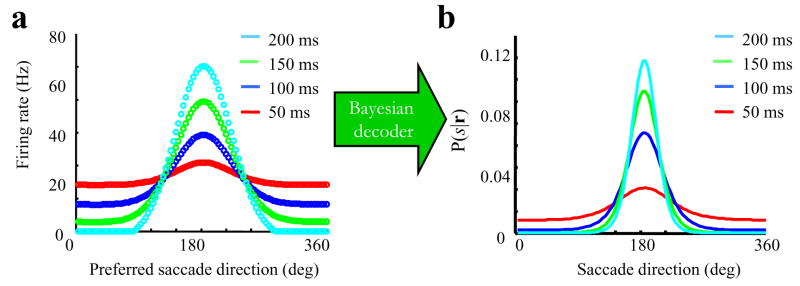
Continuous decision making (as illustrated in Fig. 1b). a. Firing rates of model neurons in LIP at four different times for a coherence of 51.2%. The direction of the moving dots is 180°. b. Probability distributions encoded by the firing rates shown in a averaged over 1000 trials. As expected, the peak of the distribution is close to 180° and the variance of the distribution decreases over time.
Figure 5
Figure 5
Average log odds at decision time computed from the model and data for the two and four choice experiments. a. Average log odds at decision time for a two choice experiment estimated from two neurons in the LIP layer of the model tuned to 0° and 180° on trials for which the model selected 180°. The average log odds is defined as the ratio of the probability that the direction is equal to 180° over the probability that it is equal 0° averaged over trials. b. Same as in a but for the 4 choice experiment (for consistency with the 2 choice experiment, we use log odds in the four choice experiment). c. Same as in a but for actual LIP neurons (N=45) in the 2 choice experiment. (dotted line, data from Roitman and Shadlen, 2002; solid line, data from Churchland et al, 2008) d. Same as in b but for actual LIP neurons (N=51–70) in the four choice experiment. (data from Churchland et al, 2008). In both c and d, the log odds increases with coherence. Since higher coherence also implies higher performance, log odds also increases with performance. This is indeed what is expected if the posterior encoded in LIP reflects the quality of the data and, at decision time, the performance of the animal. On these plots, the y-axis is arbitrary up to a multiplicative factor.
Figure 6
Figure 6
Performance and reaction time for the model versus monkeys. a. Probability of correct responses as a function of coherence. Blue: two choice experiment. Red: four choice experiment. Solid lines: model. Closed circles: data from Churchland et al, 2008. b. Reaction time as a function of coherence. Legend as in a.

Comment in

References

    1. Anderson JS, Lampl I, Gillespie DC, Ferster D. The contribution of noise to contrast invariance of orientation tuning in cat visual cortex. Science. 2000;290:1968–1972. - PubMed
    1. Barber MJ, Clark JW, Anderson CH. Neural representation of probabilistic information. Neural Comput. 2003;15:1843–1864. - PubMed
    1. Bogacz R, Brown E, Moehlis J, Holmes P, Cohen JD. The physics of optimal decision making: a formal analysis of models of performance in two-alternative forced-choice tasks. Psychol Rev. 2006;113:700–765. - PubMed
    1. Bogacz R, Gurney K. The basal ganglia and cortex implement optimal decision making between alternative actions. Neural Comput. 2007;19:442–477. - PubMed
    1. Britten KH, Shadlen MN, Newsome WT, Movshon JA. Responses of neurons in macaque MT to stochastic motion signals. Vis Neurosci. 1993;10:1157–1169. - PubMed

Publication types

LinkOut - more resources