. 2008 Dec 29:8:391.
doi: 10.1186/1471-2407-8-391.

Targeting cyclin B1 inhibits proliferation and sensitizes breast cancer cells to taxol

Affiliations

Targeting cyclin B1 inhibits proliferation and sensitizes breast cancer cells to taxol

Ilija Androic et al. BMC Cancer. .

Abstract

Background: Cyclin B1, the regulatory subunit of cyclin-dependent kinase 1 (Cdk1), is essential for the transition from G2 phase to mitosis. Cyclin B1 is very often found to be overexpressed in primary breast and cervical cancer cells as well as in cancer cell lines. Its expression is correlated with the malignancy of gynecological cancers.

Methods: In order to explore cyclin B1 as a potential target for gynecological cancer therapy, we studied the effect of small interfering RNA (siRNA) on different gynecological cancer cell lines by monitoring their proliferation rate, cell cycle profile, protein expression and activity, apoptosis induction and colony formation. Tumor formation in vivo was examined using mouse xenograft models.

Results: Downregulation of cyclin B1 inhibited proliferation of several breast and cervical cancer cell lines including MCF-7, BT-474, SK-BR-3, MDA-MB-231 and HeLa. After combining cyclin B1 siRNA with taxol, we observed an increased apoptotic rate accompanied by an enhanced antiproliferative effect in breast cancer cells. Furthermore, control HeLa cells were progressively growing, whereas the tumor growth of HeLa cells pre-treated with cyclin B1 siRNA was strongly inhibited in nude mice, indicating that cyclin B1 is indispensable for tumor growth in vivo.

Conclusion: Our data support the notion of cyclin B1 being essential for survival and proliferation of gynecological cancer cells. Concordantly, knockdown of cyclin B1 inhibits proliferation in vitro as well as in vivo. Moreover, targeting cyclin B1 sensitizes breast cancer cells to taxol, suggesting that specific cyclin B1 targeting is an attractive strategy for the combination with conventionally used agents in gynecological cancer therapy.


Figures
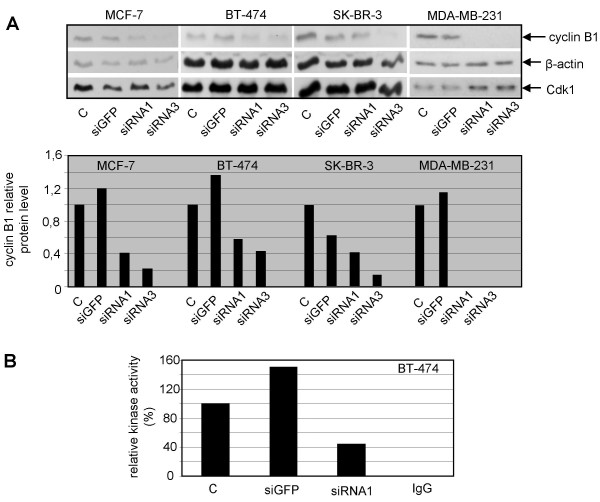
Figure 1
Figure 1
Reduced cyclin B1 protein and kinase activity of Cdk1/cyclin B1. A. Upper panel: Breast cancer cells MCF-7, BT-474, SK-BR-3 and MDA-MB-231 cells were treated with cyclin B1 siRNA1, siRNA3, GFP siRNA (GFP) or without treatment (C) for 48 h. Cells were harvested and cellular lysates were prepared for Western blot analyses with antibodies targeting cylin B1, Cdk1 and β-actin. The later served as loading control. Lower panel: Quantification of cyclin B1 levels from Western blots (upper panel), normalized to β-actin. B. Kinase assay of Cdk1/cyclin B1 in vitro. BT-474 cells were treated with cyclin B1 siRNA1 or siGFP or without treatment (C). 24 h later cells were lysed and Cdk1/cyclin B1 complex was immunoprecipitated by using antibodies against cyclin B1 from cellular extracts. Normal IgG served as negative control. Kinase assays were carried out with the precipitates in the presence of histone H1 as substrate.
Figure 2
Figure 2
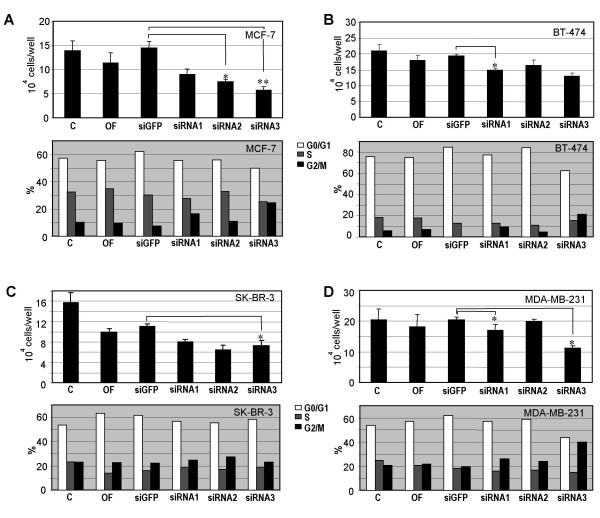
Inhibited proliferation after downregulation of cyclin B1. MCF-7 (A), BT-474 (B), SK-BR-3 (C) and MDA-MB-231 cells (D) were treated with siRNA1-3, or siGFP or oligofectamine alone (OF). After 48 h cells were harvested for cell number counting (upper panels in Fig. 3 A-D) and for cell cycle analysis (lower panels in Fig. 3 A-D). Cells without any treatment (C) served as control. The results of cell numbers are expressed as mean ± SD (n = 3) and statistically analysed. *P < 0.05, **P < 0.01.
Figure 3
Figure 3
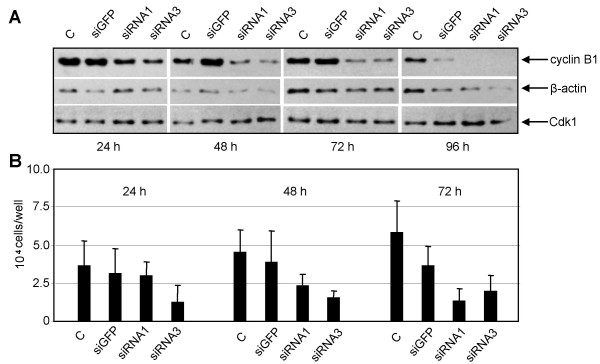
Time kinetics in MCF-7 cells. MCF-7 cells were treated with cyclin B1 siRNA1, siRNA3, siGFP or without treatment (C). Treated cells were harvested at different time points as indicated for Western blot analyses with antibodies against cyclin B1, Cdk1 and β-actin (A) and for cell number determinations (B). The results of cell numbers are expressed as mean ± SD (n = 3).
Figure 4
Figure 4
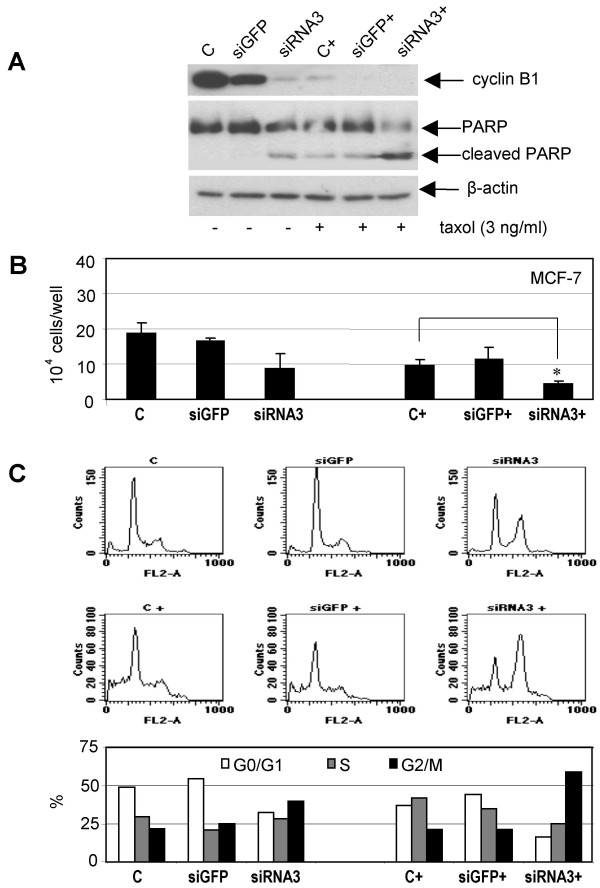
More sensitive to taxol in MCF-7 cells with reduced cyclin B1. A. MCF-7 cells were transfected with siRNA3 or siGFP and 4 h later followed with treatment of taxol (C+, siGFP+ and siRNA3+) or without taxol (C, siGFP and siRNA3). 48 h after transfection cells were harvested for Western blot analyses with antibodies as indicated. β-actin served as loading control. PARP: poly (ADP-ribose) polymerase. B. Cells were treated as in A and cell numbers were counted. The results are expressed as mean ± SD (n = 3) and statistically analysed. *P < 0.05. C. MCF-7 cells were treated as in A and cell cycle was analyzed (upper panel) and distribution of cell cycle population was quantified (lower panel).
Figure 5
Figure 5
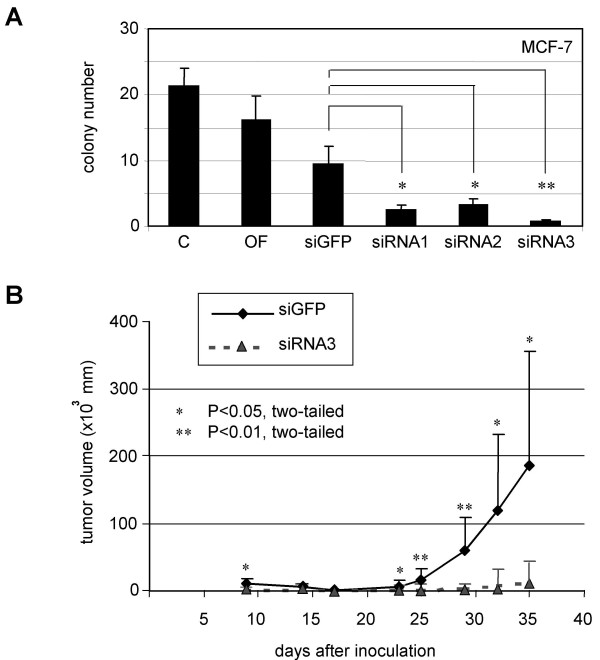
Impaired colony-forming ability and reduced tumor growth. A. Colony formation assay. MCF-7 cells were treated with siRNA1-3 or siGFP. 48 h after transfection cells were transferred to soft-agar plates for further incubation. 4 weeks later the colony numbers were scored with a microscope. The colony number of control cells was regarded as 100% for calculation. The data were expressed as mean ± SD (n = 3) and analysed by Student's t-test. *P < 0.05, **P < 0.01. B. Xenograft experiment in nude mice. 1 × 10⁶ of HeLa cells treated with siRNA3 or control siGFP were subcutaneously injected into each flank of nude mice. Each group contained 4 mice. Tumor sizes were measured every 2–3 days and tumor volumes were calculated. The data were statistically analysed by Mann-Whitney U test. *P < 0.05, **P < 0.01.

References

    1. Weigelt B, Peterse JL, 't Veer LJ. Breast cancer metastasis: markers and models. Nat Rev Cancer. 2005;5:591–602. doi: 10.1038/nrc1670. - DOI - PubMed
    1. Schiffman M, Castle PE, Jeronimo J, Rodriguez AC, Wacholder S. Human papillomavirus and cervical cancer. Lancet. 2007;370:890–907. doi: 10.1016/S0140-6736(07)61416-0. - DOI - PubMed
    1. Wang A, Yoshimi N, Ino N, Tanaka T, Mori H. Overexpression of cyclin B1 in human colorectal cancers. J Cancer Res Clin Oncol. 1997;123:124–127. doi: 10.1007/BF01269891. - DOI - PMC - PubMed
    1. Zhao M, Kim YT, Yoon BS, Kim SW, Kang MH, Kim SH, Kim JH, Kim JW, Park YW. Expression profiling of cyclin B1 and D1 in cervical carcinoma. Exp Oncol. 2006;28:44–48. - PubMed

    1. Kawamoto H, Koizumi H, Uchikoshi T. Expression of the G2-M checkpoint regulators cyclin B1 and cdc2 in nonmalignant and malignant human breast lesions: immunocytochemical and quantitative image analyses. Am J Pathol. 1997;150:15–23. - PMC - PubMed

Publication types

MeSH terms